
Are Distributor Marketing Costs Part of GST “Consideration”?
When a distributor bears marketing or promotional costs, can they form part of GST taxable value? The question, the factors, and why it depends.
In short
Whether a distributor's marketing cost forms part of GST consideration turns on one distinction: is the distributor promoting goods it bought and owns, or supplying a service the brand directs and funds? The first is generally its own cost; the second raises a question of a supply to the brand. The analysis is fact-specific, so this frames the question rather than resolving it.
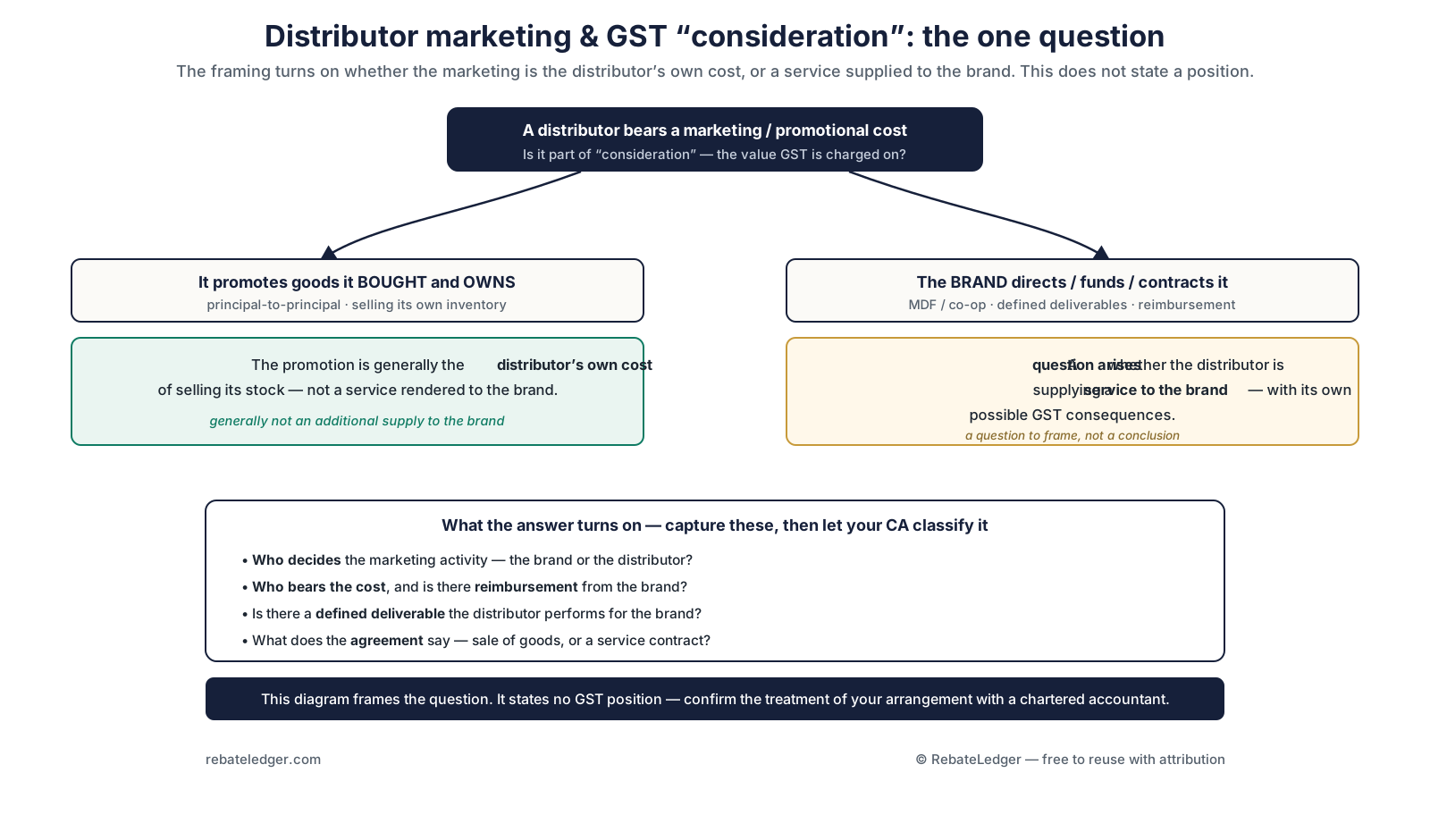
The short answer: it depends on the arrangement. The question turns on one distinction: is the marketing an independent service supplied to the brand, or the distributor promoting goods it bought and owns? If it sells its own stock, the promotion is generally its own cost. If the brand directs and funds it, a question of a service to the brand arises.
This article frames the question — it does not resolve it. The "consideration" analysis for distributor marketing is advanced and fact-specific, and a wrong assertion is damaging, so everything below stays general and points you to a professional.
What does "consideration" mean under GST?
At a general level, consideration is the value on which GST is charged for a supply — broadly, what a supplier receives, in money or otherwise, in return for supplying goods or services. The related idea of taxable value is the amount GST is actually computed on. The reason distributor marketing raises a "consideration" question at all is that GST is charged on supplies, and the analysis asks whether a marketing cost is bound up in the value of some supply — and if so, whose.
This is a general description of the concept, not a ruling on any transaction. How consideration and taxable value apply to a specific arrangement is exactly the kind of point that depends on the facts, so treat what follows as a way to organise the question for your adviser, not an answer.
When marketing is just the distributor selling its own stock
Start with the ordinary case. A distributor buys goods from a brand on a principal-to-principal basis — it takes title, carries the stock, and bears the risk. When it then advertises, runs a local promotion, or funds visibility to shift that inventory, it is promoting its own goods to make its own sale. In that setting, the marketing is generally the distributor's own cost of doing business, not a service rendered back to the brand.
Seen this way, the promotion sits on the distributor's side of the ledger, like any other selling cost — the same side its trading margin sits on. It is the same principal-to-principal logic that separates a channel discount from a commission: a party dealing on its own account is not, by that fact alone, supplying a service to the brand. This is the reading that applies to a great deal of everyday channel promotion — but it is not universal, which is where the arrangement matters. Keep this as the baseline, and test each arrangement against it rather than assuming it.
When marketing might be a service to the brand
Now change the facts. Suppose the brand directs the marketing, defines the deliverables, and reimburses the distributor for carrying them out — the shape of many market development fund (MDF) and co-op arrangements. Here the distributor is not just promoting its own stock; it is performing a defined activity for the brand in return for funding. At that point a question arises: is the distributor supplying a service to the brand, which could carry its own GST consequences?
This is the crux, and it is genuinely contested — so frame it as a question, not a conclusion. The more the arrangement looks like "the brand paid the distributor to do specific marketing work," the more sharply the question is posed; the more it looks like "the distributor spent its own money promoting its own goods," the less so. Real arrangements sit along that spectrum, and the label on the payment ("MDF", "co-op", "support") does not settle it. The structure of these funds is unpacked in MDF and co-op claims in India; whether a given one crosses into a service is a matter for professional review of the specific terms.
Why the distinction matters
The two readings lead to different GST outcomes — a cost that sits with the distributor, versus a taxable service supplied to the brand — and that is precisely why the paperwork carries so much weight. When the arrangement is only documented loosely as "marketing support," neither the brand nor the distributor can point to what was actually agreed, and the classification is left to be argued after the fact.
What resolves it is the substance captured in the documents: who decided the activity, who bore the cost, whether there was a defined deliverable, and whether the brand reimbursed the distributor against it. The same discipline runs through the wider GST treatment of channel money — the financial-versus-tax credit-note line and the post-sale discount rules in CBIC Circular 251 both turn on how an arrangement is structured and evidenced, not on what it is called. Where a reduction or reimbursement flows through the GST system, the input-tax-credit consequences follow the structure too.
What to document
This last part is practical, not tax — and it is where you can act today without waiting on a ruling. Whatever the eventual classification, capture the arrangement clearly so it can be classified correctly:
- Who decides the activity — the brand, the distributor, or jointly.
- Who bears the cost, and whether the brand reimburses any of it.
- Whether there is a defined deliverable the distributor performs for the brand.
- What the agreement actually says — a sale of goods with promotion, or a service engagement.
Holding these facts in one place does not decide the tax, but it lets your chartered accountant classify the arrangement correctly, and it keeps your claims and settlement records consistent with whatever tax position is reached. RebateLedger records each scheme, claim and settlement with the arrangement behind it, so the commercial paper trail and the numbers line up when the question is asked — the same rebate and scheme record that runs the rest of your channel spend. Adjacent channel-spend categories — trade promotions, free-goods and BOGO schemes and deductions — benefit from the same discipline.
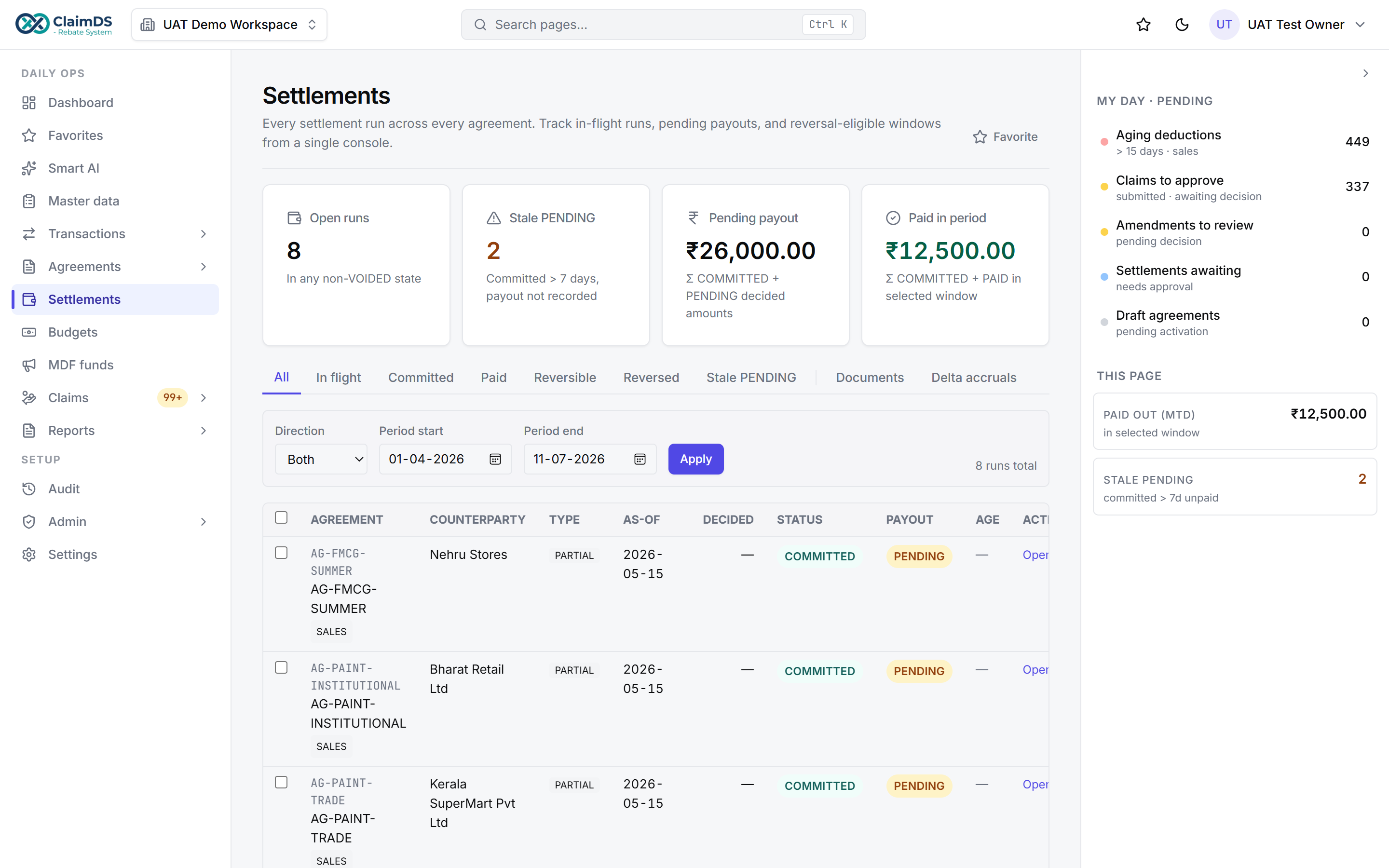
The RebateLedger settlement view — schemes, claims and settlements recorded with the arrangement behind each, in one place.
General information, not tax advice. This article raises and frames a contested GST question; it does not resolve it and states no position on any specific arrangement. The GST treatment of distributor marketing costs depends on the facts and the agreement, and can change. Confirm the treatment of your own arrangement with a qualified chartered accountant or cost accountant before you rely on it.
Read next
- MDF and co-op claims in India — the structure of the funds this question is really about.
- CBIC Circular 251 on post-sale discounts — how GST turns on the structure of a channel arrangement.
- Financial vs tax credit notes under GST — the same "how is it structured" line, on the credit-note side.
- ITC reversal on post-sale discounts and credit notes — the input-tax-credit consequences that follow the structure.
- Supplier, dealer and trade-scheme incentives — the principal-to-principal vs service distinction, drawn for incentives.
The tax question is your CA's to answer — but the arrangement behind it is yours to record. RebateLedger keeps each scheme, claim and settlement with its underlying arrangement, so the paper trail matches the numbers when the question comes up.
Book a demo to see how RebateLedger keeps the arrangement and the settlement together in one auditable record.
Frequently asked questions
Are distributor marketing costs part of GST consideration?
It depends on the arrangement. If a distributor promotes goods it has bought and owns, the marketing is generally its own cost of selling its stock, not a supply to the brand. If the brand directs, funds and contracts specific marketing with defined deliverables, a question arises whether the distributor is supplying a service to the brand. The facts and the agreement decide it, so confirm with a chartered accountant.
Is MDF or co-op marketing support a taxable service under GST?
It can raise that question, but it is not automatic. Where market development funds or co-op support come with the brand directing the activity, defining deliverables and reimbursing the distributor, the arrangement starts to look like a service to the brand rather than the distributor's own promotion. Whether it is a taxable service turns on the specific structure, so have a professional review it before you rely on any treatment.
What is "consideration" under GST?
Consideration, in general terms, is the value on which GST is charged for a supply — broadly what is received in money or otherwise in return for supplying goods or services. Whether a particular payment or cost forms part of the consideration for a supply depends on the facts of the arrangement. This is a general description; confirm how it applies to a specific transaction with your tax adviser.
Does a distributor charge GST on marketing activity?
Only if that marketing activity is itself a supply of a service by the distributor to the brand. If the distributor is simply promoting goods it owns to sell its own stock, there is generally no separate service to charge GST on. If the brand contracts and pays the distributor for defined marketing deliverables, the position can differ. The distinction is fact-specific, so confirm it with a chartered accountant.
How should a brand and distributor document marketing support for GST?
Capture the arrangement clearly: who decides the marketing activity, who bears the cost, whether there is a defined deliverable, and whether the brand reimburses the distributor. Keep the agreement, the deliverables and the reimbursement mechanism on record. This does not decide the tax, but it lets your chartered accountant classify the arrangement correctly and keeps your claims and settlement records consistent with the tax position.
Does the law require a marketer to reimburse GST to a distributor?
It depends on the arrangement, not on a general rule. Whether a marketer must bear or reimburse GST on a scheme or marketing cost turns on how the arrangement is structured and documented. This answer asserts no position; confirm the treatment for your own arrangement with your CA.
See RebateLedger on your own claims data
A 30-minute walkthrough tailored to how your channel actually settles claims.