
GST on Discounts and Rebates You Receive: The Buyer's Side
Most guidance covers the supplier giving a discount. What questions arise for the business receiving one, and what determines each answer.
In short
When you receive a discount or rebate from a supplier, the questions that arise are not the supplier's questions. What matters on your side is which document you received, whether it adjusts the tax on the original purchase, and what that means for credit you have already taken. The answers follow from the document and the arrangement.
Almost every explanation of discounts and rebates under GST is written for the party giving them. That is the party with the document to issue and the reporting obligation, so it is the perspective the guidance follows. If you are the business receiving the discount, you are left to work out the consequences on your own side — which is where most of the confusion in this area comes from.
This page is written from the receiving side. It sets out what questions arise when a trade or supplier rebate, scheme payout or post-sale discount lands on your account, and what determines each answer. It states no tax position and reaches no conclusion — those belong to your own chartered accountant on your own facts.
The same event, two different sets of questions
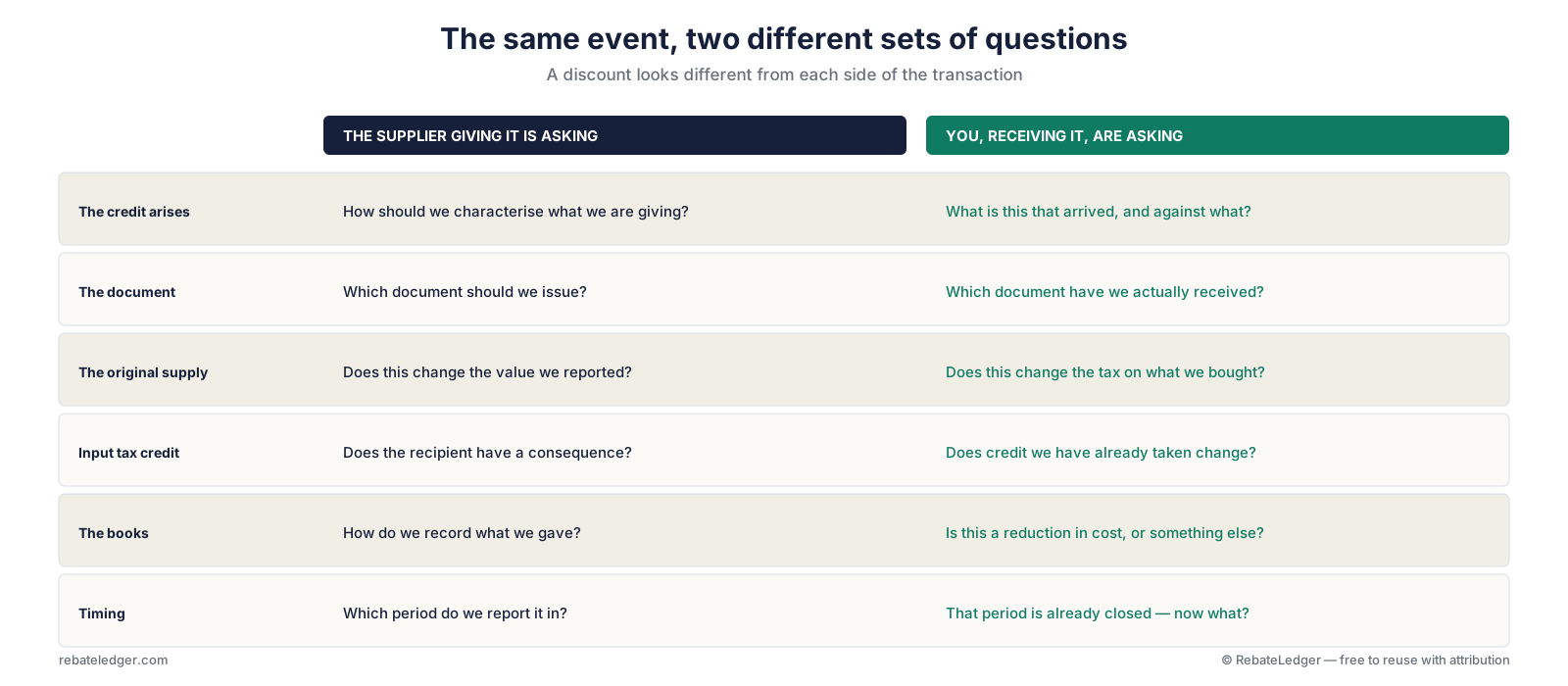
A supplier issuing a credit note and a distributor receiving one are looking at the same transaction and asking almost entirely different things about it.
| The moment | The supplier is asking | You, receiving, are asking |
|---|---|---|
| The payment or credit arises | How should we characterise what we are giving? | What is this that has arrived, and against what? |
| The document | Which document should we issue? | Which document have we actually received? |
| The original supply | Does this change the value we reported? | Does this change the tax on what we bought? |
| Input tax credit | Does the recipient have a consequence? | Does credit we have already taken change? |
| The books | How do we record what we gave? | Is this a reduction in cost, or something else? |
| Timing | Which period do we report it in? | It relates to a period we have already closed — now what? |
Notice that only the third and fourth rows overlap at all, and even there the two sides are asking about different obligations. This is why reading supplier-side guidance and mentally reversing it does not work: the questions are not mirror images.
Why the buy side gets less attention
The party issuing a document is the party the rules speak to most directly. It has to decide what to issue, when to issue it, what it must contain and how to report it. That generates a large body of practical guidance, and all of it is written in the second person to the issuer.
The receiving party has no document to issue. What it has is a document that arrived, often without warning, sometimes months after the purchases it relates to, and frequently without a clear indication of which purchases those are. Its obligations are real but derivative — they follow from what the other party did. Guidance written for the issuer never quite lands on them, and the result is a business that knows a credit note has arrived and is genuinely unsure what it is supposed to do about it.
That gap is worth naming plainly, because it is not a failure of understanding on the receiving side. It is a gap in what has been written.
The document you received determines the questions
Three things can arrive from a supplier when a discount or rebate is settled, and the first practical step is establishing which one you are holding. This is a question of fact about the document, not a question of interpretation.
- A tax credit note. Issued under the GST machinery, carrying a tax component and referencing the original supply. It is the instrument the statute contemplates for adjusting the value of a supply already made.
- A financial or commercial credit note. A settlement of money between the parties that does not carry a tax component. Businesses use it where the arrangement does not fit the tax route, or where the parties have chosen to settle commercially.
- A payment. Money arriving with no credit note at all, against an invoice you raised or simply as a transfer.
These are different instruments with different consequences, and the difference between the first two is the single most consequential fact about any credit you receive. Financial vs tax credit notes under GST sets out how the two differ as instruments. What follows from holding one rather than the other is a determination for your chartered accountant on your arrangement.
One practical warning: the label on the document is not always reliable. Businesses use "credit note" loosely for both, and the only way to know which you have is to look at whether it carries a tax component and references the original supply. If you cannot tell, ask the supplier before you record it.
The input tax credit question
This is the question the buy side is really asking, and it deserves to be stated clearly rather than buried.
You bought goods, you took input tax credit on that purchase, and now a discount has arrived that reduces what you effectively paid. Does the credit you already took change?
That is the question. This article does not answer it, and it would not be safe for it to — the answer depends on which document settled the discount, on how the arrangement between you and the supplier was structured, and on facts specific to your case. What can be said is where the question is worked through: ITC reversal on post-sale discounts and credit notes addresses the mechanics directly, and CBIC Circular 251 on post-sale discounts is the clarification most often referenced when this comes up.
Take the question to your chartered accountant with the document in hand. It is not answerable in the abstract, and a general answer applied to a specific arrangement is exactly how this area goes wrong.
When the discount arrives in a later period
A purchase in one period and a credit in another is the normal case for anything settled on a quarterly or annual scheme. The purchases happen across the period; the entitlement is only established when the period closes; the credit note follows after that. By the time it arrives, the period the purchases sat in may well be closed on your side.
That ordinary sequence raises questions about which period each side records the adjustment in, and whether any constraint applies to how late a document can be issued or acted on. Those are addressed in GST credit note time limits and reporting. Nothing about the lateness is unusual — but the questions it raises are real, and they are worth settling before year-end rather than during it.
What this means for your cost of goods
The commercial effect and the tax treatment are separate questions with separate answers, and conflating them is a common source of error.
Commercially, a supplier rebate reduces what you paid for goods, which changes your landed cost and therefore your real margin on everything you sell from that stock. That is a question about your accounts, and it is addressed in supplier rebate accounting treatment and, from the margin side, in distributor margin after rebates.
Separately, the same event may or may not adjust the tax on the original purchase. Neither answer determines the other. A business that assumes the accounting treatment settles the tax question, or the reverse, is making an assumption that nothing supports.
What to check when a credit note arrives
This section is about process rather than treatment, which is why it can be stated plainly. Before the tax question arises at all, four things need to be established, and none of them require professional advice.
- Which purchases does it relate to? Specific invoices, ideally referenced on the note itself. A credit note you cannot match to particular purchases is a reconciliation problem before it is anything else.
- Which document type is it? Tax or financial. As above, check the document rather than the label.
- Does the amount match what you claimed? If you raised a claim, compare line by line. A partial settlement with no explanation is worth querying immediately, while the period is fresh.
- Which period does it fall in? Both the period of the underlying purchases and the period the document is dated.
Answer those four before anything else. Most of the difficulty businesses have in this area is not tax difficulty — it is that the credit arrived unmatched and nobody reconciled it while the trail was warm. The discipline of matching every incoming credit note to the claim and the purchases behind it is covered in distributor ledger reconciliation for claims and credit notes, and the wider question of what a claim should carry is in the documents required for a distributor scheme claim.
Where a business is receiving rebates from suppliers and paying schemes to its own customers at the same time, the two sides are usually run separately and never reconciled against each other. Customer rebates and supplier rebates cover each side, and the margin only makes sense when the two are read together.
General information, not tax advice. This article describes which questions arise for a business receiving a discount or rebate from a supplier, and where each is discussed. It states no position on any of them, and deliberately contains no rate, threshold, time limit or treatment. The answers depend on the facts of a specific arrangement and on current law. Confirm every question raised here with a qualified chartered accountant or cost accountant before relying on any position.
Frequently asked questions
Is GST applicable on a discount received?
The question is not whether GST applies to the discount itself but whether the discount adjusts the tax on the original purchase. That turns on the document you received and the arrangement behind it, not on the word used to describe the payment. The financial versus tax credit note distinction is where that determination starts. Confirm your position with your chartered accountant.
What is the difference between a tax credit note and a financial credit note received from a supplier?
They are different instruments. A tax credit note is issued under the GST machinery and carries a tax component; a financial or commercial credit note is a settlement of money between the parties. Which one you have received determines what follows in your records. The two are compared in financial vs tax credit notes under GST.
Does a discount received affect input tax credit already taken?
This is the central question on the buy side, and the answer depends on which document settled the discount and on the underlying arrangement rather than on the amount involved. It is addressed directly in ITC reversal on post-sale discounts and in CBIC Circular 251. Confirm the position for your facts with your chartered accountant.
What if the credit note relates to a previous period?
A purchase in one period and a credit arriving in another is the normal pattern for period-end schemes, not an exception. It raises questions about which period each side records the adjustment in and whether any timing constraint applies. Those are addressed in GST credit note time limits and reporting.
Does a supplier rebate reduce my cost or count as income?
That is an accounting question rather than a GST one, and the two are decided separately. The commercial effect on your cost of goods and the tax treatment of the same event do not have to align. The accounting side is covered in supplier rebate accounting treatment.
What should I check when I receive a credit note?
Before any tax question, establish the practical facts — which purchases it relates to, which document type it is, whether the amount matches what you claimed, and which period it falls in. A credit note you cannot match to specific purchases is a reconciliation problem first and a tax question second.
Who decides how a discount received is treated?
You do, on advice. The supplier chooses the document it issues, but how you record and report the effect on your own books and returns is your determination, made with your chartered accountant on the facts of your arrangement. No article, and no system, can make that call for you.
See RebateLedger on your own claims data
A 30-minute walkthrough tailored to how your channel actually settles claims.