
Scheme Provision and Liability Reconciliation at Year End
Prove the scheme provision equals accrued-but-unclaimed, claimed-but-unsettled and settled-after-cutoff — then clear what Section 34 makes unadjustable.
In short
Year-end scheme reconciliation means proving the provision on the books equals (accrued-but-unclaimed + claimed-but-unsettled + settled-after-cutoff) across every live scheme — and clearing, before the Section 34(2) cliff on 30 November, whatever still needs a tax-adjusting credit note against the closing year's invoices. This is general information, not tax advice.
Most scheme-heavy companies can tell you their total provision. Far fewer can prove what it is made of — which is exactly what the year-end close, and the auditor, require. This is the reconciliation method, plus the two 2025 law changes that made the credit-note side harder.
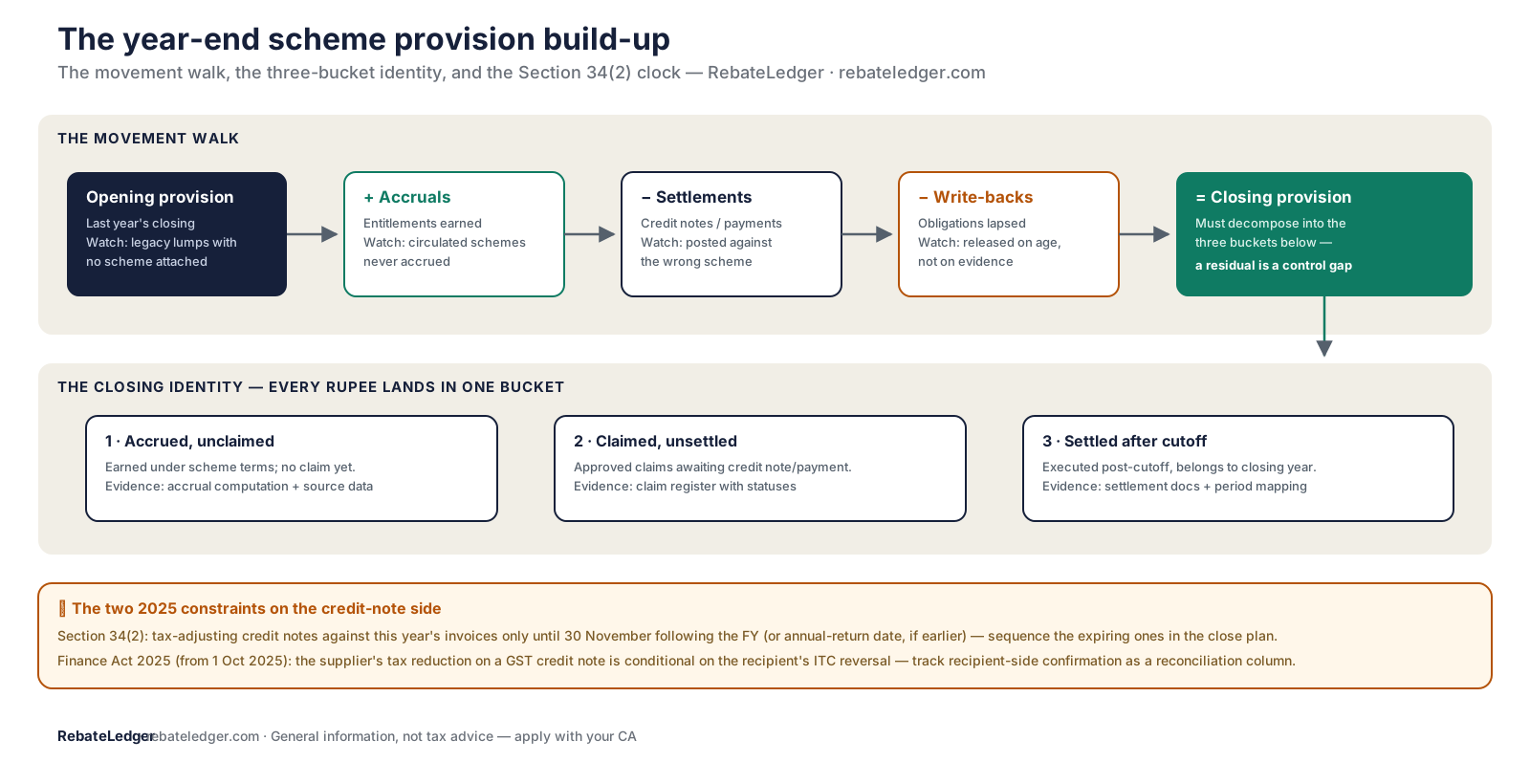
The identity to prove: closing provision = accrued-but-unclaimed + claimed-but-unsettled + settled-after-cutoff, per scheme, summing to the books.
The provision build-up walk
Reconcile the movement, not just the closing balance:
| Movement | What it is | Watch for |
|---|---|---|
| Opening provision | Last year's closing, carried in | Unreconciled legacy lumps with no scheme attached |
| + Accruals | Scheme entitlements earned this year | Schemes circulated but never accrued (completeness) |
| − Settlements | Credit notes / payments issued against claims | Settlements booked against the wrong scheme |
| − Write-backs | Provision released as no longer payable | Releases without evidence the obligation lapsed |
| = Closing provision | Decomposes into the three buckets | A residual that fits no bucket |
The accrual mechanics feeding this walk — forecast accruals, true-ups and the write-back decision — are covered in rebate accrual management; how accruals and settlements post is in the accounting treatment of rebates under GST.
A residual that fits no bucket is the finding. The usual causes: settlements posted against the wrong scheme, claims approved outside the register, or a legacy provision nobody can attribute — each is a control gap wearing an accounting costume.
The Section 34(2) cliff: a close-planning item, not a December surprise
A credit note with tax adjustment against this year's invoices is possible only until 30 November following the financial year (or the annual-return date, if earlier) under Section 34(2) of the CGST Act. At year end you know precisely which unsettled liabilities sit against closing-year invoices — so the close plan should name them and sequence their settlement before the cliff. After it, settlement is still possible, but by commercial credit note without the tax adjustment — a different economics. The distinction between the two documents is explained in financial vs tax credit notes under GST.
The Finance Act 2025 condition: your reconciliation now depends on the distributor
Effective 1 October 2025, the Finance Act 2025 amendment to Section 34(2) made the supplier's output-tax reduction on a GST credit note conditional on the recipient reversing the corresponding input tax credit. For reconciliation, that adds a dependency you don't control: a tax-adjusting settlement is not fully closed until the recipient side is confirmed. Separately, CBIC's Circular 251/08/2025-GST (September 2025) clarified that commercial credit notes carry no recipient ITC-reversal requirement — which is exactly why the commercial-vs-GST decision per settlement now deserves a documented basis. Track the recipient-side confirmation as a reconciliation column, not as a hope.
This is general information, not tax advice — the statutory positions above should be applied to your facts by your CA.
The auditor-evidence checklist
Per live scheme, have ready: the circular/agreement; the accrual computation with its data source; the claim register with statuses and ageing; credit notes issued with their commercial-vs-GST basis; write-back justifications; and the reconciliation statement tying every closing rupee to a bucket. The fifteen-check version of this — completeness, accuracy, cutoff and documentation — is the companion piece: the channel incentive accrual audit checklist. The distributor-side mirror of the same close — why their ledger disagrees with yours — is in distributor ledger reconciliation.
Frequently asked questions
What makes up the scheme provision at year end?
Three buckets: amounts accrued under scheme terms but not yet claimed by distributors; claims received and approved but not yet settled by credit note or payment; and settlements executed after the cut-off that belong to the closing year. If the provision on the books does not decompose into those three numbers, something is double-counted or missing.
What is the Section 34(2) cliff and why is it a year-end item?
A GST credit note that adjusts tax must be issued by 30 November following the financial year of the underlying supply, or the annual-return date if earlier. At year end you know exactly which unsettled scheme liabilities sit against the closing year's invoices — after the cliff they can still be settled, but only by commercial credit note, without the tax adjustment. That timing decision belongs in the close plan, not in December's surprises.
How did the Finance Act 2025 change credit-note reconciliation?
For GST credit notes, the supplier's output-tax reduction is now statutorily conditional on the recipient reversing the corresponding input tax credit (effective 1 October 2025). Practically, your reconciliation gained a dependency on distributor compliance — a tax-adjusting settlement is not fully closed until the recipient side is confirmed. Commercial credit notes are outside this condition.
What evidence should be ready for the auditor?
Per scheme: the circular or agreement, the accrual computation with its data source, the claim register with statuses, credit notes issued with their basis (commercial vs GST), and the write-back justification for any released provision. The reconciliation statement should tie every closing rupee to one of the three buckets — and every write-back to evidence the obligation lapsed, not just aged.
See RebateLedger on your own claims data
A 30-minute walkthrough tailored to how your channel actually settles claims.