
What Is Claims Management Software? A Complete Guide for Indian Channel Businesses
Claims management software for Indian channels — rebates, chargebacks, price protection and buyback settled by GST credit note in multi-tier RTM.
In short
Claims management software captures, validates, approves and settles the trade claims that flow between manufacturers and channel partners — rebates, chargebacks, price protection, buyback and scheme settlement — across multi-tier Indian route-to-market. It replaces scattered spreadsheets with one auditable record and settles each claim through a GST-compliant credit note.
Claims management software captures, validates, approves and settles the trade claims that flow between manufacturers and their channel partners — rebates, chargebacks, price protection, buyback, stock compensation and scheme settlement — across multi-tier Indian route-to-market. It replaces scattered spreadsheets with one auditable record and settles each claim through a GST-compliant credit note.
One disambiguation before anything else: this covers trade and distributor claims raised within a supply channel — money moving between manufacturers, distributors and dealers — not insurance or legal claims, which are a different industry entirely.
What it is
In Indian distribution, "claims" is the money that moves back up the channel: the rebates a distributor earned, the deduction a brand took, the compensation for a price drop, the return of expired stock. Most businesses manage them in a patchwork of spreadsheets and emails. Claims management software is the single system of record that holds every claim type, validates each against its agreement, and settles it correctly. It is the hub above the specialised hubs: rebate management, chargeback management, price protection, buyback and trade promotion management. Some claim types are native to particular verticals — subvention claims, where a brand funds a zero-interest offer or a dealer's cost, are the automotive and consumer-durables example.
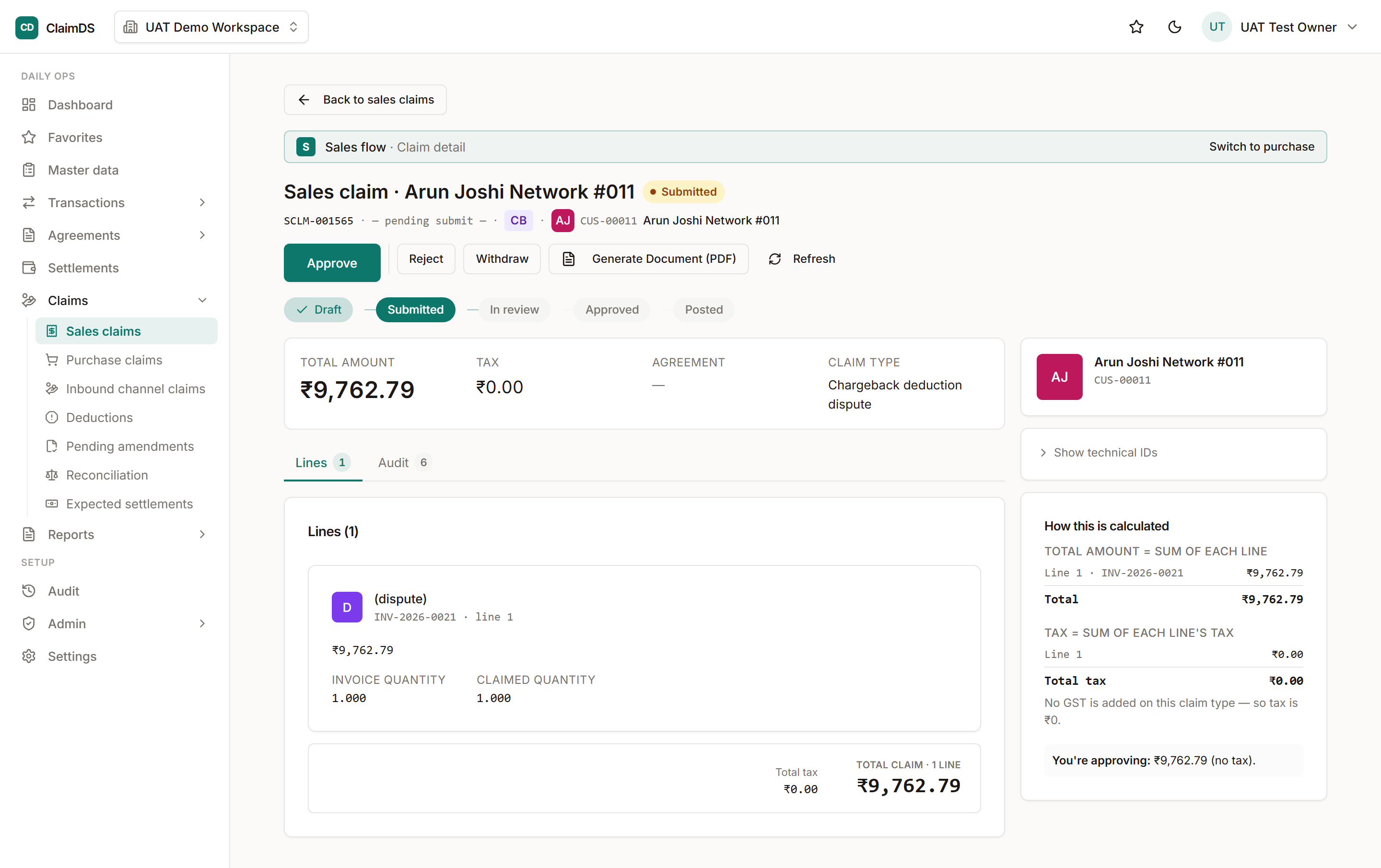
The claim-type taxonomy
| Claim type | What it settles | Hub |
|---|---|---|
| Rebates | Volume, growth, supplier, dealer incentives | Rebate |
| Chargebacks / deductions | Trade deductions between brand and partner | Chargeback |
| Price protection | Compensation when prices drop on stock in hand | Price protection |
| Buyback | Returns of expired/damaged/unsold stock | Buyback |
| Stock compensation | Compensation for affected/slow stock | Stock comp |
| Scheme settlement | Primary & secondary trade schemes | TPM |
Keeping distributor and dealer claims on one ledger gives finance a single view of channel liability and a single audit trail.
The claim lifecycle
Every claim, whatever its type, moves through the same backbone: submitted with evidence, validated against the agreement and source data, approved with the right authority and segregation of duties, and settled by credit note. The detailed walk-through is in the claim process explained and how to submit a claim request.
Why Indian RTM is different
Indian route-to-market is multi-tier — manufacturer → super-stockist → distributor → sub-stockist → dealer → retailer — with primary and secondary schemes running at once. Validating a claim means knowing which tier's sales data backs it — what primary, secondary and tertiary data can and cannot prove is covered in primary, secondary and tertiary sales. A system that flattens the channel to two parties cannot represent this faithfully, which is exactly where leakage and disputes concentrate.
GST credit-note settlement
In India, claims settle through a credit note — and the choice between a tax and a financial credit note has real ITC consequences. A correct platform issues the right instrument by rule. See financial vs. tax credit notes and CBIC Circular 251.
GST note: This article is general information, not tax or legal advice. GST positions — including CBIC Circular No. 251/08/2025-GST and the Finance Act 2026 amendments to Section 34 of the CGST Act, assented 30 March 2026 but not yet notified into force as of publication — must be re-verified at publish time with a qualified professional.
Claims management vs ERP, CRM and trade promotion management
It helps to place claims management software against the systems it sits near.
- ERP records the invoice and the payment, but it was not built to model a tiered secondary scheme or reconcile a partner's claim file against it. Claims management software usually integrates with the ERP rather than replacing it.
- CRM tracks the relationship and the pipeline, not scheme terms or settlements.
- Trade promotion management (TPM) is the full cycle — planning a scheme, budgeting, launching it, settling its claims and measuring ROI. Claims management is the settlement stage inside that cycle. The wider view is in the step-by-step trade promotion management guide, or for consumer goods the CPG trade promotion guide.
What manual claims actually cost
When claims are run on spreadsheets the cost shows up in two places: leaked margin and locked-up cash. Invalid, duplicate and over-claims pass because there is no rules engine and no audit trail to catch them. Settlement drags for weeks, parking a partner's working capital and straining the relationship the scheme was meant to strengthen.
Neither cost announces itself. A duplicate claim looks like a normal claim; a slow settlement looks like a busy month. The failure mode is unpacked in why distributor rebate claims slip through the cracks.
Why generic global tools fall short
Global suites optimise for enterprise revenue management in largely single-tier Western markets; Indian mid-market needs multi-tier RTM fidelity and GST credit-note depth at a mid-market price. That is the gap RebateLedger targets (positioning detail in why RebateLedger and a fair comparison in Vistex alternatives).
Choosing a system
Map your real claim types first; score tools on claim-type breadth, multi-tier fidelity and GST correctness; pilot on one quarter of real data. Pair this with the CFO revenue-leakage playbook and the best-software buyer's guide. New to the category? Start with the full explainer: what claims management software is and how it works.
Frequently asked questions
What is claims management software?
Claims management software is a system that captures, validates, approves and settles the trade claims that flow between manufacturers and their channel partners — rebates, chargebacks, price protection, buyback, stock compensation and scheme settlement — across multi-tier Indian route-to-market, with GST-compliant credit-note settlement and a full audit trail.
What claim types does it handle?
It handles rebates, trade chargebacks, billbacks, buyback of expired or damaged stock, price protection, stock compensation, warranty and dealer-incentive and secondary-scheme settlement — ideally in one product so all claim types share one ledger and audit trail.
Why are global tools a poor fit for Indian mid-market firms?
Global tools are built for single or two-tier Western models and treat GST credit-note settlement as a localisation. Indian route-to-market is multi-tier with primary and secondary schemes, and settlement runs through GST credit notes, so India-first depth matters more than generic breadth.
How is claims management software different from an ERP or CRM?
An ERP records invoices and payments and a CRM tracks relationships, but neither knows your scheme terms or reconciles a partner's claim against them. Claims management software is built for the claim-to-settlement loop — scheme rules, accruals, claim validation and credit notes — and usually integrates with the ERP rather than replacing it.
Does claims management software handle GST credit notes?
Good India-built software does. It applies the correct financial or tax (Section 34) credit note to each settlement, tracks input-tax-credit reversal, and enforces the statutory timeline, so settlement is compliant by design rather than a manual judgement each month.
How is claims management different from trade promotion management?
Trade promotion management is the full cycle from planning a scheme to measuring its return. Claims management is the settlement portion of that cycle — capturing, validating and settling the claims a scheme generates. Claims management is a core stage within trade promotion management.
How is a retailer or distributor claim validated automatically?
A claim is validated by testing it against the scheme terms on record: was the partner eligible, do the claimed transactions fall inside the scheme period, are the products in scope, is the rate the one the agreement specifies, has the same claim been submitted before, and have returns been netted out of the qualifying volume? Anything failing a test becomes an exception to review.
How is a distributor claim settled once it is approved?
Approval produces two things: a settlement statement showing how the amount was calculated — which scheme, what achievement, what adjustments — and the settlement instrument itself, usually a credit note referenced back to the claim it settles. Keeping that reference is what lets either side reconcile later. The GST treatment of the credit note is covered separately.
See RebateLedger on your own claims data
A 30-minute walkthrough tailored to how your channel actually settles claims.