
Primary vs Secondary Trade Margin: How the Chain Splits
Where margin sits at each tier of the Indian channel, how primary and secondary margin differ, and why stockist margin is rarely what a rate card says.
In short
Primary margin is earned on the sale from the company into the channel — the distributor's trading margin on what they buy, built into the invoice. Secondary margin is earned on the onward sale to the retailer, and is largely funded by schemes that must be claimed. Confusing the two is the most common reason a distributor believes a brand is profitable when it is not.
Primary margin is what you earn on the buy; secondary margin is what you earn on the sell. They are different numbers, they are funded in completely different ways, and running them together is the most common reason a distributor believes a brand is profitable when it is not.
Primary margin is earned on the sale from the company into the channel — the trading margin built into your purchase price, visible on the invoice, yours the moment the goods are billed. Secondary margin is earned on the onward sale from you to the retailer, and much of it is not in any price at all: it arrives as schemes you have to claim.
One is billed to you. The other is owed to you. That difference is the whole article.
The chain, with numbers
Take a single MRP of ₹100 and follow it down. All margins here are quoted on MRP, and all figures are illustrative — real margins are contractual and vary widely by category.
| Tier | Buys at | Sells at | Margin | % of MRP |
|---|---|---|---|---|
| Consumer | — | — | — | pays ₹100 |
| Retailer | ₹90 (PTR) | ₹100 (MRP) | ₹10 | 10% |
| Wholesaler | ₹85 (PTW) | ₹90 (PTR) | ₹5 | 5% |
| Distributor | ₹77 (PTD) | ₹85 (PTW) | ₹8 | 8% |
| Super stockist | ₹75 | ₹77 | ₹2 | 2% |
| C&F agent | — | — | handling fee | no trading margin |
| Company | — | bills ₹75 | — | realises 75% |
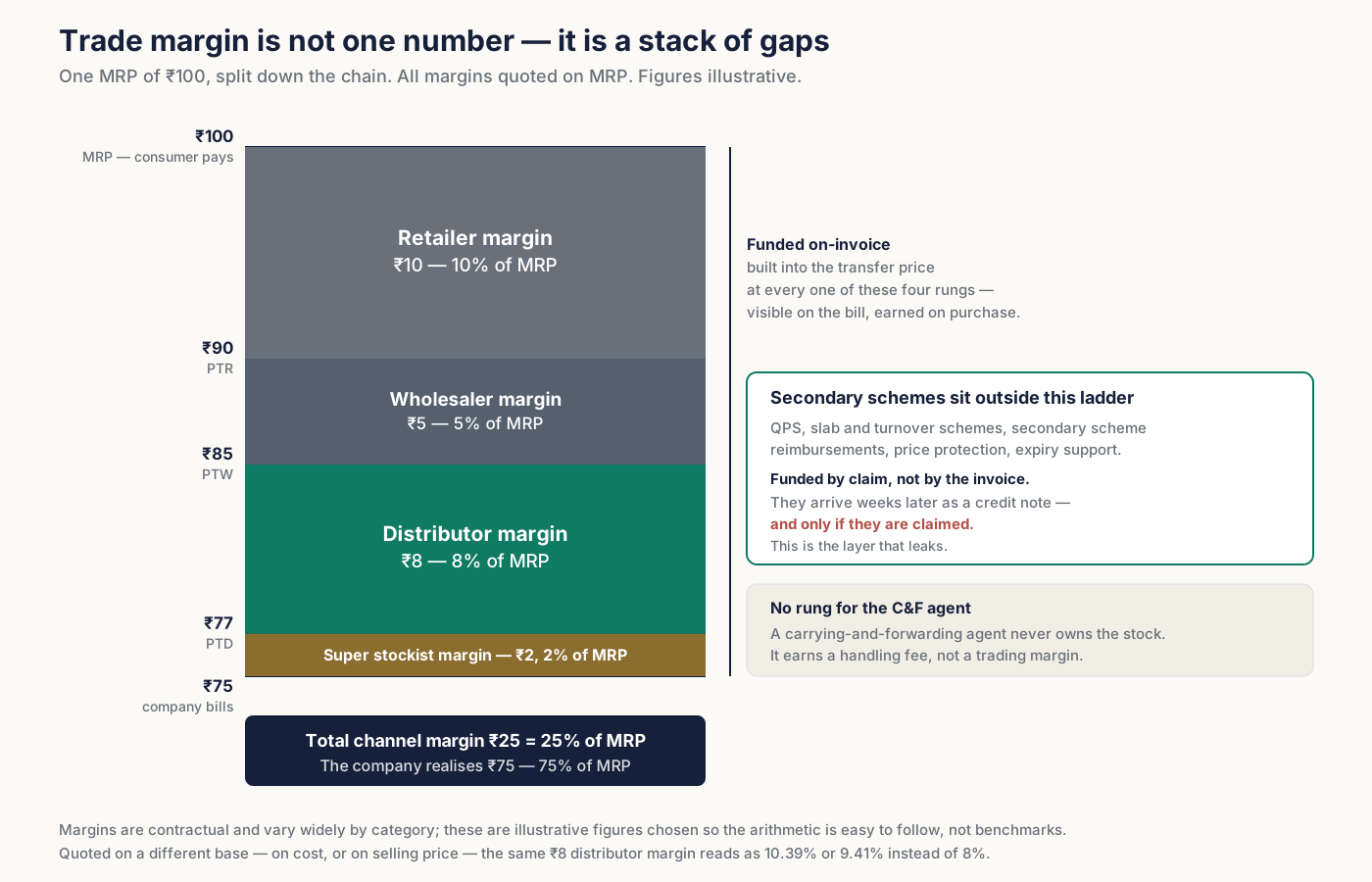
Total channel margin is ₹25 — a quarter of what the consumer pays, split four ways. The company realises ₹75.
Two things in that table are worth pausing on.
The C&F agent has no rung. A carrying-and-forwarding agent warehouses and invoices on the manufacturer's behalf but never takes ownership of the goods, so it earns a handling fee or commission rather than a trading margin. It is a cost in the company's books, not a gap in the price ladder. If you are mapping your own chain and cannot find the C&F margin, that is why — the full cast of tiers is set out in distributor vs dealer vs super-stockist.
Every gap in that ladder is funded the same way — on-invoice. Each tier's margin is built into the price at which the tier above bills it. That is the defining feature of primary margin: it needs no claim, no evidence, no deadline. It is simply the difference between two invoice prices.
Which is exactly why it is the smaller half of the story.
What happens when a tier is skipped
Chains rarely run their full length. A company may bill a large distributor directly and skip the super stockist; modern-trade chains and e-commerce platforms are usually served direct, with no wholesaler and often no distributor at all.
The mistake is assuming a skipped tier's margin disappears. It does not — it is redistributed, and the redistribution is a negotiation.
When you take over a super stockist's territory, that ₹2 does not automatically become yours. The company may keep it, pass part of it, or convert it into a scheme you have to earn rather than a price you are billed at. That last option is the one to watch, because a margin moved from the invoice into a scheme has quietly changed from guaranteed to conditional — it has crossed from the primary half of this article to the secondary half, and it now carries claim risk it did not carry before.
Modern trade rewrites the ladder more aggressively still. A chain buying direct negotiates on its own terms and carries costs that barely exist in general trade — listing fees, slotting allowances, promotional participation, agreed returns. Its headline margin can look generous beside a general-trade retailer's 10% while the realised number is thinner, because far more of it is contingent. The structural differences between the two routes are set out in general trade vs modern trade.
The rule of thumb: count the gaps, not the tiers. Removing a tier removes a name from the chain, not the money that sat in its gap.
Where stockist margin actually lands
Ask a distributor what margin they make on a brand and you will usually be quoted the rate card — the 8% in the table above. Ask what they realised last year and the number is different, sometimes by several points, almost always downward.
The rate card states primary margin. Realised margin is primary margin plus every scheme actually collected, minus every cost the rate card ignores.
A distributor on that 8% rate card might have, in the same year:
- Off-invoice schemes — QPS, slab and turnover schemes worth several points more, but only on what was claimed inside the window and evidenced properly.
- Secondary scheme funding they paid out to retailers and reclaimed from the company, with a gap of weeks or months in between.
- Freight, expiry, damage and breakage that the rate card never mentions.
- Cash discount taken or forgone, which is a financing decision rather than a trading one.
Put those together and the realised number can sit meaningfully above or below 8%, depending almost entirely on claim discipline. The full arithmetic of assembling it — all nine components, per unit, with the free goods handled correctly — is net landing cost, and it is the cost side of this same question. This page tells you where margin is supposed to sit; that one tells you what a case actually cost you.
The practical test: if you cannot state what you were entitled to under live schemes and what you actually received, your realised margin is not 8%. It is 8% minus an unknown you have never measured.
Why the same margin is quoted three different ways
Here is a source of confusion that costs more arguments than it should. Margin percentages are quoted on different bases at different tiers, and the base is almost never stated.
Take the distributor's ₹8 from the table. It can be honestly expressed as:
| Base | Calculation | Reads as |
|---|---|---|
| On MRP | ₹8 ÷ ₹100 | 8.00% |
| On cost (PTD) | ₹8 ÷ ₹77 | 10.39% |
| On selling price (PTW) | ₹8 ÷ ₹85 | 9.41% |
Same rupee. Same trade. Three numbers, spread across 2.39 percentage points — and every one of them is correct.
This is why a company's commercial team and a distributor's accountant can look at identical paperwork and disagree about the margin. FMCG convention leans toward quoting on MRP; accountants compute on cost, because that is what a gross margin is; sales teams often work on selling price. Nobody is wrong and nobody says which base they mean.
The gap widens as margins rise. At a 20% retail margin — unremarkable in pharma — the same margin reads as 20% on MRP and 25% on cost, a five-point apparent disagreement created entirely by the denominator.
The fix is trivially simple and almost never done: write the base next to the number. "8% on MRP" and "8% on cost" are different commercial terms, and a scheme circular that says only "8%" is ambiguous on its face. Where this bites hardest is PTR and PTS calculation, because those prices are themselves derived from a margin assumption — get the base wrong there and every downstream price inherits the error.
Primary margin is billed; secondary margin is claimed
Now the distinction that matters most operationally.
Primary margin is funded on-invoice. It is the ₹8 gap between what you paid and what you sell at. It arrives automatically, because it is nothing more than the difference between two prices. Nobody has to do anything for you to earn it. It cannot leak.
Secondary margin is largely funded by claim. Retailer schemes you ran and must recover, secondary scheme reimbursements, price protection on a revision, expiry and damage support — these are not in any price. They are entitlements. Each one requires you to know the scheme existed, compute what you are owed, evidence it, file inside the window, and chase the credit note.
Every one of those five steps is a place to lose money, and losing it is silent. An unclaimed scheme does not appear in your ledger as a loss. It does not show up in the P&L. Nothing in your accounting system knows the entitlement existed, so nothing can flag its absence. The margin simply never arrives, and next year's rate card negotiation starts from a realised number that was understated by your own process.
This is also why the two halves need different disciplines. Primary margin is a negotiation problem — you fix it once a year when terms are set. Secondary margin is an operations problem — you fix it every month, or you do not fix it at all.
And it is why the data question sits underneath the money question. Most Indian secondary schemes settle on secondary sales data, which the company never records natively and must have reported up from you. If your secondary data is late, incomplete or unverifiable, the claim fails regardless of what you were entitled to — the mechanics of that are in primary, secondary and tertiary sales, which covers whose books record what. This page is about who earns what; that one is about who can prove it.
What to do with this
Three questions worth being able to answer about any brand you carry:
- What is my primary margin, and on what base is it quoted? If the circular does not say, ask — and get the answer in writing.
- What secondary schemes am I entitled to this period, and what have I actually received? The gap between those two columns is your leak.
- What did the goods actually cost me once schemes, freight, expiry and cash discount are counted? That is net landing cost, and it is the only figure your pricing should be built on.
Answer the first from the agreement, the second from a claim register, and the third from both. What you earn on top of that cost, and why the timing hides it, is worked through in what a distributor actually earns after rebates.
RebateLedger holds scheme terms as rules rather than documents, accrues entitlement as purchases post, and tracks every claim through to the credit note that settles it — so the secondary half of your margin is something you can see while it is still claimable, rather than something you reconstruct a year later.
Frequently asked questions
What is the difference between primary and secondary margin?
Primary margin is earned on what you buy — the trading margin built into your purchase price, visible on the invoice and yours the moment the goods are billed. Secondary margin is earned on the onward sale to the retailer, and much of it is not in any price at all: it arrives as schemes you have to claim.
How is trade margin split across the channel?
Each tier's margin is the gap between two rungs of the price ladder. On an illustrative ₹100 MRP with margins quoted on MRP, a retailer might take ₹10, a wholesaler ₹5, a distributor ₹8 and a super stockist ₹2 — ₹25 of total channel margin, leaving the company ₹75. Real margins are contractual and vary widely by category.
Why do two people quote different margin percentages for the same trade?
Because they are using different bases and neither says so. A distributor's ₹8 on a ₹100 MRP reads as 8.00% of MRP, 10.39% of cost and 9.41% of selling price — a spread of 2.39 percentage points, and all three are correct. Writing the base next to the number ends most of these arguments.
Does a C&F agent earn a trading margin?
No. A carrying-and-forwarding agent warehouses and invoices on the manufacturer's behalf but never takes ownership of the goods, so it earns a handling fee or commission rather than a margin. It is a cost in the company's books rather than a rung on the price ladder, which is why you cannot find a C&F margin in the chain.
Is stockist margin what the rate card says?
Rarely. The rate card states primary margin only. What a stockist realises is that figure plus every scheme actually collected, minus the freight, expiry, damage and cost of funds the rate card ignores. Two stockists on identical terms can end a year several points apart purely on claim discipline.
What happens to the margin when a tier is skipped?
It is redistributed, not removed. Taking over a super stockist's territory does not automatically hand you their margin — the company may keep part of it, or convert it into a scheme you have to earn rather than a price you are billed at. That last move quietly turns guaranteed margin into conditional margin.
Why does secondary margin leak when primary margin does not?
Primary margin is simply the difference between two invoice prices, so it arrives automatically and cannot be lost. Secondary margin is an entitlement: you must know the scheme existed, compute it, evidence it, file inside the window and chase the credit note. Every one of those steps can fail silently, and an unclaimed scheme never appears as a loss.
See RebateLedger on your own claims data
A 30-minute walkthrough tailored to how your channel actually settles claims.