
Net Landing Cost: What You Actually Pay for a Case
Your invoice says ₹950 a case. Your real cost is ₹835. Net landing cost step by step, with the full calculation and where distributors get it wrong.
In short
Net landing cost is what a case of goods really costs a distributor once every on-invoice discount, off-invoice scheme, credit note, cash discount, allowance and freight has been counted, divided by the quantity actually received including scheme goods. It is almost always materially lower than the invoice price, and it is the only cost figure that makes unclaimed scheme money visible.
Net landing cost is what a case of goods really costs you once every discount, scheme, credit note, allowance and cost of delivery has landed — not what the invoice says.
Almost every distributor knows this number is not the invoice price. Very few can state it per SKU, this month, with the working shown. That gap is where most distribution businesses quietly lose their margin, and it is the reason two distributors buying identical goods on identical terms can end the year several points apart.
This page shows the full calculation.
Landed cost, or net landing cost?
"Landed cost" has two live meanings, and they are not competing definitions — they are different questions asked by different businesses. Searching the term returns mostly the first; this page is about the second.
Import landed cost is the cost of getting goods into the country: the purchase price, plus international freight, insurance in transit, customs duty, and port and clearing charges. It answers "what did it cost to land this consignment here?", and it is what import and supply-chain software is built to compute.
Net landing cost — also written net landed cost, and both spellings are in everyday use in Indian trade — is what the goods effectively cost you once every trade discount, scheme and supplier rebate earned on them has been applied. It answers a different question: "what did this stock actually cost me, after everything came back?"
An importing distributor has both, and they stack rather than compete. Import landed cost produces the figure that arrives in your warehouse; net landing cost then works that figure down by everything you earn on the goods afterwards. If you import, read the section on import costs below alongside the nine components — the import layer sits at the top of the same calculation.
Why the invoice price is not your cost
A distributor's cost is assembled from at least nine components, arriving at different times, in different documents, from different people.
Some are on the invoice. Some arrive weeks later as credit notes. Some depend on you claiming them. One of them — cash discount — you only get if you pay early, which means it is a financing decision disguised as a price.
The invoice tells you one of the nine. Your accounting system records maybe five. Nobody adds up all nine per SKU, so the number everyone uses for pricing and for judging whether a brand is worth carrying is wrong in the same direction every time: too high.
Being wrong too high sounds harmless. It is not. It makes you quote higher than you need to, walk away from business you could profitably win, and — most damagingly — it hides the fact that the schemes you never claimed were the difference between a good year and a bad one.
The full calculation, worked
A distributor buys 100 cases at ₹1,000 list. All figures illustrative.
| # | Step | Amount | Running total |
|---|---|---|---|
| 1 | Gross value (100 × ₹1,000) | ₹1,00,000 | ₹1,00,000 |
| 2 | Less on-invoice trade discount @ 5% | −₹5,000 | ₹95,000 |
| 3 | Scheme goods: 10+1, so 110 cases received | — | ₹95,000 for 110 cases |
| 4 | GST @ 18% (₹17,100) — recoverable, not a cost | — | ₹95,000 |
| 5 | Less QPS credit note @ 2% of invoice | −₹1,900 | ₹93,100 |
| 6 | Less cash discount @ 2% for payment in 7 days | −₹1,900 | ₹91,200 |
| 7 | Plus freight borne by you | +₹1,500 | ₹92,700 |
| 8 | Less expiry/damage allowance credited | −₹800 | ₹91,900 |
| 9 | Net landing cost | ₹91,900 ÷ 110 cases | ₹835.45 per case |
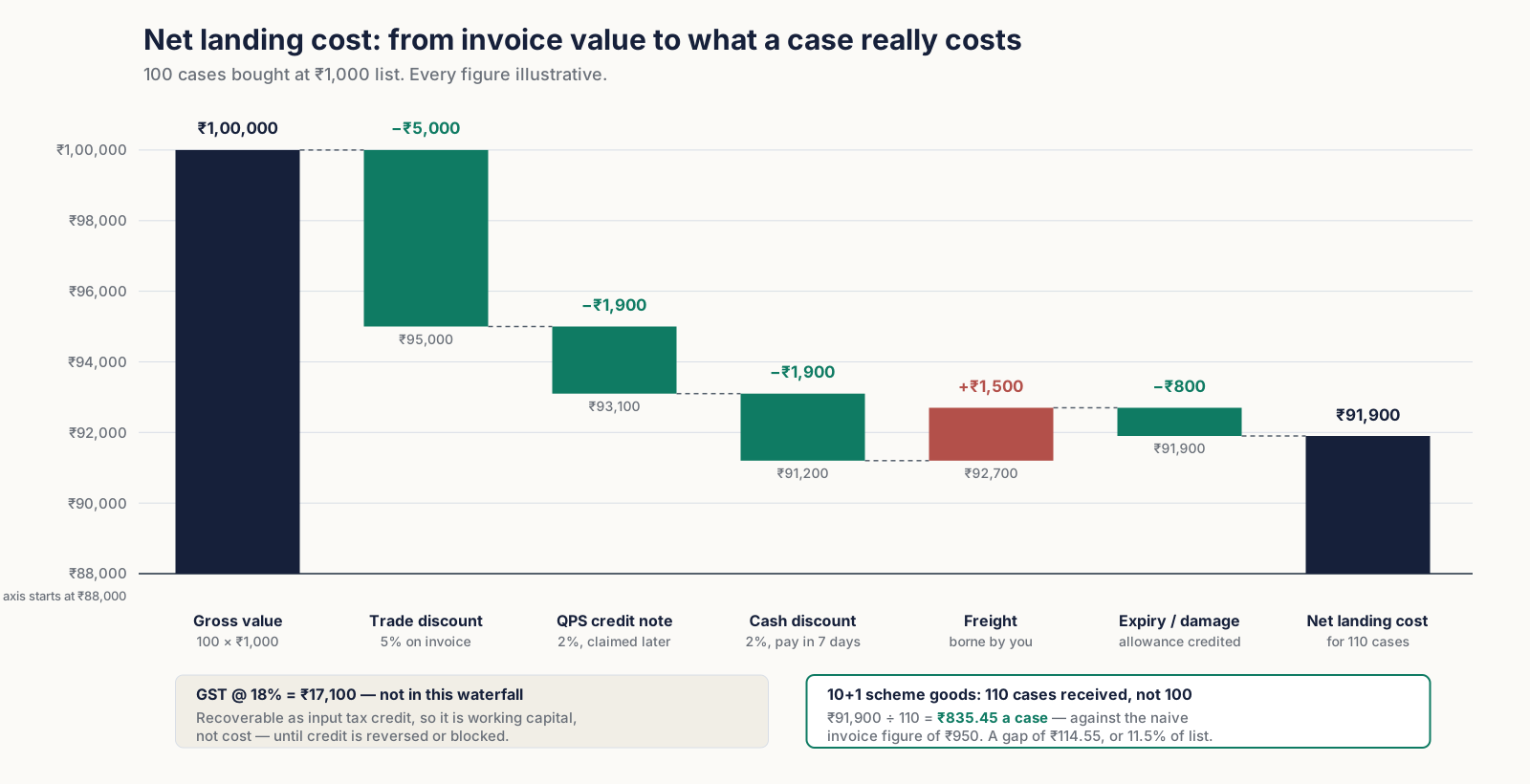
The naive number — list less the on-invoice discount — is ₹950 a case. The real number is ₹835.45.
The difference is ₹114.55 a case, or 11.5% of list. In a business running on 6–8% gross margin, that difference is not a refinement. It is the entire margin, twice over.
What this does to a pricing decision
Say you sell that case to a retailer at ₹900.
- Working from the naive cost of ₹950, you appear to be selling at a loss of ₹50 a case.
- Working from the real net landing cost of ₹835.45, you are making ₹64.55 a case — 7.2% on the selling price.
Distributors make both errors. Some refuse profitable business because the invoice price says it loses money. Others accept unprofitable business because they assume unclaimed schemes will cover it. Both are the same failure: pricing against a number that is not their cost.
The nine components, and where each one hides
1. Gross / list price. The starting point. Usually the only number in the ERP as "cost".
2. On-invoice trade discount. Deducted at billing, visible, and therefore the one everyone knows about. Also usually the smallest of the reductions.
3. Scheme goods and free goods. A 10+1 does not reduce the price — it increases the quantity, which reduces cost per unit. Systems that record 110 cases received against a ₹95,000 invoice get this right automatically. Systems that record 100 cases and treat 10 as a separate zero-value receipt get it wrong, and the error is invisible because both entries look correct on their own. The full costing treatment is in free goods and scheme goods; the GST treatment is a separate question again.
The 10+1 arithmetic trap. 10+1 is not a 10% discount. You pay for 10 and receive 11, so the effective discount is 1 ÷ 11 = 9.09%. Costing a 10+1 at 10% overstates your discount on every single case — and the error grows with the scheme, reaching 8.33 points on a 3+1. The ratio table for common schemes has the rest.
4. GST. Recoverable through input tax credit, so it is not a cost — but it is working capital. You pay it on purchase and recover it on sale, and in between it sits blocked. It does not belong in landing cost; it does belong in your cash planning. Where ITC is reversed — a credit note under Section 34, or Rule 37's 180-day rule — a portion becomes a real cost, which is the one case where GST enters this calculation.
5. Off-invoice schemes: QPS, slab, turnover discount. Settled later, by credit note, and only if claimed. This is the largest single source of error, because an unclaimed scheme is invisible everywhere: it does not appear in the ledger, it does not appear in the P&L, and nothing in the system flags its absence. A quantity purchase scheme is the common case, and it behaves like every other FMCG trade scheme — earned over a period, settled after it.
6. Cash discount. Not really a discount — it is the price of money. A 2% discount for paying 23 days early is an annualised return of roughly 32%. If your cost of funds is lower than that, taking it is one of the best returns available to your business, and skipping it to preserve cash is usually a mistake worth quantifying. Why this is a financing decision rather than a pricing one, with the annualised value of common terms, is in trade discount vs cash discount.
7. Freight and handling. Depends entirely on the terms. Where you bear it, it is a real addition to cost and is very often left out because it arrives as a separate transporter bill with no link to the purchase.
8. Expiry, damage and breakage allowances. A credit received reduces cost. A loss not compensated increases it. Both belong here, and both usually sit in a general expense head where they never reach the SKU.
9. Secondary scheme reimbursements. Where you fund a retailer scheme and claim it back from the company, the reimbursement reduces your cost — when it arrives. The gap between funding it and recovering it is working capital you are lending the brand, interest-free.
If you import goods
Where you import rather than buy domestically, a layer sits above the nine components — and it behaves differently from all of them, which is why it is worth separating rather than folding in.
Import costs attach to a consignment. Freight, insurance in transit, customs duty, and port and clearing charges are incurred once, for one shipment, and have to be spread across the goods in it. Trade schemes work the other way round: they attach to a period, are earned across everything you bought in it, and settle afterwards. So the two halves of an importing distributor's cost arrive on different clocks and are attributed by different rules.
The practical consequence is an allocation question that domestic buying never raises. A consignment carrying several products has to spread its shared costs across them somehow — by value, by weight, by volume — and whichever basis you pick, you should pick it deliberately and keep it consistent, because changing it silently moves cost between SKUs and makes month-on-month comparison meaningless.
Two further points are worth knowing before you build the number:
- Duty timing is a choice, not just a cost. When duty is paid affects working capital rather than the eventual cost of the goods, and warehousing arrangements exist precisely to move that timing. What changes and what does not is set out in bonded versus non-bonded warehouse pricing.
- Recoverable and non-recoverable are different lines. Some import charges are recoverable and some are a genuine cost, and only the second kind belongs in landing cost. That is the same principle as component 4 above, where GST is excluded because it is recoverable.
This article does not cover how any particular import charge is classified, calculated or claimed back. Duty and customs treatment depends on the goods, the route and the arrangement, and it belongs with your own customs adviser or chartered accountant rather than with a general article.
Once the consignment cost is settled, the rest of this page applies unchanged: the import figure is what lands in your warehouse, and every discount, scheme and credit note you earn on those goods then works it down.
The two distributors
Same brand, same terms, same volume. The only difference is claim discipline.
| Distributor A | Distributor B | |
|---|---|---|
| Gross purchases | ₹5,00,00,000 | ₹5,00,00,000 |
| On-invoice discounts realised | 5% (₹25,00,000) | 5% (₹25,00,000) |
| Off-invoice schemes entitled to | ₹18,00,000 | ₹18,00,000 |
| Off-invoice schemes actually claimed and received | ₹17,10,000 (95%) | ₹11,70,000 (65%) |
| Unclaimed | ₹90,000 | ₹6,30,000 |
| Difference in annual gross profit | — | ₹5,40,000 worse |
Neither distributor did anything wrong commercially. B simply could not evidence 35% of what they were owed inside the claim window — missing invoices, no proof of secondary sales, claims submitted after the cut-off, disputes never followed up.
B's net landing cost is 1.08% higher than A's on identical terms. On a 7% gross margin, that is roughly 15% of their profit, gone, with no visible cause.
This is the practical reason net landing cost matters. It is not an accounting exercise. It is the only number that makes unclaimed money visible.
How to calculate it for your own business
Start with one brand and one month. You do not need software to find the answer; you need software to keep finding it.
- Pick your largest brand and a closed month. Pull total gross purchase value.
- List every on-invoice deduction from the purchase invoices.
- Count actual quantity received, including scheme and free goods. This is where most calculations first go wrong.
- Pull every credit note received from that company in the following four months, and tag each one to the month it relates to — not the month it arrived.
- Add freight you paid on those consignments.
- Add or subtract expiry and damage settlements for that stock.
- Divide by actual units received.
- Compare to what your ERP thinks the cost was.
Then ask the question the exercise exists for:
Of the schemes running that month, how much were we entitled to — and how much did we actually receive?
If you cannot answer that from records, you have found the leak. The answer is almost never zero, and in businesses without a claim tracker it is commonly between 15% and 40%.
Why this is hard to keep doing
The one-month exercise above is straightforward. Doing it every month, per brand, per SKU, is not — for structural reasons rather than effort reasons.
Credit notes arrive late and unlabelled. A credit note received in August may relate to April's purchases, and frequently says nothing about which scheme, which period, or which invoices it settles. Matching it back is manual archaeology, and the tax-versus-commercial credit note distinction adds a second dimension to get right.
Entitlement lives outside the system. The scheme circular is a PDF or a WhatsApp message. Nothing computes what you should receive, so nothing can tell you what is missing.
Scheme goods break unit costing. Free quantity received against a priced invoice needs the quantity and the value to meet, and most inventory systems keep them apart.
Nobody owns the number. Purchase owns the invoice. Finance owns the credit note. Sales owns the scheme. No one owns the sum, so the sum does not exist.
Your cost changes after you have sold the goods
There is a structural awkwardness in this calculation that no amount of discipline removes, and it is worth naming plainly rather than discovering at year end.
You buy in April and sell through May. The quarterly scheme on those purchases is only earned when the quarter closes in June. The credit note settling it arrives in July, and may relate to invoices you can no longer easily identify. By the time you know what the goods cost, they have been gone for two months and the margin on them is already in a closed period.
So the net landing cost of goods you have already sold changes retrospectively. That is not a failure of your process — it is what off-invoice settlement means.
Businesses handle it in one of two ways:
- Recompute when the scheme settles. Wait for the credit note, attribute it back to the purchases it relates to, and restate the cost of those goods. Accurate, but it means the cost of a period is not final until well after the period ends.
- Accrue an expected reduction at the time of purchase. Estimate what the goods will earn and carry that estimate in the cost from the start, then true it up when the credit note arrives. The cost is available immediately, at the price of being an estimate until settlement.
The choice matters because it changes which period your margin appears in, and a business that switches between the two — or applies one to some brands and the other to others — will produce margin figures that are not comparable across periods. Whichever you use, use it consistently and be able to say which it is.
Which approach is appropriate for your books is an accounting question rather than an operational one, and it depends on the framework applicable to your entity. This article states no position on it; the recognition, true-up and write-back mechanics are discussed in rebate accounting, and the treatment for your business should be settled with your chartered accountant.
The one thing that makes either approach workable is the same thing: being able to attribute a settlement back to the specific purchases it relates to. Without that link, both methods degrade into a guess applied to a total.
Net landing cost is the cost side, not the margin side
Worth separating two questions that get run together. Net landing cost answers what you pay for a case. What you earn on it is a different calculation — selling price less that cost, with its own timing problems, covered in what a distributor actually earns after rebates. Get the cost number right first: every margin figure you compute is only as good as the cost underneath it.
There is a third view of the same money, and together the three make a set. The price waterfall shows the structure — every step from list price downward, and where each deduction sits. This page shows what you paid once those steps have run. The margin article shows what you earned on top. Same transactions, three different questions, and confusing them is how businesses end up defending a margin figure built on a cost they never computed.
The same distinction applies downstream. PTR, PTS and PTW are the prices you sell at; net landing cost is the price you bought at. Where the margin between those rungs sits, and which half of it is billed rather than claimed, is primary vs secondary trade margin. And because schemes are earned on purchases but often evidenced by sell-through, the primary and secondary sales split decides which of your numbers a company will even accept as proof.
What good looks like
A distributor with this under control can answer three questions in minutes:
- What is my net landing cost per SKU this month, and what was it last month?
- What am I entitled to under live schemes that I have not yet claimed?
- Which claims are overdue for settlement, from which company, and for how long?
Those three answers turn scheme income from something that arrives to something you manage. That is the whole point.
RebateLedger holds company scheme terms as rules rather than documents, accrues your entitlement as purchases post, tracks every claim from submission to credit note, and reconciles received credit notes back to the schemes and periods they settle — so net landing cost is a number you can read rather than a project you run.
Frequently asked questions
What is net landing cost?
The true cost of goods to a distributor after every on-invoice discount, scheme, credit note, allowance and delivery cost, divided by the quantity actually received. It is almost always materially lower than the invoice price, and materially higher than the best case people assume.
Is landed cost the same as import landed cost?
Not quite — the term carries two meanings and both are valid. Import landed cost is what it costs to get goods into the country: purchase price, freight, insurance, customs duty and clearing charges. Net landing cost is what the goods cost you after every discount, scheme and rebate earned on them. An importing distributor has both, stacked.
When should net landing cost be recalculated?
Whenever a settlement lands that relates to goods already costed — which for off-invoice schemes is routinely after those goods have been sold. Businesses either recompute when the credit note arrives or accrue an expected reduction at purchase and true it up. Which suits your books is a question for your chartered accountant.
What is the difference between landing cost and net landing cost?
Landing cost usually means invoice value plus freight and handling. Net landing cost also subtracts everything that comes back later — off-invoice schemes, credit notes, cash discounts and allowances. For a distributor the net figure is the one that matters, because the later credits are often larger than the on-invoice discount.
Should GST be included in net landing cost?
No, where the input tax credit is fully recoverable — it is a working capital item, not a cost. It becomes a cost only where credit is reversed or blocked, for example under a Section 34 credit note or Rule 37's 180-day rule.
How do free goods affect landing cost?
They reduce cost per unit by increasing quantity rather than reducing value. A 10+1 gives an effective discount of 9.09%, not 10%, because you pay for 10 and receive 11. Costing it at 10% overstates your discount on every case.
Is cash discount part of landing cost?
Yes, when taken. It is worth calculating its annualised value before deciding to skip it — 2% for paying 23 days early is roughly a 32% annualised return, which is higher than most distributors' cost of funds.
Why does my ERP cost differ from my net landing cost?
Most ERPs record the invoice and the quantity, then stop. Credit notes received later usually post to a general income or discount head rather than back to the stock or the SKU they relate to, so the cost the ERP carries never sees them.
How much do distributors typically lose to unclaimed schemes?
It varies widely by claim discipline and by how well scheme terms are documented, so treat any single figure with suspicion — including this one. What is consistent is that businesses without a claim tracking process cannot state the number at all, and businesses that start tracking it are almost always surprised by the size.
See RebateLedger on your own claims data
A 30-minute walkthrough tailored to how your channel actually settles claims.