
Trade Discount vs Cash Discount: Not the Same Thing
Trade discount reduces the price. Cash discount buys early payment. Why one is a pricing decision and the other a financing decision, with the maths.
In short
A trade discount is a reduction in price given for who the buyer is or how much they buy, and it is applied when the invoice is raised. A cash discount is a reduction given for paying early. One changes the price of the goods; the other buys time. Treating a cash discount as a pricing concession, rather than as borrowing, is how most businesses get it wrong.
A trade discount changes the price. A cash discount buys time. One is given for who the buyer is or how much they buy and is applied when the invoice is raised. The other is given for paying early, and it is not really a discount at all — it is a short-term loan, priced in percentage points.
That distinction sounds academic until you price it. A cash discount that looks like a modest 2% concession is routinely worth more than 30% a year, which makes it either the best return available to your business or an expensive habit, depending entirely on facts most companies never check.
The discount family
Five terms get used loosely and often interchangeably. They are not interchangeable.
| What triggers it | When it is applied | On the invoice? | GST, in outline | |
|---|---|---|---|---|
| Trade discount | Who the buyer is — tier, status, agreement | At invoicing | Yes | Recorded on the invoice, so outside taxable value under 15(3)(a) |
| Quantity discount | How much they buy | At invoicing if known; after the period if earned | Sometimes | On-invoice under 15(3)(a); if later, must clear 15(3)(b) |
| Cash discount | Paying earlier than the credit terms require | On payment | Usually not | Settled after supply, so 15(3)(b) territory |
| Commercial / financial discount | Any commercial reason, settled by financial credit note | After supply | No | Does not reduce taxable value; GST on the original invoice stands |
| Post-sale discount | Umbrella for anything settled after supply | After supply | No | Reduces taxable value only if 15(3)(b) is satisfied |
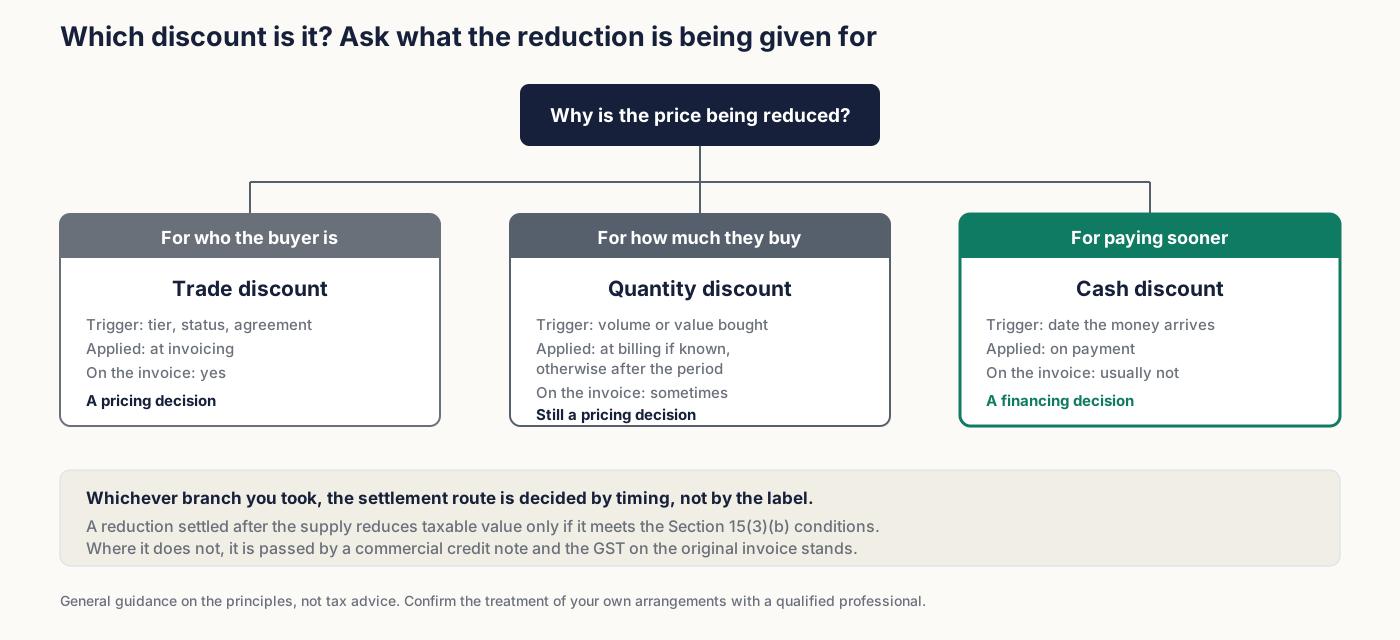
The first two rows are pricing. The third is financing. The last two are not really categories at all — they describe how a reduction was settled, not what earned it. That is why a single scheme can be described accurately as a quantity discount, a post-sale discount and a commercial discount all at once, and why arguing about the label rarely resolves anything. Ask what triggered it and when it settles; those two answers determine everything else.
Where the trigger is the sharpest test, the on-invoice question is the sharpest consequence — worked through in on-invoice vs off-invoice discounts, and the discount/rebate/scheme boundary in is a rebate a discount.
Cash discount is a financing decision
Here is the part worth the page.
When a supplier offers 2% off for paying 23 days early, they are not repricing the goods. They are offering to pay you 2% of the invoice to lend them money for 23 days. Whether that is a good deal has nothing to do with the product and everything to do with your cost of funds.
The annualised value is:
Annualised return = ( d ÷ (100 − d) ) × ( 365 ÷ days gained )
The denominator is 100 − d, not 100, because the sum you actually part with early is the discounted amount. You are putting up ₹98 to save ₹2, not ₹100 to save ₹2.
Run it across common terms:
| Terms | Discount | Days gained | Annualised |
|---|---|---|---|
| 2/7 net 30 | 2% | 23 | 32.4% |
| 2/10 net 30 | 2% | 20 | 37.2% |
| 1/10 net 30 | 1% | 20 | 18.4% |
| 2/15 net 45 | 2% | 30 | 24.8% |
| 1/15 net 45 | 1% | 30 | 12.3% |
| 3/10 net 60 | 3% | 50 | 22.6% |
| 2/10 net 60 | 2% | 50 | 14.9% |
| 1/10 net 60 | 1% | 50 | 7.4% |
Read that column properly and the decision rule falls out. Compare the annualised figure to what money costs you. If your working-capital facility runs at, say, 11–13%, then 2/10 net 30 at 37.2% is close to the best return your business can earn on cash, and skipping it to feel liquid is an expensive comfort. But 1/10 net 60 at 7.4% is below your borrowing cost — taking it means borrowing at 12% to earn 7.4%, which is a straightforward loss. The same "1% discount" is a bargain over 20 days and a mistake over 50.
Three honest qualifications, because the maths on its own will lead you astray:
You need the cash, or cheap access to it. The 37% is a return on money you actually have. Financing it on a facility priced above the annualised figure destroys the gain, and financing it on something expensive — supplier credit elsewhere, an informal loan — can turn a saving into a loss.
Do not buy the discount with a stockout. Cash spent capturing 2% on a slow line, leaving you unable to fund the fast-moving SKU that carries your margin, is a bad trade however good the percentage looks. Availability usually beats 2%.
It is a per-invoice decision, not a policy. Terms differ by supplier, and as the table shows, the same headline discount can be worth 37% or 7%. A blanket "we always take cash discount" rule is as wrong as never taking one.
GST treatment, in outline
General guidance on the principles, not tax advice.
Whether a discount reduces the taxable value of a supply turns on Section 15(3) of the CGST Act, and the dividing line is timing.
Given before or at supply — Section 15(3)(a). If the discount is duly recorded in the invoice for that supply, it is outside taxable value. No further conditions. A trade discount shown on the invoice face is the clean case.
Given after supply — Section 15(3)(b), and here both limbs must be met: the discount is established in terms of an agreement entered into at or before the time of supply and specifically linked to relevant invoices, and the input tax credit attributable to it is reversed by the recipient. The second limb is the one people forget, and it is not optional.
A cash discount sits interestingly against those conditions. Its facts line up better than most: it is written into the payment terms from the outset, so it exists before the supply, and it attaches to one identifiable invoice rather than floating across a quarter's purchases — which is precisely where a volume scheme struggles. That is an observation about the shape of the transaction, not a conclusion about any particular arrangement. The reversal limb still has to actually happen, and the treatment depends on your facts and documentation.
Where the conditions are not met, or the supplier simply chooses not to reduce GST, the reduction is passed by a commercial credit note: the GST on the original invoice stands, and per Circular 251/08/2025-GST the recipient is not required to reverse ITC.
One live caveat. The Finance Act 2026 rewrites Section 15(3)(b) to drop the pre-agreement and invoice-linkage conditions, keeping only the credit note and the ITC reversal — but as at August 2026 it has not been brought into force, so the conditions above are still the ones that apply. The full dissection, including what changes when it is notified, is in Section 15(3)(b) and post-supply discounts.
"Commercial discount" and financial credit notes
"Commercial discount" is not a statutory category. In Indian practice the phrase usually signals a settlement route rather than a type of concession: a reduction the supplier passes by financial or commercial credit note, deliberately leaving the original invoice's GST alone.
Companies choose that route for ordinary reasons — the discount cannot clear the 15(3)(b) conditions, or the reconciliation burden of a tax credit note is not worth the tax relief, or the scheme was decided after the goods shipped. It is a legitimate choice with a real cost: the GST relief is forgone and the reduction is absorbed commercially. The instrument choice, and what each does to both sides' books, is worked through in financial vs tax credit notes.
Credit terms and the real cost of the credit period
The last piece joins the two halves.
Sellers treat extended credit as a concession that costs nothing. It costs exactly your cost of funds on the outstanding amount for the period — 45 days on ₹50 lakh at 12% is roughly ₹74,000 of real money, every cycle, invisible because no one invoices you for it.
Buyers make the mirror error: treating credit as free. Net 30 with 2/10 terms is not thirty days of free credit. It is ten days free, followed by twenty days borrowed at 37% annualised. The forgone discount is the interest rate — you simply never see a statement for it.
Once you see it that way, the two sit in the same decision. The cash discount tells you what your supplier charges for time. Your facility tells you what your bank charges. Take the cheaper one, invoice by invoice.
And whichever you take, it lands in the same place: the cash discount is one of the nine components that turn an invoice price into what a case actually cost you, worked through in net landing cost.
Note: This article is general commercial information, not tax, accounting or financial advice. Statutory references are signposts, not an opinion on any arrangement, and all figures are illustrative. Confirm the treatment of your own contracts with a qualified professional.
Frequently asked questions
What is the difference between a trade discount and a cash discount?
A trade discount is a reduction in price given for who the buyer is or how much they buy, and it is applied when the invoice is raised. A cash discount is given for paying early. One changes the price of the goods; the other is a short-term loan priced in percentage points.
How do you calculate the value of a cash discount?
Annualise it: (d ÷ (100 − d)) × (365 ÷ days gained). The denominator is 100 − d because you part with the discounted amount rather than the full one — you put up ₹98 to save ₹2. On 2/7 net 30, paying 23 days early works out at roughly 32.4% a year.
Is it always worth taking a cash discount?
No — compare the annualised figure with what money costs you. 2/10 net 30 is about 37.2%, well above most working-capital rates, so taking it is close to the best return available. But 1/10 net 60 is only 7.4%, below typical borrowing cost, so taking that one is a straightforward loss.
Is a cash discount a pricing decision or a financing decision?
A financing decision. The supplier is not repricing the goods; they are paying you to lend them money for the days you pay early. Whether it is a good deal has nothing to do with the product and everything to do with your cost of funds — and it changes invoice by invoice, so a blanket policy is wrong either way.
Does a discount reduce the taxable value under GST?
It turns on timing. Under Section 15(3)(a) a discount duly recorded in the invoice is outside taxable value with no further conditions. A discount given after supply must satisfy both limbs of Section 15(3)(b) — established in an agreement made at or before the supply and linked to relevant invoices, and the recipient reverses the attributable input tax credit.
What is a commercial discount?
Not a statutory category. In Indian practice it describes a settlement route rather than a type of concession: a reduction passed by financial or commercial credit note, deliberately leaving the original invoice's GST alone. The relief is forgone and the reduction absorbed commercially, and per Circular 251/08/2025-GST no ITC reversal is required.
Is net 30 with 2/10 terms thirty days of free credit?
No. It is ten days free, then twenty days borrowed at roughly 37% annualised. The discount you forgo is the interest rate — you simply never receive a statement for it. Sellers make the mirror error, treating extended credit as costless when it costs their cost of funds on the outstanding amount every cycle.
See RebateLedger on your own claims data
A 30-minute walkthrough tailored to how your channel actually settles claims.