
The Customer Discount Agreement: What Your Terms of Trade Must Contain
What a customer discount agreement with an organised retailer must contain, and why every deduction you receive later traces back to a clause inside it.
In short
A customer discount agreement sets the commercial terms between a supplier and an organised-retail customer — the margins, allowances, promotional funding and service expectations that govern the relationship for a period. Almost every trade deduction a supplier receives later is a claimed application of one of its clauses, which is why the precision of its wording matters.
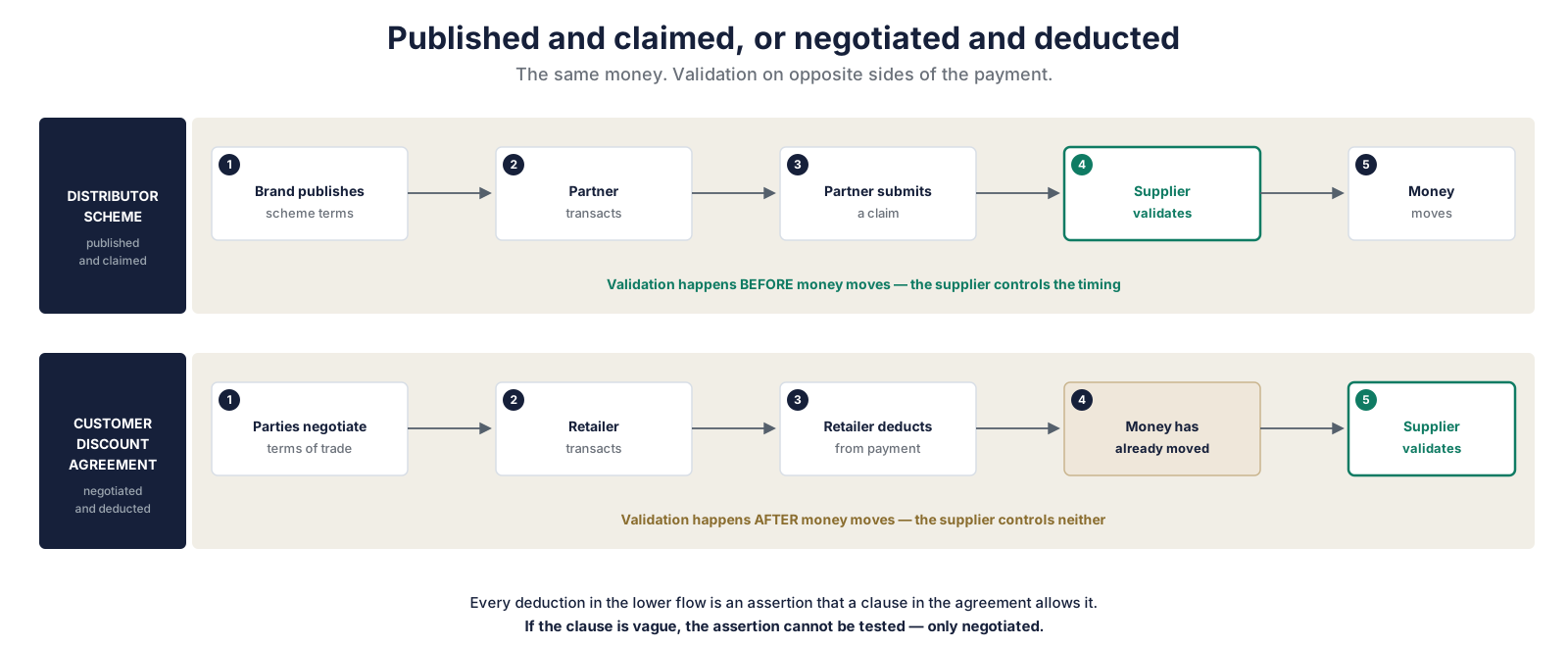
A customer discount agreement sets the commercial terms between a supplier and an organised-retail customer — the margins, allowances, promotional funding and service expectations that govern the relationship for a period. Almost every trade deduction a supplier receives later is a claimed application of one of its clauses, which is why the precision of its wording matters.
The diagram above is free to reuse with attribution. Throughout this article, deduction means a customer or trade deduction — an amount a customer withholds from an invoice payment — not a tax-deductible expense. Claims means distributor and channel claims. This is general commercial information, not legal advice.
What a customer discount agreement must contain
The table below is the working checklist. The third column is the point of the whole document: each clause governs a specific deduction you will receive later, and the clause is the only thing that makes that deduction checkable.
| Clause | What it must state | The deduction it governs |
|---|---|---|
| Base margin or trade discount | The on-invoice terms, and what value the percentage applies to | Nothing directly — it is priced into the invoice, which is why it rarely disputes |
| Volume or growth rebate | Thresholds, the measurement period, what counts toward it, and the settlement route | Periodic rebate deductions, and arguments about which transactions counted |
| Listing and slotting terms | What is payable for range presence, and per what unit — store, SKU, or range review | Listing deductions, usually taken at range-review points |
| Promotional funding | How each promotion is funded, approved in advance, and evidenced afterwards | Promotional deductions — the single largest dispute category for most suppliers |
| Display and visibility allowances | The specific activity paid for, and the proof required that it happened | Display allowance deductions, where the proof requirement is the whole argument |
| Marketing or co-op contribution | What it funds, how it is calculated, and how it is invoiced or deducted | Marketing contribution deductions |
| Service-level expectations | The standard, the measurement window, and the financial consequence of missing it | Service-level or fill-rate deductions |
| Returns and damages | Who bears what, in what circumstances, and within what period | Return and damage deductions |
| Price change notice | How much notice is required, and what happens to stock already delivered | Price-protection and rate-difference adjustments |
| Settlement mechanism | For each amount: deducted from payment, or invoiced and settled separately | Determines whether you validate before or after the money moves |
| Reconciliation and dispute process | How a disputed deduction is raised, by whom, and the deadline for resolving it | Governs every deduction above once contested |
| Term, renewal and change control | How long it runs, and how a variation is agreed and recorded | Determines which version governs a given transaction date |
What a customer discount agreement is
A customer discount agreement is the negotiated terms-of-trade document between a supplier and an organised-retail customer — a chain that buys centrally and sells through its own stores. It covers a defined period, and it is the reference point for the commercial relationship during that period.
It is worth distinguishing plainly from the document most Indian suppliers know better: the distributor scheme circular. The difference in general trade versus modern trade is not only in store formats. It is in how money comes back.
A distributor scheme is published. The brand decides the terms, circulates them to the channel, and the partner then claims against them — submitting a request that the brand assesses before paying. The distributor-side equivalent of this checklist covers what those agreements need.
A customer discount agreement is negotiated. Both parties argue the terms, and the retailer then deducts what it believes those terms entitle it to, directly from what it owes on your invoices. Nobody asks first.
That inversion is the whole point. In the published-and-claimed model, validation happens before money moves, and the supplier controls the timing. In the negotiated-and-deducted model, validation happens after money has already moved, and the supplier controls neither. The same commercial substance — a rebate, an allowance, a promotional contribution — arrives through a mechanism that reverses who carries the burden of proof.
Two related mechanics are worth distinguishing while we are here. A billback is a post-sale charge one partner raises against the other, and a chargeback in this context is a trade chargeback — not a card-payment dispute — with its own dispute process. Whether an amount reaches you on-invoice or off-invoice is a separate axis again, covered in on-invoice versus off-invoice discounts.
Why every deduction traces back to a clause
When a retailer short-pays an invoice, it is making an assertion: this agreement entitles us to withhold this amount. Every trade deduction is that assertion in numeric form.
Which means the question your team faces on receiving one is not "is this fair" but "does the agreement say this". And whether that question can be answered at all depends entirely on how the clause was written months earlier.
A clause that states a basis, an evidence requirement and a measurement window produces deductions you can check. A clause that states an entitlement without them produces deductions you can only accept or argue about. The distinction between valid and invalid trade deductions is really a distinction between deductions that map to a specific agreed term and deductions that do not — and that mapping is only possible if the term was specific in the first place.
This is why agreement quality is a deduction-management problem rather than a legal-department problem. The team that validates deductions inherits whatever precision the negotiating team left behind. Vague terms do not create risk at signature; they create it every month afterwards, in a different department, usually without anyone connecting the two. Suppliers who treat their agreement as an operational document rather than a filed contract find their deduction disputes fall without anyone becoming more aggressive.
The clauses most often left loose
Four clauses account for a disproportionate share of disputes, and in each case the omission is the same shape: the entitlement is agreed, and the mechanics that would make it checkable are not.
Promotional funding
The agreement establishes that promotions will be jointly funded. It frequently does not state how — whether funding comes off-invoice, arrives as a deduction, or is invoiced separately — nor what evidence establishes that the promotion ran as agreed.
Illustrative: a supplier agrees to fund a promotion across a retailer's stores. Three months later a deduction arrives for the full agreed amount. The supplier believes the promotion ran in fewer stores than planned. Nothing in the agreement says who counts participating stores, what record establishes the count, or what happens if the two parties count differently — so there is no basis on which to adjust the amount, only a conversation.
The fix is structural rather than legal: state the funding mechanism and the evidence requirement for each promotion type. The clause need not be long. It needs to answer "how do we both know this happened, and to what extent".
Service-level consequences
Agreements commonly state a fill-rate or on-time-delivery expectation. Far fewer state the measurement window, what is excluded from the calculation, and what the financial consequence of missing the standard actually is.
Any figure attached to a service level — the standard itself, and any amount payable on missing it — is set entirely by the specific agreement between the parties. There is no general rate. What matters structurally is that the clause defines how performance is measured and over what period, because a standard measured weekly and a standard measured quarterly describe very different obligations even at the same percentage.
Price change notice
When a supplier raises prices, stock already sitting in the retailer's network was bought at the old price. When a supplier cuts prices, the same stock is now worth less than the retailer paid.
Agreements routinely specify how much notice a price change requires and stop there — leaving the treatment of stock in hand unaddressed. That gap surfaces as a price-protection or rate-difference adjustment that one party expects and the other did not budget for. The clause should state whether stock in hand is adjusted, on what evidence of quantity, and within what period of the change.
The dispute window
The most consequential omission is also the least visible: no deadline for raising or resolving a disputed deduction.
Without one, a contested item has no natural end. It is queried, it awaits information, it is escalated, and it ages. Illustrative: a supplier disputes a deduction in one quarter and is still exchanging emails about it three quarters later, by which point the people who negotiated the underlying promotion have moved roles and the supporting records sit in an archive. Nothing was refused. The item simply never resolved, and aged items accumulate until someone writes them off — which is a decision made by exhaustion rather than on the merits.
A dispute window converts that into a bounded process. It states who raises a dispute, in what form, by when, and by when it must be answered.
Deducted or settled separately?
For every payable amount in the agreement, there is a mechanism question: does the retailer take it off a payment, or is it invoiced and settled as its own transaction?
The commercial substance can be identical. The operational consequence is not.
Deducted from payment. The supplier learns the amount exists when a remittance arrives short. Validation is retrospective — the money has moved, and recovering an incorrect deduction requires persuading the counterparty to pay something it has already decided it does not owe. Cash is affected immediately, and the deduction has to be identified, matched to a clause and either accepted or disputed after the fact. This is what makes deduction reason codes and claim matching a distinct discipline from claims processing.
Invoiced or settled separately. The amount arrives as a claim to be assessed. It can be checked against the clause before payment, and a disagreement is resolved before money moves rather than after. The trade-off is administrative volume — separate settlement means separate documents and separate reconciliation.
Neither route is universally correct, and the choice is often not really the supplier's to make. What the agreement can do is state which route applies to each type of amount, so that neither side is surprised. An agreement silent on mechanism defaults to whatever the stronger party's systems do.
Any documentation, credit-note or tax question arising from either route is a separate matter with its own requirements, and this article takes no position on it. Those questions are covered in the financial versus tax credit note guide and the rate-difference credit note material, and should be confirmed with your own adviser.
Making the agreement operable
An agreement only helps at settlement if the person validating a deduction can actually see its terms.
This sounds trivial and is the most commonly missed step. The agreement is negotiated by a commercial team, signed, filed — and the finance team that receives deductions against it works from memory, a summary email, or a spreadsheet somebody built two years ago. The terms exist. They are just not where the work happens.
Two properties make the difference:
Effective dates. Terms are commonly renegotiated annually while deductions arrive monthly. A deduction raised in one period against transactions in another must be tested against the version in force on the transaction date, not the version in force today. An agreement recorded without effective dates cannot support that test, and the error it produces is silent — the arithmetic works, against the wrong terms.
Versions. A mid-year variation to one allowance does not replace the agreement; it creates a second version of one clause. Unless the change is recorded as a version with its own effective date, the only record that it happened is the memory of the two people who agreed it.
RebateLedger holds agreement terms with effective dates and versions so a deduction can be checked against the terms that were in force when the underlying transactions happened.
If you are assessing how your own process handles this, the claim lifecycle walks the same problem from the distributor-claim side, and reconciling invoice data against agreements covers the matching step.
Book a demo if you want to see how agreement terms are held and checked against deductions.
Before you sign
A short review pass, in the order that surfaces problems fastest.
-
Is every payable amount defined with a basis? For each rebate, allowance, fee and contribution: what is it calculated on, and at what rate or amount. An entitlement without a basis is not yet a term.
-
Is the evidence requirement stated for each? What record establishes that the amount is due, and who produces it. If the answer is "we will agree that later", it will be agreed under dispute conditions.
-
Is the settlement mechanism stated for each? Deducted from payment, or invoiced separately. Silence here defaults to the counterparty's practice.
-
Is there a dispute window with a deadline? Both directions — a deadline for raising a dispute and a deadline for answering one. This single clause does more to prevent aged deductions than any other.
-
Is there a price-change notice provision that addresses stock in hand? Notice alone is not enough; the treatment of stock already delivered is the part that generates adjustments.
-
Are service-level standards paired with a measurement window? A standard without a stated measurement period is not testable.
-
Can the finance team see these terms at settlement time? Not "is the agreement filed" — can the person validating a deduction next month read the clause it relies on, with its effective dates. If not, the agreement will be precise and unused.
Have the agreement reviewed by your own legal adviser before signing. This article describes what clauses need to address so that deductions can be validated operationally; it does not provide contract wording, and nothing here is legal advice or a substitute for advice on your specific arrangement.
General commercial information, not legal advice. This article explains what a customer discount agreement typically covers and why the precision of each clause affects whether later deductions can be validated. It makes no statement about whether any particular commercial term is appropriate, fair or lawful — that depends on the parties, the market and the applicable law. Have your agreements reviewed by your own legal adviser.
Read next
- Supplier rebate agreements — the distributor-side counterpart to this checklist, where terms are published and then claimed against.
- General trade vs modern trade — why the two channels settle money differently.
- Quick commerce claims and deductions — the same clauses, at a cadence that punishes imprecision.
- Valid vs invalid trade deductions — the test applied to a deduction once it arrives.
- Deduction management for accounts receivable — the operational discipline these clauses feed.
- Distributor claims management — the wider picture across both channels.
Terms of trade set the deductions a retailer may take; what they do not show is the cumulative effect on what you actually realise per case. Laying those deductions out in sequence is the purpose of a gross-to-net price waterfall.
Frequently asked questions
What is a customer discount agreement?
A customer discount agreement is the negotiated terms-of-trade document between a supplier and an organised-retail customer. It sets out the margins, rebates, listing terms, promotional funding, service expectations and settlement mechanics that govern the relationship for a defined period. It is the document every later deduction from your invoice payments refers back to, explicitly or otherwise.
What is the difference between a customer discount agreement and a distributor scheme?
A distributor scheme is published: the brand sets terms, circulates them, and the partner claims against them afterwards. A customer discount agreement is negotiated between the parties, and the retailer then deducts what it believes it is owed straight from payment. The money moves the same way. The mechanism, the timing and the balance of power do not.
What should terms of trade with a retailer include?
Every payable amount with a stated basis, the evidence required to support each one, whether each is deducted from payment or settled separately, the service expectations and their consequences, the price-change notice provision, a dispute window with a deadline, and how the agreement can be varied. Anything left unstated becomes a negotiation later.
What are listing or slotting fees?
Listing and slotting terms describe amounts payable in connection with a product's range presence at a retailer — typically negotiated per store, per stock-keeping unit, or per range review. The commercial arrangement varies widely between parties and markets. Whether any particular arrangement is appropriate is a commercial and legal matter for the parties and their own advisers.
Why do retailer deductions get disputed?
Because the clause the deduction relies on is imprecise. When a retailer short-pays an invoice it is asserting that the agreement entitles it to. If the clause states no basis, no evidence requirement and no measurement window, the supplier has nothing to test the assertion against — so the deduction becomes a negotiation rather than a check.
Should promotional funding be deducted or invoiced separately?
The trade-off is when validation happens. Deducted from payment, the supplier learns the amount after the money has already moved and must validate retrospectively. Invoiced or settled separately, it can be checked before payment. Neither is universally right, but the agreement should state which route applies to each type of amount rather than leaving it to practice.
How long should a customer discount agreement run?
The practical test is not the length of the term but whether the agreement stays operable while it is in force. Terms are commonly renegotiated annually while deductions arrive monthly, so what matters is that the version in force on a transaction date can be identified and checked at settlement time, whatever the period.
See RebateLedger on your own claims data
A 30-minute walkthrough tailored to how your channel actually settles claims.