
Quick Commerce Claims and Deductions: The Third Channel Model
Quick commerce settles trade spend on a weekly cadence at SKU level — neither general trade nor modern trade. What changes for claims and deductions.
In short
Quick commerce is a third channel model, not a variant of modern trade. The platform typically buys and holds stock like a retailer, but runs promotions on a weekly or shorter cadence at SKU level, and blends trade spend with platform advertising. The deduction volume per rupee of revenue is far higher, so processes built for monthly cycles struggle.
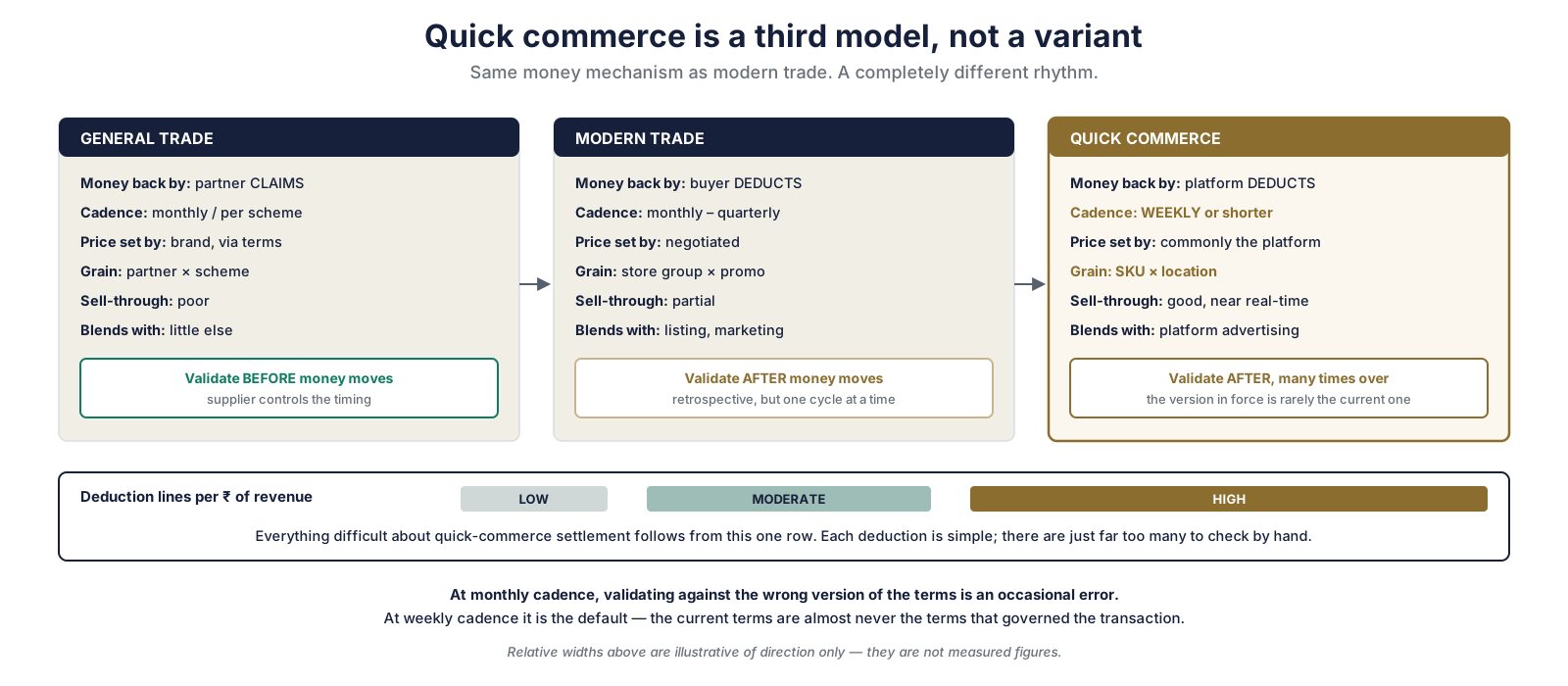
Quick commerce is a third channel model, not a variant of modern trade. The platform typically buys and holds stock like a retailer, but runs promotions on a weekly or shorter cadence at SKU level, and blends trade spend with platform advertising. The deduction volume per rupee of revenue is far higher, so processes built for monthly cycles struggle.
The diagram above is free to reuse with attribution. Throughout, deduction means a customer or trade deduction — an amount withheld from an invoice payment — not a tax-deductible expense. Claims means distributor and channel claims. No platform is named: the dynamics below are structural rather than specific to any one operator, and individual agreements vary widely.
Why it is a third model, not a variant
The useful way to place quick commerce is by asking two questions the general trade versus modern trade distinction already asks: who initiates the money coming back, and on what cadence.
In general trade, a distributor buys, sells onward, and then claims against published scheme terms — typically monthly, on a submission the brand assesses before paying. In modern trade, an organised retailer negotiates terms and then deducts what it believes it is owed, and the supplier validates after the money has moved. That inversion is covered in the customer discount agreement.
Quick commerce shares modern trade's mechanism — an organised buyer deducting rather than claiming — and almost nothing of its rhythm. And the rhythm is what breaks processes.
| General trade | Modern trade | Quick commerce | |
|---|---|---|---|
| Money comes back by | Partner claims | Buyer deducts | Buyer deducts |
| Promotion cadence | Monthly or per scheme period | Monthly to quarterly, per plan | Weekly or shorter |
| Price set by | Brand, via scheme terms | Negotiated, retailer executes | Commonly the platform, within agreed limits |
| Granularity of settlement | Partner and scheme | Store group and promotion | SKU, often by location |
| Sell-through visibility | Poor — needs distributor data | Partial, via the retailer | Usually good, and near real-time |
| Trade spend blends with | Little else | Listing and marketing terms | Platform advertising and visibility placements |
| Deduction lines per ₹ of revenue | Low | Moderate | High |
Read the last row as the operational summary. Everything difficult about quick-commerce settlement follows from it.
The cadence problem
A monthly promotion generates one set of terms to record, one measurement window, and one reconciliation. A weekly promotion generates four of each in the same month — and quick-commerce promotions often run shorter than a week.
This is not a harder problem intellectually. Each individual deduction is usually simple: a promotion ran, a price was funded, an amount was withheld. The difficulty is that there are many, they change constantly, and the terms governing each one were agreed at a different moment.
Three consequences follow.
Scheme terms stop being documents and become data. A process where the terms live in a circular, an email thread or a signed plan works at monthly cadence because a person can hold a month's terms in their head. At weekly cadence across many SKUs, nobody can, and the terms have to be recorded somewhere queryable with effective dates — a point that applies to every channel but becomes unavoidable here.
Version-in-force stops being an edge case. In general trade, validating a claim against the wrong version of a scheme is an occasional error. When terms change weekly, it is the default error, because the current terms are almost never the terms that governed the transaction. The claim lifecycle has always required matching a transaction to the terms in force on its date; quick commerce makes that requirement bite every period.
The threshold habit becomes a real control gap. Facing more deduction lines than can be checked, teams do the sensible thing and check the large ones, accepting everything below a cut-off. As a coping strategy that is defensible. As a control it is weak, because a systematic error — a wrong funding split applied to a whole SKU group, repeated weekly — sits entirely inside the unchecked tail and never trips the threshold. The problem is not that small deductions are wrong; it is that repeated small deductions stop being small.
Where the funding split lives
The single most consequential term in a quick-commerce arrangement is usually the least precisely written: who funds what share of a promotional price.
A platform discount can be funded by the brand, by the platform, or by both in some proportion. Commercially all three are normal. The problem is that the proportion is frequently agreed per promotion, informally, by people under time pressure — and then a deduction arrives asserting a split the supplier does not recognise.
Illustrative: a brand agrees to support a promotional price on a group of SKUs for a week. A deduction arrives for the full difference between list and promotional price on every unit sold in that week. The brand believed the platform was carrying part of the discount as its own customer-acquisition cost. Nothing recorded at the time says otherwise, so there is no basis for adjusting the amount — only a conversation, held weeks later, about a promotion nobody has notes on.
At monthly cadence a supplier might absorb that once and fix the process. At weekly cadence it recurs before the fix lands.
What makes the difference is not a longer agreement but a recorded per-promotion approval: what price, on what SKUs, for what dates, funded in what proportion, approved by whom. That record is what turns a later deduction from an assertion into a check — the same principle as valid versus invalid trade deductions, applied at a frequency that punishes its absence.
Advertising is not trade spend, and both are channel cost
Quick-commerce platforms sell visibility — placement, sponsored positions, category presence — usually contracted and billed separately from price-based promotions.
Two mistakes are common, in opposite directions.
The first is treating platform advertising as ordinary marketing spend, owned by a brand team, invisible to the people who track channel profitability. The channel then appears cheaper than it is, because a real cost of selling through it sits in another budget. This is the same reporting failure described in trade spend management, with a newer label.
The second is folding advertising into trade spend as though it were a scheme. It is not: it buys attention rather than adjusting price, it is generally contracted differently, and its documentation and treatment are not the same. Collapsing the distinction makes the total right and every component wrong.
The workable answer is boring: track them separately, report them together. Keep advertising as its own commitment type with its own evidence, and roll it into a single view of what the channel costs. The distinction between consumer and trade promotions is the closest existing analogue.
Any documentation or tax question arising from how a platform bills for advertising or recovers promotional funding is separate, arrangement-specific, and not addressed here — route those to your own adviser and to the tax checklist.
Returns, expiry and the speed of the cycle
Quick commerce moves stock fast, which helps, and concentrates it in dark stores, which does not always.
The claim-relevant point is that returns and near-expiry stock interact with promotions that have already been settled. A promotion is funded, the deduction is taken, and units later come back or are written off — so the volume the funding was calculated on has changed after the fact. That is clawback logic, and it needs the same treatment it needs anywhere: a rule in the terms rather than an argument afterwards.
What differs is the compression. In general trade there is usually a gap between settlement and returns becoming visible. Here they can overlap, which means a period can be settled and then materially restated. The operational process for expiry and breakage still applies; the tolerance for reconciling it late does not.
Price changes have the same shape: where stock is held at an old price and the platform changes the selling price, the price-protection or rate-difference question arrives faster and more often than in slower channels.
What to get into the agreement
Quick commerce does not need a different kind of agreement. It needs the same terms written with more precision, because the cadence removes the slack that hides imprecision elsewhere. The clause checklist for organised retail is the starting point; these are the terms that matter disproportionately here.
-
The funding split, by promotion type — with a mechanism for recording the split agreed for each individual promotion, not only the default.
-
Pre-approval of promotions — who on your side agrees a promotion before it runs, and what record that agreement leaves. Retrospective approval is not approval.
-
Evidence that a promotion ran — at what price, on what SKUs, over what dates. This is the single term that decides whether a later deduction is checkable.
-
Deducted or invoiced, per amount type — including advertising, which is often the one settled differently from everything else.
-
Returns and expiry treatment against settled promotions — the clawback rule, and the window in which a settled period can be restated.
-
A dispute window with a deadline — both directions. At weekly cadence, aged items accumulate faster than anywhere else, and an unbounded dispute process quietly becomes a write-off process.
-
Data you receive, and in what form — sell-through and promotion-participation data at the grain you need to validate. Good visibility is one of the channel's genuine advantages; it only helps if the format is agreed and stable.
What this means for process
The honest summary is that quick commerce does not introduce a new kind of claims problem. It introduces the existing problem at a frequency and grain that manual processes cannot absorb.
That has a practical implication worth stating plainly: the channel is often taken on by the same team, with the same spreadsheet, that handles general and modern trade — because it starts small. The volume then grows faster than the process, and the first signal is usually not a visible failure but a quiet shift to threshold-based acceptance.
RebateLedger holds promotion and scheme terms with effective dates and versions, and matches deductions against the terms in force when the underlying transactions happened — which is the mechanism that makes weekly-cadence validation tractable rather than heroic.
If you are taking on a quick-commerce account, book a demo and bring one month of real deduction lines.
General information. This article describes structural dynamics in the quick-commerce channel and how they differ from general and modern trade. It names no platform, quotes no figures, and takes no position on tax or on the terms of any specific arrangement — those depend on your own agreement and should be confirmed with your own advisers.
Read next
- General trade vs modern trade — the two models quick commerce sits alongside.
- The customer discount agreement — the clause checklist this channel needs written more tightly.
- Valid vs invalid trade deductions — the test each deduction has to survive.
- Trade spend management — where platform advertising belongs in the channel-cost picture.
- India's multi-tier channel claim map — how the routes to market fit together.
Quick commerce adds a third set of terms to budget for, on top of general and modern trade. Comparing what each channel actually costs to serve requires a system that holds trade spend across all of them.
Frequently asked questions
Is quick commerce the same as modern trade?
No. Both involve an organised buyer that deducts from payment rather than claiming, so the money mechanism is similar. But quick commerce runs promotions at a weekly or shorter cadence, prices dynamically at SKU level, and mixes trade spend with platform advertising billed separately. The reconciliation problem is a different size and shape.
How are quick-commerce deductions different?
Mostly in volume and granularity. The same rupee of revenue generates far more deduction lines, because promotions change weekly rather than monthly and are applied per SKU and sometimes per location. A process that reconciles a monthly deduction statement by hand does not scale to that, even when each individual deduction is straightforward.
Who sets the selling price in quick commerce?
Commonly the platform, within whatever the agreement allows. That matters for claims because a discount funded partly by the platform and partly by the brand has to be split, and the split depends on what was agreed for that specific promotion. Where the agreement is silent on the split, the deduction becomes a negotiation.
Should platform advertising be treated as trade spend?
Track it separately but report it together. Advertising or visibility spend on a platform is commercially distinct from a price-based scheme, and often contracted and invoiced differently. But if it is excluded from the channel-cost view, the total cost of that channel is understated — which is how quick commerce ends up looking cheaper than it is.
What should a quick-commerce agreement specify?
The funding split for each promotion type, who approves a promotion before it runs, what evidence establishes that it ran and at what price, whether amounts are deducted or invoiced, the treatment of returns and near-expiry stock, and a dispute window with a deadline. The cadence makes an unstated term expensive quickly.
Why does reconciliation break in quick commerce?
Because the volume of small deductions exceeds what a manual process can check, so teams accept below a threshold and check only large items. That is a reasonable coping strategy and a poor control: the unchecked tail is where systematic errors hide, and a small error repeated weekly across many SKUs is not small.
Does quick commerce need different claims software?
Not different software — the same calculation, run at a higher frequency and finer grain. What matters is whether the system can hold promotion terms that change weekly, match deductions at SKU level, and reconcile without a person touching each line. Those are volume and configurability questions rather than new features.
See RebateLedger on your own claims data
A 30-minute walkthrough tailored to how your channel actually settles claims.