
The Tax Checklist for Dealer and Distributor Incentive Programmes
A dealer incentive programme raises GST and withholding questions across several provisions. A checklist of what to ask, and where each answer lives.
In short
A dealer incentive programme raises questions under several different provisions at once — how the payout affects the value of the underlying supply, what document settles it, whether input tax credit is affected, and what withholding applies. The answers depend on how the arrangement is structured, so the practical task is knowing which questions to ask.
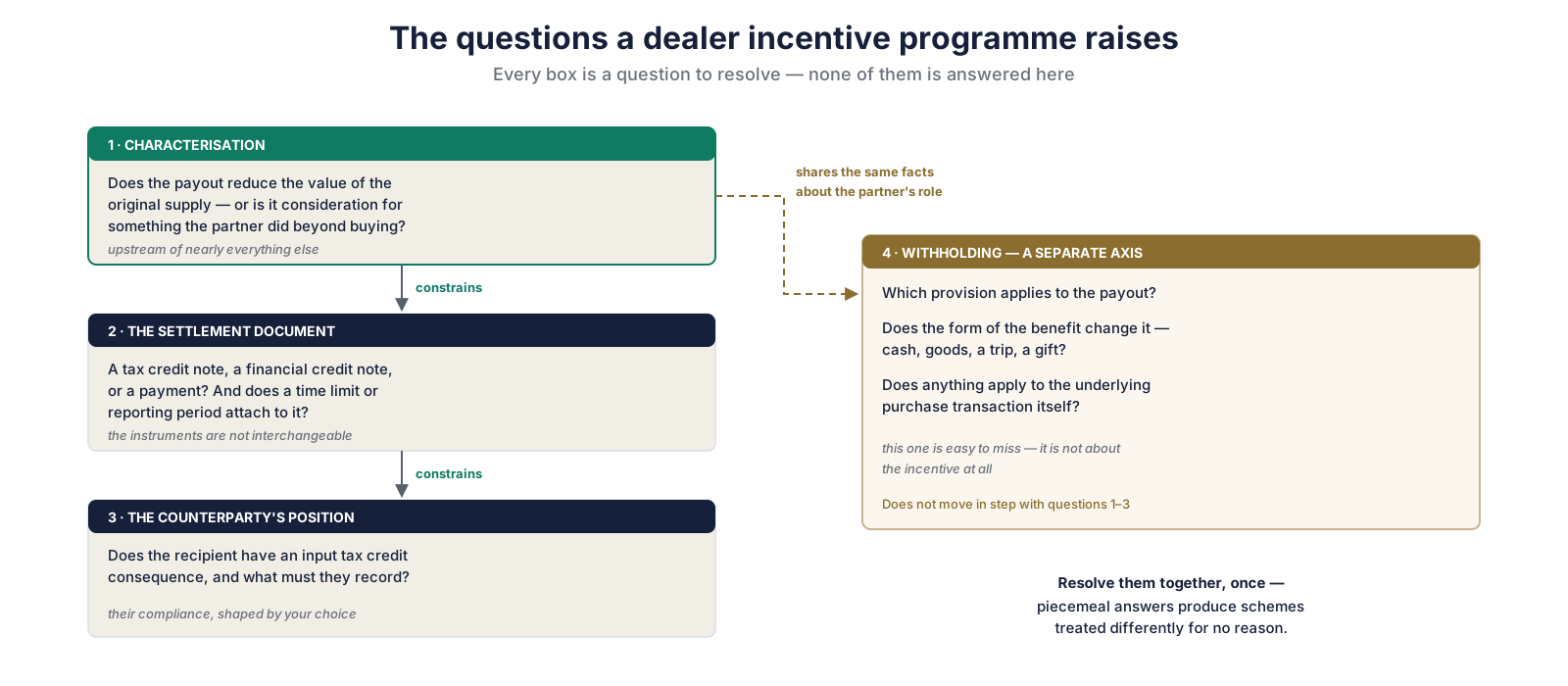
A dealer incentive programme raises questions under several different provisions at once — how the payout affects the value of the underlying supply, what document settles it, whether input tax credit is affected, and what withholding applies. The answers depend on how the arrangement is structured, so the practical task is knowing which questions to ask.
This article is a map, not an answer. It lays out which questions arise and where each is discussed — on this site, and with your own adviser. It deliberately resolves none of them. Throughout, incentive means a dealer, distributor or trade incentive, not a government production-linked incentive, and rebate means a trade or channel rebate.
The checklist
Fourteen questions. Each is a question your programme has to answer; none of them is answered here.
| Question to resolve | Why it arises | Where it is discussed |
|---|---|---|
| Does the payout reduce the value of the original supply, or is it something else? | The characterisation drives almost everything downstream | Section 15(3)(b) · Circular 251 |
| Which settlement document will be used — a tax credit note, a financial credit note, or a payment? | Different documents carry different consequences for both sides | Financial vs tax credit notes |
| Is there a time limit on the settlement document, and does the period matter? | Timing questions attach to the document, not the entitlement | Credit-note time limits |
| Does the counterparty have an input tax credit consequence? | The recipient's position can be affected by how you settle | ITC reversal on post-sale discounts |
| Is the payout consideration for anything the partner did, beyond buying? | This is the pivot between two very different characterisations | Target-based incentives · Distributor marketing costs |
| Does any withholding provision apply to the payout, and which? | Several provisions can be engaged depending on the partner's role | Section 194R · Discount or commission |
| Does the form of the benefit change the answer — cash, goods, a trip, a gift? | Form is not always neutral to treatment | Section 194R |
| Does anything apply to the underlying purchase transaction itself, separately from the incentive? | A purchase-side obligation can exist independently of the incentive | 194R vs 194Q vs 194H |
| What documentation should exist before the programme starts? | Several characterisations depend on what was agreed in advance | Supplier rebate agreements |
| How will the treatment be evidenced at settlement? | A position you cannot evidence is a position you may not keep | Reconciling scheme credit notes |
| Is the payout calculated on a tax-inclusive or a tax-exclusive base? | The same rate on two different bases pays two different amounts | Tax-inclusive vs exclusive rebate base |
| What happens when goods are returned after the payout was settled? | The entitlement and the settlement can move apart after the fact | Returns, reversals and cancellations |
| What applies when goods are supplied free or as bonus quantity? | Free supply raises a different set of questions from a payout | GST on free goods and BOGO schemes |
| What applies when stock is destroyed rather than returned? | Destruction and return are not the same event for either side | Credit notes for expired and damaged goods |
The fourteen questions in detail
1. Does the payout reduce the value of the original supply?
Every incentive payout has a relationship to the goods that were already sold. The first question is what that relationship is: whether the payout is best understood as reducing what was charged for those goods, or as something separate from them.
This matters because it is upstream of nearly every other question on this list. The document you use, the period you use it in, and what your counterparty records all follow from it.
The provision dealing with discounts and taxable value is discussed in Section 15(3)(b) and post-supply discounts, and the clarification most often referenced alongside it in Circular 251. Both set out the conditions the question turns on. Whether your arrangement satisfies them is a facts question that belongs with your chartered accountant.
2. Which settlement document will be used?
An entitlement is not a document. Once you have decided a dealer has earned something, you still have to choose the instrument that settles it — and the available instruments are not interchangeable.
The distinction between a tax credit note and a financial credit note, and what each implies for both parties, is covered in financial versus tax credit notes. A payment is a third route again.
The question to resolve is which instrument your programme will use, decided in advance and applied consistently rather than chosen scheme by scheme. This article states no position on which is appropriate for any arrangement.
3. Is there a time limit, and does the period matter?
Timing questions in this area tend to attach to the settlement document rather than to the underlying entitlement — which means a delay between earning and settling can raise questions that the entitlement itself does not.
That is worth knowing at design time, because scheme periods and settlement cycles are set by commercial teams who may not know a timing question exists. A scheme that measures over one period and settles well into another is making a choice with consequences.
The time-limit and reporting-period questions are discussed in credit-note time limits and reporting. This article states no limit, deadline or period.
4. Does the counterparty have an input tax credit consequence?
How you settle an incentive can affect what the receiving party has to do at their end. This is the question most often missed at design time, because it concerns someone else's compliance rather than your own.
It matters commercially as well as technically: a settlement route that creates an obligation for your dealer is a route your dealer may resist, and that resistance usually arrives after the scheme has been announced.
The question is discussed in ITC reversal on post-sale discounts, with a related timing question in Rule 37 and the 180-day reversal. This article states no outcome for any party.
5. Is the payout consideration for something the partner did?
This is the pivot of the whole checklist. A payout given because a dealer bought a quantity of goods invites one description. A payout given because a dealer performed an activity — displayed, promoted, serviced, committed — invites another.
The difficulty is that real schemes frequently contain both, sometimes in the same clause, and the scheme circular is often the clearest evidence of which was intended. That makes scheme wording a tax-relevant document rather than purely a commercial one.
The question is examined in target-based incentives and GST and, where the partner bears promotional cost, in distributor marketing costs and GST consideration. Both describe what bears on the question. Neither resolves it for your arrangement, and nor does this article.
6. Does any withholding provision apply, and which?
Withholding is a separate axis from the GST question, and the two do not necessarily move together. A single payout can raise a question under one regime and a different question, with a different answer, under the other.
Which provision is engaged depends substantially on the partner's role — whether they buy on their own account or act on your behalf — rather than on what the payout is called.
The provisions and how they are distinguished are set out in Section 194R on dealer and distributor incentives and in the discount-or-commission test. Note also that the section numbering changes from 1 April 2026, covered in Section 194H becomes Section 393. This article states no rate, threshold or applicability test.
7. Does the form of the benefit change the answer?
Programmes reach for non-cash rewards — goods, gifts, travel, event access — because they motivate differently from a credit note. The question to resolve is whether the choice of form changes anything about the treatment.
It is worth asking before the reward is announced rather than after, because the form is the hardest element to change once dealers have been told what they are competing for.
The question is discussed in the Section 194R material, which deals with benefits and perquisites arising out of business. This article expresses no view on any form of benefit.
8. Does anything apply to the underlying purchase transaction itself?
This question is easy to miss because it is not about the incentive at all. Separately from any question about a payout, obligations can attach to the underlying purchase transaction between the parties — and those exist whether or not an incentive scheme is running.
It belongs on this checklist precisely because it is adjacent: a finance team reviewing an incentive programme is looking at the payout, and can reasonably conclude it has covered the transaction when it has only covered one side of it.
The relationship between the purchase-side and payout-side provisions is set out in the 194R vs 194Q vs 194H comparison. Confirm which apply to your own transactions with your chartered accountant.
9. What documentation should exist before the programme starts?
Several of the questions above turn on what was agreed in advance. That makes documentation not merely good practice but part of the factual picture any adviser or reviewer will read.
The practical question is which documents your programme will create, and when — before launch, or reconstructed afterwards from correspondence.
What a scheme agreement needs to contain is covered in supplier rebate agreements, and the same discipline on the organised-retail side in the customer discount agreement. Agree the document set with your adviser when the programme is designed.
10. How will the treatment be evidenced at settlement?
The last question is operational. A position decided correctly at design time still has to be visible in the records months later, across many partners and periods, to whoever asks.
This is where programmes that made good decisions still struggle: the decision was taken in a meeting, applied by one person, and never recorded in a form that survives their absence.
The reconciliation side is discussed in reconciling scheme credit notes, and the record-keeping side in rebate accounting and GST credit notes.
11. Is the payout calculated on a tax-inclusive or a tax-exclusive base?
A payout expressed as a percentage needs a stated base, and the base is not self-evident. The same rate applied to the taxable value and to the tax-inclusive value produces two different amounts on the same transaction.
This is a drafting question before it is a tax question — most schemes that get this wrong did not choose the wrong base, they simply never stated one, and each side then computed the base that suited it.
The question is worked through in tax-inclusive vs exclusive pricing and the rebate base. Which base is appropriate for your arrangement is a matter to settle with your adviser and then write into the scheme document.
12. What happens when goods are returned after the payout was settled?
Entitlement is measured on transactions that can subsequently be undone. Goods come back, invoices are cancelled, and a payout already settled may relate in part to sales that no longer exist.
The questions this raises are whether the entitlement is recomputed, what document reflects the change, and which period each side records it in. None of them is answered here, and all of them are easier to resolve if the scheme document said in advance how returns would be treated.
The operational side is covered in returns, reversals and cancellations on channel claims, and the clawback mechanics in rebate clawbacks and scheme cancellations.
13. What applies when goods are supplied free or as bonus quantity?
Many schemes pay in goods rather than money — bonus quantity, a free case with every ten, or promotional stock supplied alongside an order. A free supply is a different event from a payout, and it raises its own questions rather than inheriting the answers from the cash case.
Whether your scheme is structured as a discount on a larger quantity or as a free supply alongside a normal one is a design decision with consequences, and it is worth taking deliberately rather than discovering at assessment which one your paperwork describes.
The questions are set out in GST on free goods and BOGO schemes and the commercial structuring in free goods and scheme goods explained.
14. What applies when stock is destroyed rather than returned?
Expired, damaged or unsaleable stock is often destroyed rather than sent back up the channel, and the two routes are not the same event for either party. Destruction produces no return of goods, so what it produces instead — and what evidence it needs — is a separate question from the returns case above.
This matters most in pharma, agri inputs and food, where destruction is routine and the evidence requirements are specific.
The document side is covered in credit notes for expired and damaged goods and the process side in expiry, breakage and returns as an operational process.
Why these questions interact
These are not ten independent questions with ten independent answers. They form a chain, and that is why resolving them piecemeal causes trouble.
The characterisation of a payout influences which document is appropriate to settle it. The document influences what your counterparty has to record. What the counterparty records influences what evidence exists on both sides. And the withholding question, while on a separate axis, turns on some of the same facts about the partner's role that the characterisation question turns on.
The practical consequence is that an answer adopted for one scheme carries implications for the others. Where different schemes in the same programme were designed by different people at different times, the result is often inconsistent treatment across schemes that are commercially identical — which is difficult to explain later precisely because there is no principle behind the difference.
This is also why the sequence matters. Question five — whether the payout is consideration for something the partner did — sits upstream of most of the others. A programme that answers it late finds that several downstream decisions were already made implicitly, by whatever the settlement process happened to do.
None of which tells you what any answer should be. It tells you that the answers should be decided together, once, and applied consistently.
When to involve your CA
Four moments are worth the call.
Before the programme launches. The characterisation questions turn substantially on what was agreed in advance and how it was recorded. Advice taken at design time can shape those facts; advice taken at settlement can only describe them.
When a scheme's structure changes. Adding a performance condition, changing what the partner must do, or moving from a purchase-based to an activity-based trigger can move a scheme across the pivot in question five, even when the payout amount is unchanged.
When a payout takes a new form. A programme that has always settled by credit note and now wants to award goods or travel has changed something relevant.
When a notice or query is received. This is the point at which general material stops being useful and specific advice becomes necessary.
This article cannot substitute for advice on a specific arrangement, and it is not intended to. Its purpose is to make sure the conversation you have covers everything it should.
What to bring to that conversation
The quality of the answer depends heavily on what you put in front of the person answering. In rough order of usefulness:
-
The scheme circular or agreement — the actual document issued to partners, not a summary. Its wording is often the most important single input.
-
What the partner is required to do — stated plainly. Purchase a quantity, and nothing else? Or purchase and display, promote, report, or maintain something? This is the input to question five.
-
How the payout is calculated — the basis, the rate structure, and what the rate applies to.
-
How it will be settled — the instrument, and whether it is netted against amounts owed or paid separately.
-
How both sides will record it — yours and the partner's, because several questions concern the counterparty's position rather than yours.
-
The periods involved — when the entitlement is earned, when it is measured, and when it is settled. Where these differ, say so explicitly.
-
The form of the benefit — particularly if it is anything other than money.
Agreement terms held with effective dates and versions make items 1, 3 and 6 straightforward to produce for any period, rather than an exercise in reconstruction. Book a demo to see how that works in practice.
General information, not tax advice. This article is a navigation aid. It sets out which questions a dealer or distributor incentive programme raises and where each is discussed — it states no position on any of them, and deliberately contains no rate, threshold, time limit or treatment. The answers depend on the facts of a specific arrangement and on current law. Confirm every question on this checklist with a qualified chartered accountant or cost accountant before relying on any position.
Read next
- CBIC Circular 251 on post-sale discounts — the clarification most often referenced in this area.
- Section 194R on dealer and distributor incentives — the withholding side, including how the provisions divide.
- Financial vs tax credit notes under GST — the settlement-document question.
- Supplier rebate agreements — what to document before the programme starts.
- GST on trade discounts and dealer incentives — the wider GST picture for channel payouts.
Every item on this checklist assumes you can say precisely what each dealer earned and why. Programmes run from spreadsheets rarely can, which is the practical argument for managing incentive agreements in dedicated software. Which of those questions apply depends on the programme type — see the range of channel incentives.
Frequently asked questions
What tax questions does a dealer incentive programme raise?
Four clusters. How the payout is characterised against the original supply; which document settles it and within what period; whether the counterparty has an input tax credit consequence; and whether any withholding provision applies to the payout or to the underlying purchase. Each depends on how your arrangement is structured, so each belongs with your own chartered accountant.
Does a dealer incentive attract GST?
That depends on characterisation, which is exactly the question to resolve rather than assume. A payout treated as an adjustment to the price of goods already supplied raises different questions from one treated as consideration for something the dealer did. The arrangement between the parties determines which description fits, so confirm it with your chartered accountant.
Which TDS provision applies to a dealer incentive?
More than one can be in play depending on the dealer's role and the form the benefit takes, and a separate question can arise on the underlying purchase transaction rather than the incentive. Which provision applies is a facts question. The provisions and their interaction are set out in the withholding articles linked from this checklist.
Does the form of an incentive change its tax treatment?
It can, which is why the form is worth deciding deliberately rather than discovering later. Cash, free goods, a gift and a trip are not automatically treated alike, and the choice can change which provision is engaged. The question is covered in the Section 194R material; confirm the position for your programme with your chartered accountant.
When should tax treatment be decided?
Before the programme launches. The characterisation of a payout often depends on what was agreed in advance and how it was documented, so decisions taken at design time are easier to evidence than decisions reconstructed at settlement. Deciding late does not simply delay the question — it can narrow the options available for answering it.
What documents support the tax treatment of an incentive?
Typically the scheme circular or agreement, the record of what the partner was required to do, the calculation of the payout, the settlement document, and the records both sides made. Which of these matters most depends on the characterisation question, so agree the document set with your chartered accountant when the programme is designed.
See RebateLedger on your own claims data
A 30-minute walkthrough tailored to how your channel actually settles claims.