
What Is a Billback? Meaning, Process and Accounting
Billback meaning in plain English — how billbacks work, how they are accounted for, billback vs chargeback vs deduction, and a worked example.
In short
A billback is a post-sale charge where one trading partner bills the other back for an agreed amount after the sale — typically a distributor billing a supplier for the difference between its into-stock price and a lower contracted customer price, or for promotional allowances it has earned.
A billback is a post-sale charge where one trading partner bills the other back for an agreed amount after the sale. Typically that means a distributor billing a supplier for the difference between its into-stock price and a lower contracted customer price — or for promotional allowances it has earned. Billbacks, in the plural, are simply many of these raised together across a period, which is how most distributors actually submit them.
That is the whole billback definition; everything else is mechanics. The billback meaning does not change if you write it as two words — the bill back meaning is identical, and if you searched what is a bill back, the answer is the same post-sale recovery described above. The term is sometimes misspelled as billsback.
Which billback you are looking for
"Billback" means three unrelated things depending on the industry, and only one of them is covered here.
- Distribution and manufacturing — this page. A trading partner bills a supplier back for a price difference or an earned allowance after the sale has been invoiced.
- Hospitality. Charges routed to a master account so they can be billed later to a group, a company or a travel agency, rather than settled by the guest at checkout. Nothing on this page applies.
- Healthcare. Re-billing a payer, facility or practice for product that has already been administered or dispensed. Also unrelated to the mechanic below.
If you came here for the hospitality or healthcare sense, this is the wrong page and the rest of it will not help. Everything that follows is the distribution meaning: a trade claim between two businesses in a supply channel — a supplier and its distributor or dealer — not an insurance claim and not a card-payment dispute.
For how billbacks sit against chargebacks, deductions and rebates as a family, the master comparison is our billbacks vs chargebacks vs deductions glossary — this page goes deep on the billback side alone.
How billbacks work
The billback cycle has five steps, and every one of them leaves paper.
- Sell at the agreed lower price. A supplier and a distributor agree that a specific customer, promotion or period gets a price below the distributor's normal buying price. The distributor honours that price on its own invoice, taking the hit up front.
- Calculate the entitlement. After the sales happen, the distributor works out what it is owed — the price gap times the quantity sold under the agreement, or the promotional allowance earned.
- Submit the billback claim with proof. Sales invoices, dispatch records or a sales register go in alongside the claim, so the supplier can see which units actually moved at the deviated price.
- The supplier validates. The claim is checked against the agreement — right customer, right products, right period, right price — and against the volumes claimed.
- Settle by credit note or payment. The approved amount comes back to the distributor, most commonly as a credit note against future purchases.
Two things about this cycle are worth pausing on. First, the distributor carries the cost between step 1 and step 5 — it has already given the customer the lower price, so a slow or disputed billback is working capital stuck on its balance sheet. Second, the proof in step 3 is what makes step 4 possible: a billback claim without sell-through evidence is just an assertion, and suppliers are entitled to reject it. Most billback disputes trace back to one of those two points — settlement that dragged, or documentation that was thinner than the agreement required.
The term comes from foodservice distribution in the United States, where distributors routinely bought at list, sold to restaurant chains at contracted prices, and billed manufacturers back for the difference — hence the name. Whatever the label, the defining features hold — the partner initiates, the supplier pays, and the sale has already happened.
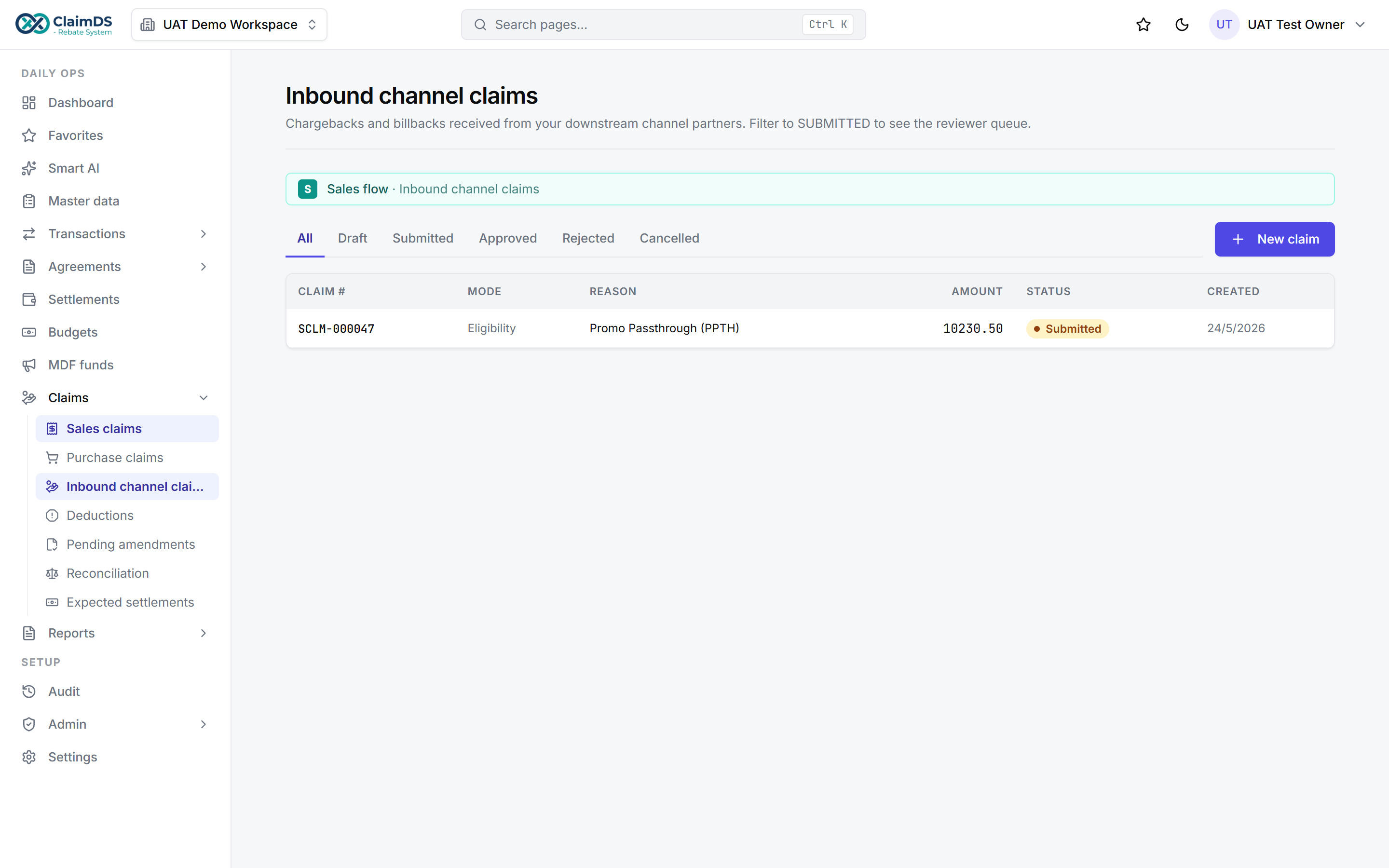
In practice, billbacks and chargebacks arrive as inbound channel claims that need validating against the agreement before settlement:
What the billback amount is calculated on
The billback basis is what the amount is worked out from, and it is the field that decides whether a claim settles quietly or turns into an argument. Three bases cover almost everything in practice.
- Price gap × qualifying quantity. The authorised price minus the price actually paid, multiplied by the units that qualify. This is the classic distribution billback and the one in the worked example below.
- Fixed amount per unit. A flat allowance per case, carton or unit sold under a promotion, regardless of the price either party paid.
- Percentage of invoice value. A share of the qualifying invoiced amount, most common where the support is promotional rather than price-related.
The arithmetic is trivial. The disputes are never about the arithmetic — they are about which units qualify. An agreement that says "the basis is the price difference" without defining the qualifying quantity leaves four questions open: does it count units purchased or units sold, does it count on invoice date or dispatch date, do returns reduce it, and do units sold outside the authorised customer or channel count at all. Every one of those has been the subject of a real billback dispute, and every one is cheap to settle in writing before the period starts and expensive to settle afterwards.
Write the basis into the agreement as a sentence a stranger could compute from. If you cannot hand the clause to someone who has never seen the deal and have them arrive at the same number you would, it is not specific enough yet.
Billback pricing explained
Billback pricing rests on two numbers. The into-stock price (list price) is what the distributor actually pays the supplier when goods land in its warehouse. The contract price — also called a deviated price — is the lower price the supplier has agreed for a specific customer or deal. The distributor buys at the first number, sells at the second, and bills back the gap:
Billback amount = (into-stock price − contract price) × quantity sold under the contract
The obvious question is why suppliers bother. Why not just lower the list price? Because billback pricing gives the supplier visibility and control over deviated pricing. A blanket list-price cut applies to every unit, every customer, forever — and is very hard to raise back. A billback funds the lower price only for the agreed customer, only for units the distributor can prove it sold there, and only for the agreed window. The supplier sees exactly where its price support went, customer by customer, and can end it by letting the agreement lapse. It is the same logic that makes price protection a claim rather than a reprice — fund the exception, protect the list.
There is an accounting benefit on the supplier side too. Under billback pricing, deviated-price support shows up as a measurable trade-spend line — so a finance team can see what each contract, customer or promotion actually cost — instead of disappearing invisibly into a lower average selling price. That visibility is exactly what makes trade spend controllable rather than merely observable.
A billback customer is simply a customer whose pricing works this way: they buy at the standard price and an agreed difference is recovered afterwards, rather than the discount appearing on the invoice itself. The arrangement is worth naming because it changes what has to be agreed before the first order — covered in vendor billback vs rebate.
Worked example
A distributor buys 1,000 units at an into-stock price of 500 per unit. The supplier has agreed price support on an institutional deal that brings the distributor's effective cost down to 460 for those units. Figures are illustrative and in a single currency.
| Item | Value |
|---|---|
| Quantity purchased | 1,000 units |
| Into-stock price | 500 per unit |
| Effective contracted cost | 460 per unit |
| Price gap | 40 per unit |
| Billback claim | 40 × 1,000 = 40,000 |
The distributor sells the units on the institutional deal, then raises a billback claim for 40,000 with its sales invoices attached. The claim is Submitted; the supplier checks it against the agreement and the quantities and marks it Validated; a reviewer signs off and it moves to Approved; and finally a credit note for 40,000 is issued against the distributor's account, at which point the claim is Settled. That Submitted → Validated → Approved → Settled path is the standard lifecycle any claims management software tracks — the billback is simply one claim type flowing through it.
Note what validation can do to the number. If the distributor's sales register only evidences 900 units sold on the institutional deal, the supplier approves 36,000, not 40,000 — a partial approval with a documented short-pay reason. That per-line adjustment, agreed and recorded rather than silently netted, is the difference between a clean billback process and a dispute.
Warehouse and purchase billbacks
Not every billback behaves the same way, and the biggest structural split is whether the goods passed through the claiming party's warehouse before they were sold.
Direct-ship billbacks
In a direct-ship arrangement the goods move from the supplier straight to the end customer, and the distributor never physically holds them. The purchase and the sale are effectively the same event, so the qualifying quantity is unambiguous: the units on that shipment, at that price, on that date. Reconciliation is a two-document exercise — the purchase and the sale — and the claim can usually be raised the same week.
The price risk in a direct-ship deal sits mostly with the supplier. Because the sale is known at the moment of purchase, the distributor is not carrying stock bought at one price and exposed to a later price change. If the supplier's price moves, it moves on the next shipment, not on inventory already sitting somewhere.
Warehouse billbacks — into-stock pricing
A warehouse billback on a purchase is the harder case, and it is the one people search for. The distributor buys stock into its own warehouse at the into-stock price, holds it for days or months, and only later sells some of it under an agreement priced differently. The billback is claimed on the units actually sold under that agreement, not on the units bought.
That gap between purchase and sale is what makes the claim difficult:
- The claim reconciles against inventory movement, not purchases. You bought 5,000 units; you sold 1,200 under the authorised agreement this month. The billback is on the 1,200, and proving that number means proving stock movement, not just showing a purchase order.
- The same physical stock may have been bought at several prices. If into-stock prices changed during the holding period, which purchase price applies to the units you just sold? The agreement has to pick a convention and stick to it.
- The claim can outlive the agreement. Stock bought under one agreement may still be selling after that agreement has lapsed or been replaced. Whether it still qualifies is a term, not a fact, and it should be written down.
- Returns unwind it. A return after the billback has been claimed reduces the qualifying quantity, which means a credit back to the supplier or an adjustment on the next claim.
The price risk in a warehouse arrangement sits with the distributor, and that is the substantive difference. Between buying into stock and selling it, the distributor owns goods bought at a known price with no certainty about the price they will fetch. If the supplier drops list prices during the holding period, the distributor is holding expensive stock in a cheaper market — which is precisely why warehouse arrangements are usually paired with a price protection clause. Price protection covers the drop in value of stock on hand; the billback covers the gap on units actually sold under a specific deal. They are different instruments answering different risks, and a distributor with warehouse stock generally needs both.
Billback vs chargeback vs deduction
Billback vs chargeback is the comparison people actually search for, and the difference is direction — who initiates, and which way the money moves.
| Billback | Chargeback | Deduction | |
|---|---|---|---|
| Who initiates | The partner (distributor/dealer) | The supplier | Either side — the payer nets it |
| Direction of money | Supplier → partner | Partner → supplier (recovery) | Reduces a payment being made |
| Typical trigger | Contracted price gap or earned allowance | Scheme the supplier funded, price difference, damage | Any claimed amount withheld from a remittance |
| How it settles | Credit note or payment | Netted off or via credit note | Netted at payment, reconciled later |
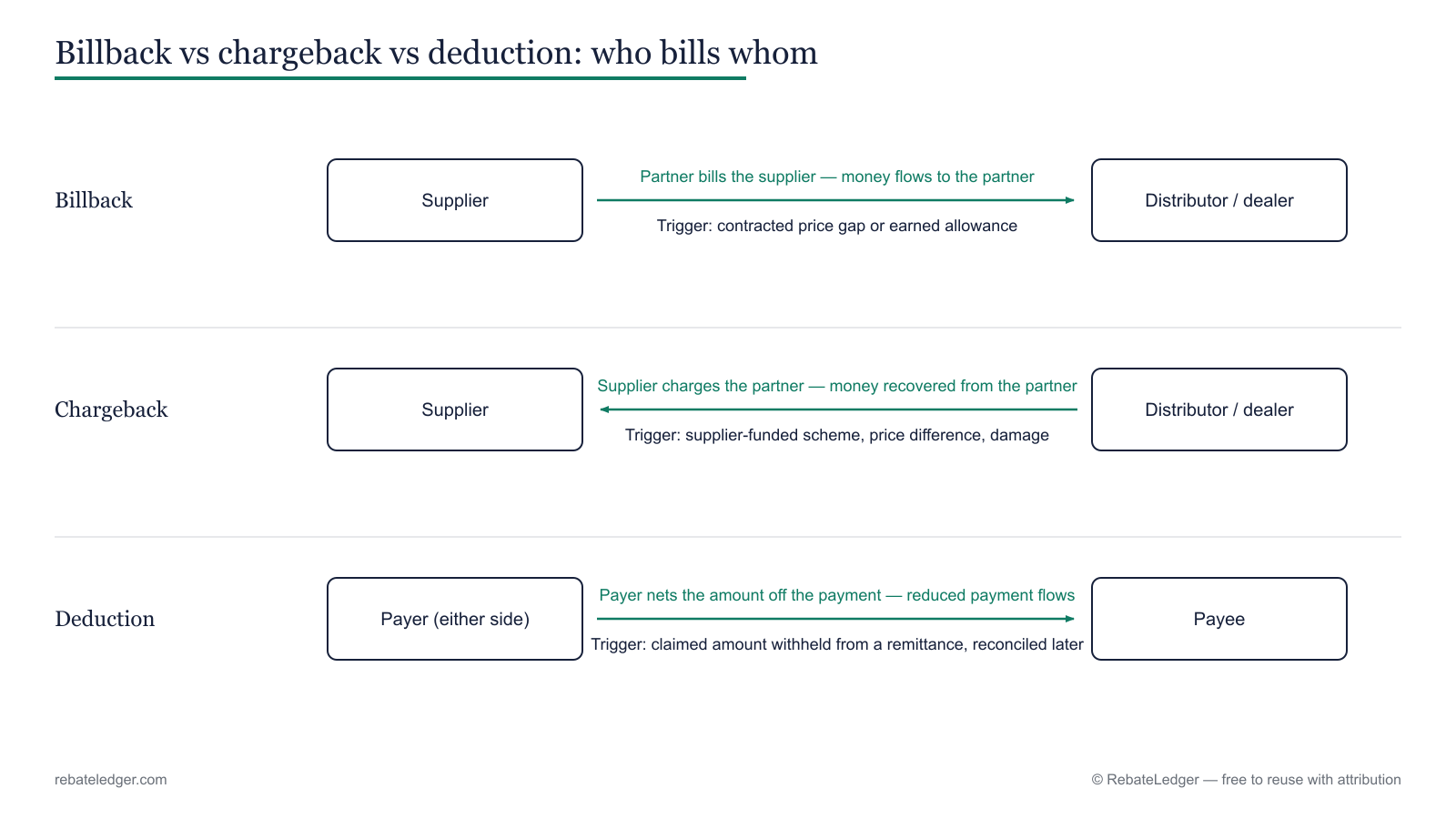
Source: RebateLedger — this diagram is free to reuse with a link back to this article.
One warning about that table before you use it: "chargeback" is used in opposite directions in different markets. The table above reflects Indian channel usage, where a chargeback is the supplier recovering from the partner. In US distribution — particularly pharmaceutical wholesaling and foodservice — a chargeback runs the other way: the distributor claims it from the manufacturer against a specific authorisation to supply a named end customer at a contracted price. Same word, opposite payer. Which sense applies to you is a question about your market, and billback vs chargeback works through both.
In the Indian sense used in the table, a billback pulls money from the supplier; a chargeback recovers money for the supplier — the chargeback process is effectively this page run in reverse. A deduction is the bluntest of the three: an amount simply netted from a payment, with the paperwork sorted out afterwards, which is why it lives in deduction management on the receivables side and why teams invest in deduction management best practices to stop unresolved deductions ageing.
Note the vocabulary carefully here, because it trips people up: an amount billed back or back billed simply means it was recovered after the original invoice rather than netted on it. That is a statement about timing and mechanism, not about who was right.
Billback vs every neighbouring term
The three-way table above covers the comparison people search for most. This one is wider: every term a billback is routinely confused with, including the two that are not channel claims at all.
| Term | What it is | Direction the money moves | When it is used | How it differs from a billback |
|---|---|---|---|---|
| Billback | A post-sale claim for an agreed price difference or an earned allowance | Supplier → partner | After the sale, once entitlement can be evidenced | — |
| Rebate | A reward earned by meeting a condition over a period | Supplier → partner | After a measurement period closes | Earned by hitting a target; a billback reimburses a concession already given |
| Chargeback (distribution) | A supplier recovering an amount from a partner | Partner → supplier | When the supplier has a claim against the partner | Runs the opposite way — and note the market difference described above |
| Chargeback (card payment) | A cardholder's bank reversing a card transaction | Merchant → cardholder | On a disputed or fraudulent card payment | Not a channel claim at all — a consumer payments mechanism that shares the word |
| Deduction | An amount withheld from a payment unilaterally | Reduces a payment being made | When the payer decides not to pay in full | Taken without asking; a billback is claimed and validated before it is paid |
| Allowance | An agreed contribution toward a partner's activity or cost | Supplier → partner | Promotions, listings, display, damage support | A funding commitment; the billback is often the mechanism used to claim it |
| Credit note | The document that settles a claim | Reduces what the partner owes | At settlement of almost any of the above | An instrument rather than a claim type — it settles a billback rather than being one |
| Price protection | Compensation for a list-price drop on stock already held | Supplier → partner | When the supplier cuts price and the partner is holding stock | Triggered by a price change on held stock, not by a sale at an agreed lower price |
Two rows in that table are worth pausing on. The card-payment chargeback shares nothing with the distribution sense beyond the word, and it is by far the more common meaning in general search — if you arrived here from a payments context, none of this page applies. And the credit note row is a category difference rather than a distinction: a credit note is how a billback gets settled, so "billback or credit note?" is not a real choice. Which type of credit note settles it is a real question, covered in financial vs tax credit notes under GST.
A billback allowance is simply an allowance settled through the billback mechanism rather than deducted on the invoice — the allowance is the money, the billback is the route it travels. And a billback clause in a supply agreement is the paragraph that makes all of this computable: which two prices, which units, which window, what evidence, and by when the claim must be raised. Agreements that omit it do not avoid billbacks; they just settle them by negotiation.
The billback lifecycle, and where it stalls
A billback is not settled or unsettled — it moves through states, and knowing which state a claim is stuck in is most of the work of managing them.
| State | What it means | What unblocks it |
|---|---|---|
| Raised | Submitted by the claiming party | Nothing yet — the clock starts here |
| Awaiting evidence | Submitted without the required proof | The underlying invoices or sell-through data |
| Under validation | Being checked against agreement and volumes | Reviewer capacity, and agreement data being findable |
| Disputed | Validation found a mismatch | A decision on the mismatch, not more documents |
| Approved | Accepted, not yet paid | The settlement run |
| Settled | Credit note issued or payment made | — |
A pending billback is any claim sitting in one of the middle four states. The single most useful report in billback management is that population aged by state: it tells you immediately whether your problem is submission quality (a pile in awaiting evidence), review capacity (a pile in under validation), commercial disagreement (a pile in disputed), or simply a settlement run that is not happening (a pile in approved). Those four problems have four different fixes, and teams routinely apply the wrong one because they only track a single unsettled total.
A pending billback that ages far enough often stops being a billback at all. The claiming party gets tired of waiting and takes the money instead, short-paying the next invoice — at which point the same entitlement arrives as a deduction, with none of the documentation that made it assessable. That conversion is covered in billback deduction vs markdown allowance.
The billback invoice
A billback invoice is the document that carries the claim. It is not a normal sales invoice — its job is to make the amount verifiable by someone who was not party to the deal. At minimum it should carry the agreement or authorisation reference, the period covered, the underlying sales invoice references, quantities, the basis and rate applied, the gross amount, and the tax treatment.
Missing references are the single most common reason a billback sits unpaid, and the reason is mundane rather than adversarial: the person validating the claim cannot find what it relates to, so it goes to the bottom of the pile. Vendor billback vs rebate works through the invoice field by field, including what happens when each one is missing.
Billbacks in multi-tier channels
The same mechanic runs constantly in multi-tier distribution — a manufacturer selling to distributors who sell to dealers or retailers — but it usually answers to other names. Rate-difference claims, where a distributor recovers the gap between the billed price and a revised or agreed price, are billbacks by another name. Price support on institutional deals works exactly like the worked example above, with a distributor honouring a negotiated price for a hospital, canteen or modern-trade account and billing the brand back. And scheme-linked support — where a trade scheme promises a per-unit payout the distributor claims after selling — follows the same submit-validate-settle path, with the documentation discipline of a scheme settlement playbook behind it.
The vocabulary shifts by industry — pharma stockists talk rate difference, FMCG distributors talk claims, electronics dealers talk price support — but the mechanic underneath is one and the same. The recovery maths is the one used to calculate FMCG distributor claims.
In India specifically, settlement is almost always a credit note rather than cash, and the type matters: a financial credit note versus a GST credit note have different tax consequences, including possible ITC reversal on post-sale discounts for the recipient — for the full instrument-by-instrument view, see how billbacks are taxed in India. That choice is a tax position; this article is general information, not tax advice, so verify the treatment with a qualified professional.
Managing billbacks without leakage
To model the arithmetic yourself — price difference × qualifying units, with the window and return adjustments that decide the number — see building a chargeback and billback simulator in Excel.
Billbacks leak in predictable places. Claims arrive that no agreement supports; agreements exist but the deviated price on the claim does not match the one on file; valid claims arrive months late and get paid anyway. The fixes are equally predictable — agreement-to-claim matching so every billback is validated against a recorded agreement, deviated-price masters so the contract price is data rather than an email, and enforced claim windows so entitlements expire instead of accumulating. These are the same controls a distributor claims software buyer should test for, and they sit naturally alongside rebate management. RebateLedger handles billbacks and chargebacks as inbound channel claims — captured, validated against the agreement, and settled with credit-note reconciliation.
Related reading
This page is the parent of a six-part billback series. Each one goes deeper on a question this page only opens:
- Billback vs chargeback — what each is validated against, why that difference decides the evidence you need, and two worked examples on the same partner in the same month.
- Billback accounting treatment — where billbacks land on the income statement, contra-revenue versus expense, accrual timing, and worked journal entries for both sides.
- Billback deduction vs markdown allowance — the retail deduction family, why deductions taken at source are the hardest category to control, and how to decide what to dispute.
- Vendor billback vs rebate — period-grained versus line-grained, what a billback invoice must contain, and why software built for one handles the other badly.
- Billback accrual — how to estimate the liability before the claim arrives, the four inputs the estimate is built from, post-flight accruals and the claim-lag tail.
- Billback in retail distribution — the vocabulary layer: sales billbacks, a customer on billback, period billbacks and billback allowances, and how each maps to Indian modern trade.
Frequently asked questions
What is a billback?
A billback is a post-sale charge where one trading partner bills the other for an agreed amount after a sale has already been invoiced — most often a distributor billing a supplier for the difference between the price they paid and the price they were authorised to sell at, or for a promotional allowance they have earned.
What does billed back mean?
It means the amount was recovered after the original invoice rather than deducted on it. The first invoice goes out at the standard price; the agreed difference is billed back separately once the qualifying sale or event has happened.
What is the billback basis?
The basis is what the billback amount is calculated on. Most commonly it is the price gap — authorised price minus the price actually paid — multiplied by qualifying quantity. It can also be a fixed amount per unit, or a percentage of invoice value. The agreement should state the basis explicitly, because ambiguity here is the single most common cause of billback disputes.
What is a billback invoice?
A document raised by the claiming party setting out the billback amount and the evidence for it: the agreement or authorisation reference, the underlying sales invoices, quantities, the rate or price gap applied, and the period covered. Without those references it cannot be validated and will usually be disputed.
What is a billback customer?
A customer whose pricing is settled partly through billbacks rather than entirely on the invoice — typically because they buy at a standard price and recover an agreed difference afterwards, or because their promotional support is claimed rather than applied at billing.
What is a warehouse billback on a purchase?
It arises when a distributor buys stock into a warehouse at one price and later sells it under an agreement priced differently. The distributor bills the supplier for the difference on the units actually sold. Because the stock sat in the warehouse between the two events, the claim has to reconcile against inventory movement, not just against purchases.
What is the difference between a billback and a chargeback?
A chargeback is claimed against an authorisation to sell a specific customer at a specific price. A billback is billed for an earned allowance or price difference after the fact. The distinction matters because they need different evidence and different validation rules. See our full comparison of billback vs chargeback.
Is a billback a deduction?
Not by default. A billback is claimed by invoice; a deduction is taken by short-paying an invoice. The same underlying entitlement can arrive either way, and a billback that goes unpaid often becomes a deduction on the next payment run. See billback deduction vs markdown allowance.
What is a pending billback?
One that has been raised but not yet settled — awaiting validation, awaiting evidence, in dispute, or approved but not paid. Ageing pending billbacks is the fastest way to see where a settlement process is stuck.
How are billbacks recorded in the accounts?
It depends on which side you are on and whether the amount reduces revenue or recovers cost. See our guide to billback accounting treatment.
What is a billback allowance?
An allowance that is settled through the billback mechanism rather than deducted on the invoice. The allowance is the money the supplier has agreed to contribute — for a promotion, a listing, a display or damage support — and the billback is the route it travels back to the partner after the sale. The two words describe the funding and the mechanism, not two different things.
What is a billback clause in an agreement?
The paragraph that makes a billback computable by someone who was not party to the deal. It should state which two prices the difference is measured between, which units qualify, the window they must fall in, what evidence the claim needs, and the deadline for raising it. An agreement without one does not avoid billbacks — it settles them by negotiation instead of by calculation.
Is a billback the same as a card payment chargeback?
No, and they are entirely unrelated. A card-payment chargeback is a cardholder's bank reversing a card transaction after a dispute or fraud. A billback is a trade claim between two businesses in a supply channel for an agreed price difference or allowance. The two share a neighbouring vocabulary and nothing else.
See RebateLedger on your own claims data
A 30-minute walkthrough tailored to how your channel actually settles claims.