
What Is a Rebate? How Rebates Work in B2B Channels (Plain-English Guide)
What a trade or channel rebate is, how it differs from a discount, and how it settles — plus the other meanings of the word and where each belongs.
In short
A trade rebate is money a supplier returns to a business buyer after purchase, earned by meeting an agreed condition such as a volume or growth target, and settled later — in the Indian channel usually by credit note. The word also carries unrelated consumer, income-tax and government meanings. This page covers the trade sense.
A trade rebate is money a supplier returns to a business buyer after purchase, earned by meeting an agreed condition — typically a volume or growth target. Unlike a discount taken at the point of sale, it is earned over a period and settled afterwards, in the Indian channel usually by credit note.
"Rebate" also means other, unrelated things — a consumer mail-in rebate, an income-tax rebate, a government charge rebate. This page is about the trade sense only; if you meant one of the others, rebate meanings explained sorts them out and this site does not cover them further.
Rebate meaning in plain English
A rebate is money returned to a buyer after a purchase once agreed conditions are met — in B2B channels, an incentive a supplier pays a distributor or dealer for hitting volume or growth targets. That one sentence is the whole rebate definition; the rest of this guide is mechanics.
Put differently, rebate means "buy first, earn back later". If someone asks what a rebate is, the short honest answer is a conditional return of part of the price, paid only once the agreed target is met. And what rebates are in the Indian channel, specifically, is the money side of trade schemes — the 2% a distributor earns for crossing a quarterly slab, settled by credit note weeks after the purchases.
So what does rebate mean in practice for a channel business? A liability (or a receivable) that builds silently as volume builds — which is why the rebates meaning that matters here is the B2B one: earned over a period, claimed, validated and settled after the fact. If you meant a GST rebate or an income-tax rebate, see our rebate meanings explainer.
Rebate vs discount vs incentive vs refund
| Term | When it applies | How it settles |
|---|---|---|
| Discount | At the point of sale | On the invoice |
| Rebate | Earned after the sale, on a condition | Later, usually by credit note |
| Incentive | Broad term for any reward to drive behaviour | Varies (a rebate is one kind) |
| Refund | Return of money for a return/error | Reversal of a payment |
A rebate is a conditional, retrospective incentive — the distinction that shapes how it's tracked and settled. That timing is also what puts a rebate off-invoice rather than on it, a split that decides both the accounting and the GST treatment: see on-invoice vs off-invoice discounts. It sits under the rebate management software pillar.
Who pays whom
In a B2B channel, rebates flow in both directions: a business earns supplier rebates from the suppliers it buys from, and pays customer rebates, sales rebates and channel rebates to the partners it sells through. Same idea, opposite direction of money.
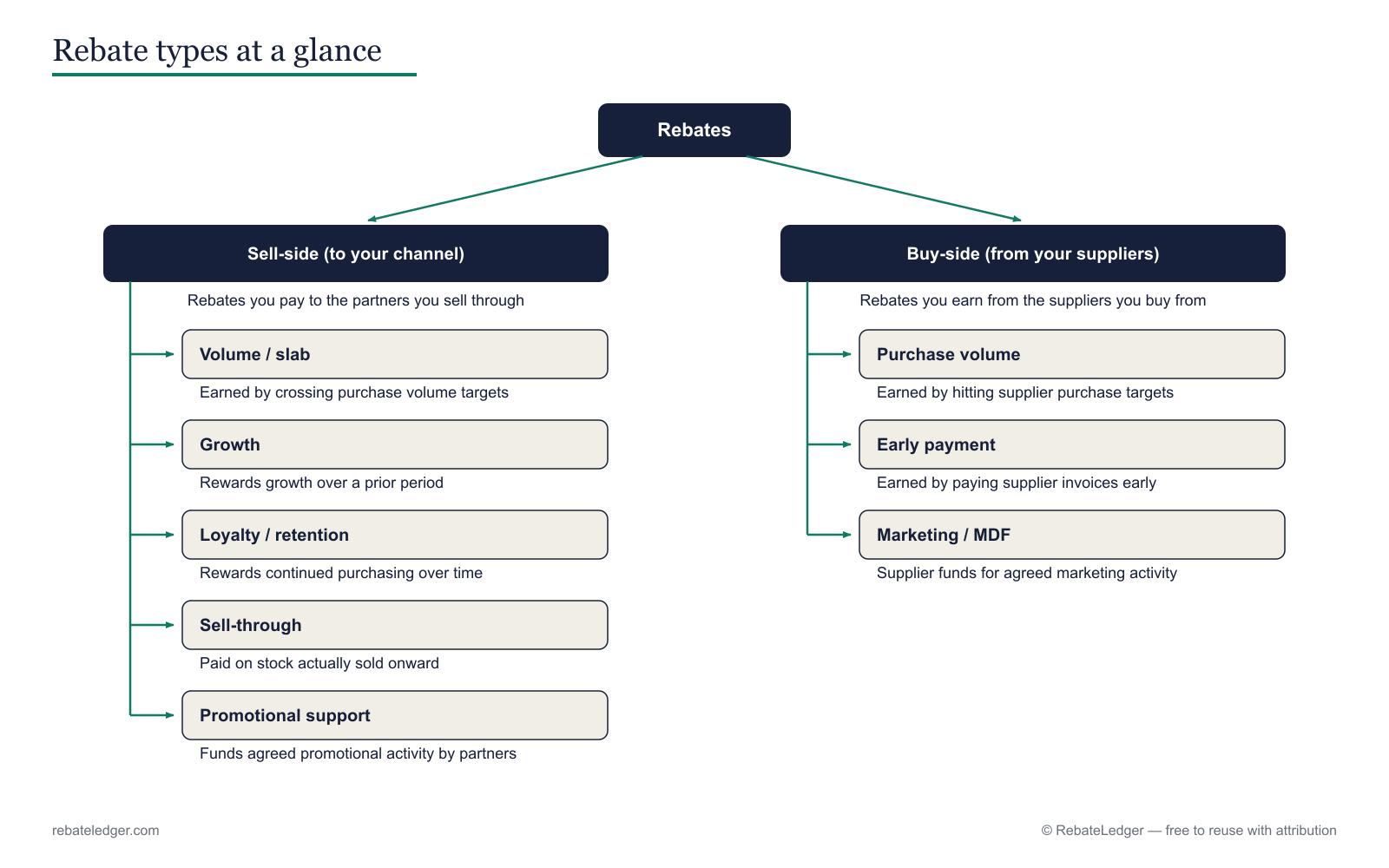
Source: RebateLedger — this diagram is free to reuse with a link back to this article.
The rebate lifecycle
Agree → purchase/sell → accrue → claim → validate → settle. The scheme is agreed as a rule; volume builds; the earned amount accrues; the partner claims it; the brand validates it against the agreement and data; and it settles, usually by credit note. The generic version is in the claim process explained.
A simple worked example
A distributor is promised a 2% rebate on quarterly purchases. They buy ₹40,00,000. The rebate is 2% × ₹40,00,000 = ₹80,000, accrued as purchases post and settled by credit note at quarter-end. Change the structure and the math changes — the four structural types are percentage, amount, quantity and formula, detailed in volume rebates.
Learn the rest of the language
New to the channel too? See distributor vs. dealer vs. super-stockist for who's who in the Indian route-to-market, and how channel rebates work in India for the sell-side money in context.
Where to go next
Rebates split into a few distinct questions once the definition is settled:
- How to calculate rebate accruals — accruing at the expected rate, and what a retrospective tier does to prior months.
- Supplier rebate accounting treatment — why rebates reduce the cost of goods rather than appearing as other income.
- Rebate management software — what a system has to do that a spreadsheet cannot.
- Is a rebate a discount? — the distinction from discounts and schemes, which decides the accounting.
- Supplier rebates — the same instrument seen from the buying side.
GST note: In India, rebates settle via credit notes; the type used affects input tax credit — see financial vs. tax credit notes. This is general information, not tax advice.
Frequently asked questions
What is a rebate in business?
In business, a rebate is money a supplier returns to a business buyer after purchase, earned by meeting an agreed condition such as a volume, growth or range target. It is not deducted at billing: it accrues as the condition is met over a period, then settles afterwards, in the Indian channel usually by credit note.
What is the difference between a rebate and a discount?
Timing and settlement. A discount reduces the price at the moment of sale and appears on the invoice, so the buyer never pays the full amount. A rebate is earned after the sale once an agreed condition is met, and settles separately afterwards — usually by credit note rather than on the original invoice.
How do rebates work in a B2B channel?
A brand and a channel partner agree a scheme; the partner buys or sells; the earned amount accrues; the partner claims it; the brand validates it against the agreement; and it settles, usually by credit note. Accurate accrual and validation are what keep it fair on both sides.
Is a trade rebate the same as a tax rebate?
No. A trade rebate is commercial: a supplier returns money to a business buyer for meeting an agreed purchase condition, settled by credit note or payout. A tax rebate is a reduction in tax liability under income-tax provisions, claimed from the tax authority rather than from a supplier. They share a word and nothing else.
How is a supplier rebate paid?
Two routes. A credit note is set against future purchases, so the buyer's next invoices are reduced and no cash moves — the common route in the Indian channel. Or the supplier pays separately. The practical difference is cash position: a credit note only helps a buyer who keeps purchasing, which matters if volumes are falling.
How do you calculate a rebate amount, with an example?
Calculate a rebate in four steps: fix the qualifying base, apply exclusions, identify the earned rate or slab, and multiply. For example, if a scheme pays 1 percent on net-of-returns, ex-GST purchases and a dealer's qualifying base works out to ₹32 lakh, the rebate is ₹32,000. The base definition in the scheme circular matters more than the headline rate.
Who pays a trade rebate?
The supplier pays it, to a business buyer, on conditions both agreed in advance. In the Indian channel that usually means a manufacturer paying a distributor, or a distributor paying a retailer, once the scheme’s volume or growth condition is met. Settlement runs through a credit note against the buyer’s account, or occasionally a separate payout.
Why do sellers use rebates instead of upfront price cuts?
A rebate rewards behaviour a seller cannot guarantee at billing time — volume targets, range stocking, year-on-year growth — while protecting the invoice price. Because the money is released only after conditions are verified, brands can motivate distributors without permanently cutting list prices. Settlement usually happens through credit notes once performance is confirmed against the scheme's terms.
See RebateLedger on your own claims data
A 30-minute walkthrough tailored to how your channel actually settles claims.