
Billback Accrual: Estimating What You Owe Before the Claim Arrives
A billback is the hardest claim type to accrue, because entitlement depends on sell-through you cannot see. How the estimate is built and trued up.
In short
A billback accrual is the liability recorded for promotional price support a partner has earned but not yet claimed. It is harder to estimate than a volume rebate because entitlement depends on the partner's onward sales at the promotional price, which sit in their system rather than yours — so the accrual is an estimate until claims arrive.
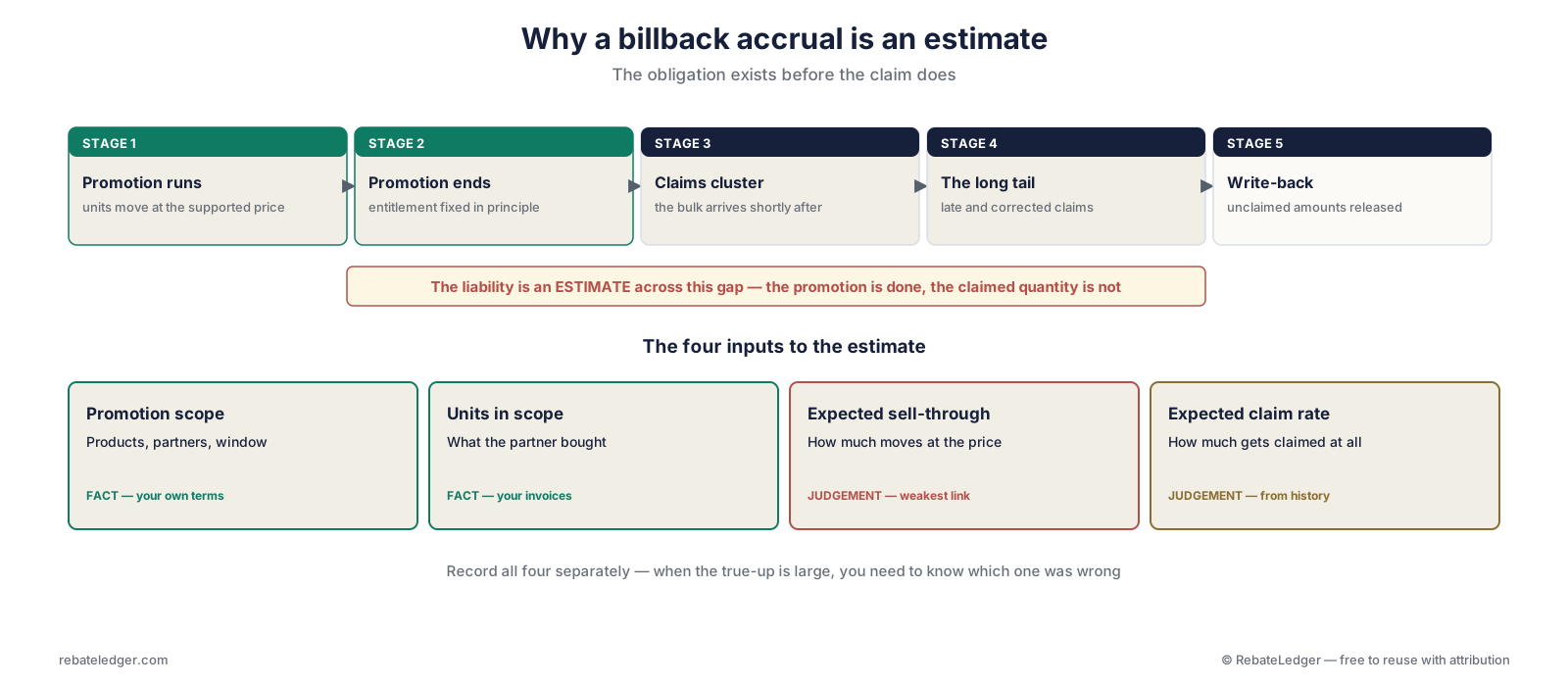
A billback accrual is the liability you record for promotional price support a partner has earned but has not yet claimed. The promotion ran, units moved at the supported price, and you owe the difference — but nothing has arrived from the partner, so the amount is an estimate rather than an invoice.
This page is about building and defending that estimate. Where the accrual lands in the accounts, and the journal entries on both sides, are covered in billback accounting treatment; this one is about the harder problem of arriving at the number in the first place. For the mechanic itself, see what a billback is.
Why billbacks are the hardest claim type to accrue
Most accrual guidance assumes you can compute the entitlement from data you already hold. For a volume rebate that is true: the partner's purchases are on your own invoices, so the accrual is arithmetic on facts you own. How to calculate rebate accruals works through that case.
A billback breaks that assumption. The entitlement is measured on the partner's onward sales at the supported price — how many units they actually sold to the end customer under the promotion. That data sits in their system, not yours. Until they claim, you know the promotion ran and you do not know how much of it was used.
That single difference is why billback accruals are estimates in a way volume rebate accruals are not, and why they need a method rather than a spreadsheet formula. The distinction between measuring on purchases and measuring on onward sales is the same one described in sell-in vs sell-through rebates.
The four inputs to the estimate
Every billback accrual is built from the same four things. Naming them separately matters, because when the true-up is large you need to know which one was wrong.
| Input | What it is | Where it comes from | How reliable |
|---|---|---|---|
| Promotion scope | Which products, partners and window the support covers | Your own promotion terms | High — it is your document |
| Units in scope | What the partner bought that could be sold under the promotion | Your invoices | High |
| Expected sell-through | How much of that stock actually moves at the supported price | Partner data, or an assumption | Weakest link |
| Expected claim rate | What proportion of eligible support gets claimed at all | That partner's claim history | Moderate, and improves with history |
The first two are facts. The second two are judgements, and almost every billback accrual that goes badly wrong does so because one of them was carried forward unexamined from a previous period.
The claim rate is the one teams most often forget exists. Not every entitlement gets claimed — partners miss deadlines, small amounts go unpursued, and some partners simply claim less diligently than others. Accruing at 100% of theoretical entitlement systematically overstates the liability, and accruing at last year's rate without checking it drifts.
A worked illustration
Illustrative figures in a single currency, to show the shape of the calculation rather than any real programme.
| Line | Value |
|---|---|
| Units shipped to the partner in the promotion window | 10,000 |
| Supported price difference per unit | 40 |
| Theoretical maximum exposure | 400,000 |
| Expected sell-through under the promotion | 70% |
| Expected entitlement | 280,000 |
| Expected claim rate for this partner | 90% |
| Billback accrual raised | 252,000 |
Two things follow from laying it out this way. The accrual is 252,000, not 400,000 — accruing the theoretical maximum would overstate the liability by almost 60% against the figure the assumptions actually support. And when claims eventually total, say, 265,000, you can see immediately that the gap came from sell-through or claim rate rather than from an error in the price difference. An accrual recorded as a single number gives you no way to ask that question.
To model this yourself before committing to a method, the chargeback and billback simulator in Excel sets up the same arithmetic, and modelling trade scheme cost before launch covers doing it before the promotion runs rather than after.
Post-flight accruals and the claim lag
A post-flight accrual is one raised after the promotion has finished but before the claims against it have landed. For billbacks this is the normal state rather than an edge case, because the lag between a promotion ending and its claims arriving routinely spans a period close.
That lag has a shape worth knowing for your own partners. Claims usually arrive in a cluster shortly after the window closes, then a long thin tail of late and corrected submissions. If you only measure the average, you will consistently under-provide for the tail; if you provide for the whole tail immediately, you will carry liabilities that quietly become permanent.
The practical discipline is to age the accrual by promotion rather than lumping it into one balance. An accrual that has been sitting against a promotion that closed nine months ago is telling you something — either the claim is never coming, or your claim window is not being enforced. Rebate accrual management covers the forecast, true-up and write-back cycle this feeds.
Conditional rates make the estimate move
Some promotional support is not a flat rate. Where the supported difference steps up with volume, or applies only above a threshold, the accrual rate itself is a function of a quantity you are still estimating — so a change in the sell-through assumption moves both the quantity and the rate at once.
The safe treatment is to accrue at the rate the partner's current run-rate actually supports, not the rate they might reach, and to revisit it as the period progresses. Accruing at the top rate from day one on the assumption a partner will get there produces a liability that has to be written back, and repeated write-backs make the whole accrual population look unreliable to an auditor even when the method is sound.
Is it a promotion cost or a merchandise recovery?
This question comes up constantly and it has a clean answer: classify by what the money funded, not by how it arrived.
Price support given so a partner could sell at a promotional price is a promotional cost. Recovery for damaged, short-shipped or unsaleable goods is not — it is a different cost that happens to travel the same route and settle through the same document. Both may arrive as a billback and both may settle by credit note, and neither of those facts tells you what the cost was.
Classifying by settlement mechanism is how trade spend becomes unreadable: the promotion line contains recoveries that were never promotional, and nobody can say what the promotion actually cost. The families are separated in billback deduction vs markdown allowance and, on the receivables side, in deduction management.
Where the settlement route raises GST questions, those depend on the instrument and the arrangement — see financial vs tax credit notes under GST. This article states no tax or accounting position; confirm both with your own advisers.
Where billback accruals go wrong
Five failure modes account for most of it, and each has a different fix.
- Accruing only when the claim arrives. The liability appears in the wrong period and interim margin is wrong by an unknown amount all year.
- Accruing the theoretical maximum. Ignoring sell-through and claim rate overstates the liability, then produces a large write-back that looks like a correction rather than a method.
- One number, no components. Without the four inputs recorded separately, a true-up cannot be explained, only absorbed.
- No claim deadline. Without a stated window, there is no defensible moment to write back an unclaimed accrual, so old balances accumulate indefinitely.
- Classifying by mechanism. Promotional support and goods recoveries collapse into one line and trade spend stops being readable.
The checks an auditor will actually apply to this population are set out in the channel incentive accrual audit checklist, and the year-end reconciliation of provision against settlement in scheme provision and liability reconciliation.
Accruing continuously against actual transactions, with the four inputs held separately and aged by promotion, is what turns a billback accrual from a quarterly judgement into a computed figure with an audit trail — which is what RebateLedger is built to produce as a by-product of running the claims themselves.
General information, not accounting or tax advice. This article describes common practice in estimating and truing up billback liabilities. All figures are illustrative. Recognition, measurement and derecognition depend on the accounting framework applicable to your entity, and the tax treatment of any settlement depends on the arrangement and the instrument used. Confirm both with a qualified professional.
Frequently asked questions
What is a billback accrual?
The liability a supplier records for billback claims a partner has earned but not yet submitted. The promotion ran, units were sold at the supported price, and the obligation exists — but no claim has arrived. Accruing it puts the cost in the period the promotion ran rather than the period the paperwork happened to land.
Why is a billback harder to accrue than a volume rebate?
Because you cannot compute it from your own data. A volume rebate is measured on what the partner bought from you, which is on your invoices. A billback is measured on what the partner sold onward at the supported price, which is in their system. Until they claim, the qualifying quantity is an estimate rather than a fact.
When should a billback be accrued?
When the obligation arises, which is as the qualifying sales occur — not when the claim is raised and not when it settles. Waiting for the claim makes your reported margin a function of the partner's administrative diligence. The timing principle is set out in billback accounting treatment.
What is a post-flight accrual?
An accrual raised after a promotion has finished running but before the claims against it have arrived. It is the normal state for billbacks, because the claim lag routinely spans a period end. The promotion is complete, the entitlement is fixed in principle, and only the claimed quantity is still unknown.
How is a billback accrual trued up?
By comparing claims actually received against the estimate for that promotion, and adjusting the remaining liability. A small, explainable true-up is the main evidence the estimate is working. A large one usually means the sell-through assumption or the claim-rate assumption was wrong, and it is worth knowing which.
What happens to accruals for claims that never arrive?
They are written back once it is clear no claim will be made, typically after the claim window in the agreement has closed. The judgement is when to conclude that, which is why an explicit claim deadline in the promotion terms matters as much for the accounts as it does for the dispute.
Is a billback accrual a promotion cost or a merchandise chargeback?
It depends on what the money funded, not on how it arrived. Support for a price reduction during a promotion and recovery for damaged or short-shipped goods are different costs that happen to travel the same route. Classifying by settlement mechanism rather than by cause is what makes trade spend unreadable.
What data does a billback accrual need?
The promotion terms and window, the units in scope, an expected sell-through at the supported price, and an expected claim rate based on that partner's history. The weakest of the four is usually sell-through, because it depends on partner data described in the secondary sales data specification.
See RebateLedger on your own claims data
A 30-minute walkthrough tailored to how your channel actually settles claims.