
Sale or Return, Consignment and Outright Sale: Who Owns the Stock
SOR, consignment and outright sale compared — where title passes, who carries unsold-stock risk, how each is invoiced, and the GST treatment of each.
In short
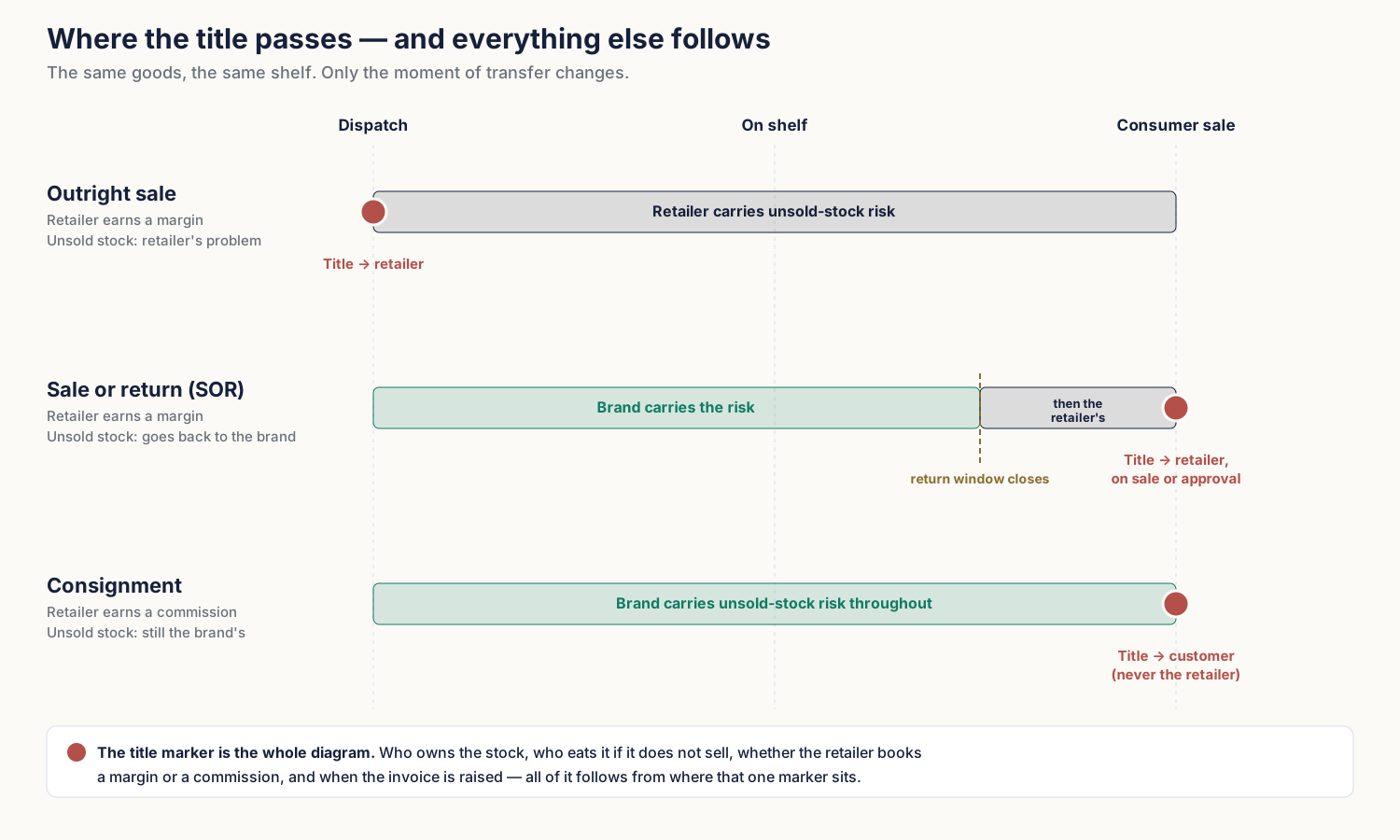
The three models differ in one thing: when title passes. In an outright sale it passes on dispatch and the retailer carries unsold-stock risk. In sale or return the goods move but title passes only on sale, so unsold stock goes back. In consignment title never reaches the retailer at all — they sell as agent and earn commission, not margin.
All three models put the same goods on the same shelf. They differ in one thing: when title passes. Everything else — who owns the stock, who absorbs it if it does not sell, whether the retailer books a margin or a commission, when the invoice is raised — follows from that single point.
Get the model right and the commercial logic is obvious. Get it wrong, or use a contract whose label does not match its substance, and you inherit somebody else's inventory risk without being paid for it.
The three models at a glance
| Outright sale | Sale or return (SOR) | Consignment | |
|---|---|---|---|
| When title passes | On dispatch | On sale or approval | On sale — to the customer |
| Who owns stock on the shelf | Retailer | Brand, until sold or accepted | Brand |
| Who carries unsold-stock risk | Retailer | Brand, within the window | Brand |
| What the retailer earns | Trading margin | Trading margin | Commission |
| When the invoice is raised | On dispatch | On sale, or at the statutory backstop | On sale by the agent |
| What happens to unsold goods | Retailer's problem | Returned to the brand | Remain the brand's |
Outright sale: the baseline
Title passes on dispatch. The retailer buys the goods, owns them, and carries every consequence of owning them — the working capital, the shelf space, the markdown if the range fails, the write-off if it expires.
This is the default across most of Indian general trade, and it is the model every other one is defined against. Its virtues are simplicity and clean accounting: one invoice, one transfer of ownership, one moment when revenue is recognised and tax is due.
Returns exist only where the agreement creates them. A damage, expiry or breakage allowance is a negotiated concession, not an inherent right — which is why those arrangements need to be written down rather than assumed, as covered in expiry, breakage and returns as an operational process.
The commercial consequence is straightforward: because the retailer takes all the risk, they will want the margin to compensate for it. A brand that wants outright terms on an unproven product usually pays for them.
Sale or return: renting shelf space with inventory risk
Under SOR the goods physically move but the sale is conditional. The retailer stocks them, and anything unsold within an agreed window goes back. Title passes when the retailer sells the goods or otherwise accepts them — not when the lorry arrives.
Three mechanics decide whether an SOR arrangement works in practice, and all three belong in the contract:
The return window. How long the retailer has before unsold stock becomes theirs. Once it closes, the arrangement converts to an ordinary purchase, and stock that has not moved is now the retailer's inventory at full cost. This is the single most contested term in an SOR deal.
Condition on return. Goods must usually come back saleable — original packaging, undamaged, unmarked, not past a freshness threshold. Without a condition standard you get disputes at exactly the moment goodwill is lowest.
Who pays return freight. Frequently unstated, and on bulky or low-value goods the freight can exceed the value of what is being returned. Agree it up front or the return right is worth less than it looks.
SOR earns its place with new launches, seasonal ranges and unproven SKUs — anything where nobody yet knows the sell-through rate. The trade is explicit: the brand takes the inventory risk back, and in exchange it gets shelf space it could not otherwise buy, plus real sell-through data on a product it needs to learn about.
For the retailer the calculation is equally clear. SOR lets them carry range they would never buy outright. The cost is usually a thinner margin than an outright deal on the same goods, because they are no longer being paid to take the risk — and the operational burden of tracking which stock is on what terms, which is where SOR quietly gets expensive.
Consignment: the retailer never buys at all
In a consignment arrangement the goods remain the company's property the entire time they sit in the retailer's premises. The retailer sells them as agent and is paid a commission for doing so.
The consequence that trips people up is an accounting one, and it is significant.
The retailer's revenue is the commission, not the sale value. A consignment retailer who moves ₹1 crore of goods at a 12% commission does not have ₹1 crore of turnover. They have ₹12 lakh. The goods were never theirs to sell; they facilitated somebody else's sale.
That single fact ripples outward. Turnover-linked thresholds read completely differently. Stock in the shop is not an asset on the retailer's balance sheet. Any scheme or incentive written against "purchases" needs redefining, because the consignee never makes a purchase. And a business that switches a large account from outright to consignment can watch its reported topline collapse while its actual economics barely move.
The C&F agent is the most familiar Indian instance of this model — the same non-ownership, the same fee-for-service economics — and the role is set out in what is a C&F agent.
GST treatment
General guidance on the principles, not tax advice. The treatment of any specific arrangement depends on its facts and should be confirmed with a qualified professional.
Outright sale is the uncomplicated case: a supply of goods, invoiced on dispatch, taxed in the ordinary way. Where goods later come back, the adjustment runs through a credit note under Section 34 — and the choice between a tax and a commercial credit note carries its own consequences, worked through in returns, reversals and cancellations.
Sale or return has a provision of its own. Section 31(7) of the CGST Act deals with goods sent or taken on approval for sale or return that are removed before the supply takes place: the invoice is to be issued before or at the time of supply, or six months from the date of removal, whichever is earlier. Two practical points follow. The goods move on a delivery challan under Rule 55 of the CGST Rules, because the movement is not itself a supply — a tax invoice at dispatch would be wrong. And the six-month point is a backstop, not an option: stock still sitting unsold and unreturned at that horizon triggers the invoice regardless of commercial intent. An SOR window longer than six months therefore collides with the statute, which is a good reason to keep the window shorter.
Consignment is the involved one. Paragraph 3 of Schedule I treats the supply of goods by a principal to an agent — where the agent undertakes to supply those goods on the principal's behalf — as a supply even without consideration, and the converse for goods received. So the principal-to-agent movement can itself be a supply, the agent's onward sale is a second supply, and the commission is a third thing again: a supply of service, which needs consideration and is taxable in its own right.
What decides whether an arrangement is inside that entry is set out in CBIC Circular No. 57/31/2018-GST. The test the circular applies is objective rather than contractual: whether the agent issues the invoice for the onward supply in his own name, which the circular ties to whether the agent has authority to pass or receive title on the principal's behalf. Where the agent invoices the customer in the principal's name instead, the circular says the agent does not fall within Schedule I. It also notes that whether the principal is named is immaterial, and works the point through a C&F agent taking possession and invoicing in his own name.
Substance beats label. This is the part worth carrying away. A contract headed "consignment" that in fact passes title on delivery is not a consignment, and calling it one changes nothing about how it is treated. Read where title actually moves and who actually raises the invoice — those are the facts that decide it. Related stock-movement questions, including branch and warranty movements, are covered in GST on stock transfers and warranty replacements.
Which to use when
From the brand's side. Outright is right for proven, fast-moving lines where the channel is happy to own stock and you want cash and simplicity. SOR is the tool for buying distribution you cannot yet justify — launches, seasonal ranges, a new territory — accepting inventory risk to get the listing and the sell-through data. Consignment suits high-value, slow-moving or highly variable stock where asking a partner to fund inventory would price them out: jewellery, large appliances, wide-fit footwear ranges, premium apparel where size curves make the risk unmanageable.
From the retailer's side. Take outright terms where you know the product sells and the margin pays you properly for the risk. Take SOR where you want to test a range without funding it, and read the window, condition and freight terms carefully, because that is where the value of the return right is decided. Take consignment where you would otherwise carry unaffordable stock — but go in knowing that your topline, your stock records and any purchase-linked scheme all behave differently, and that your margin is now a commission.
Whichever model applies, the same discipline decides whether you keep the money: knowing what you are entitled to and evidencing it before the window closes. Where trading margin ends and claimed money begins is the subject of primary vs secondary trade margin.
Note: This article is general commercial information, not tax or legal advice. Statutory references are signposts to the relevant provisions, not an opinion on any arrangement. Confirm the treatment of your own contracts with a qualified professional.
Frequently asked questions
What is the difference between sale or return and consignment?
In sale or return the retailer buys the goods, but title passes only on sale or approval, and anything unsold inside the agreed window goes back. In consignment the retailer never buys at all: the goods stay the company's property and the retailer sells as agent, earning a commission rather than a trading margin.
When does title pass in each model?
In an outright sale, on dispatch — the retailer owns the stock and carries the risk from that moment. In sale or return, on sale or acceptance rather than when the goods arrive. In consignment, straight from the company to the end customer, so the retailer never holds title at any point in the chain.
Who carries the risk of unsold stock?
Whoever holds title. In an outright sale that is the retailer from dispatch onward. In sale or return it is the brand, but only until the return window closes — after that, unsold stock becomes the retailer's inventory at full cost. In consignment it stays with the brand throughout.
What does a consignment retailer record as revenue?
The commission, not the sale value. A consignee moving ₹1 crore of goods at a 12% commission has ₹12 lakh of turnover, not ₹1 crore, because the goods were never theirs to sell. That changes turnover thresholds, keeps the stock off their balance sheet, and breaks any scheme written against purchases, since a consignee never makes one.
What are the practical terms an SOR agreement has to fix?
Three, and all of them belong in writing. The return window, after which unsold stock becomes the retailer's at full cost. The condition goods must come back in, so disputes are not settled on goodwill. And who pays return freight, which on bulky or low-value goods can exceed what is being returned.
When must a GST invoice be raised for goods sent on sale or return?
Section 31(7) of the CGST Act covers this: where goods sent or taken on approval for sale or return are removed before the supply takes place, the invoice is issued before or at the time of supply, or six months from the date of removal, whichever is earlier. The goods move on a delivery challan under Rule 55, not a tax invoice.
How is consignment treated under GST?
Paragraph 3 of Schedule I can treat the principal-to-agent movement as a supply even without consideration, the agent's onward sale is a second supply, and the commission is a third — a supply of service. CBIC Circular 57/31/2018-GST applies an objective test: whether the agent issues the invoice for the onward supply in his own name.
Does calling a contract a consignment make it one?
No. The treatment follows the substance of the arrangement rather than its heading. A contract titled consignment that in fact passes title on delivery is an outright sale, and the label changes nothing. Read where title actually moves and who actually raises the invoice; those two facts decide it.
See RebateLedger on your own claims data
A 30-minute walkthrough tailored to how your channel actually settles claims.