
What Are Market Development Funds (MDF)?
Market development funds — what MDF is, how accrual and discretionary funds differ, how the money moves from earned to reimbursed, and why it lapses.
In short
Market development funds are money a brand sets aside for its channel partners to spend on building demand locally — advertising, in-store branding, events, digital campaigns. The partner spends first and recovers the agreed share afterwards against proof that the activity happened. MDF is reimbursement for work done, which is what separates it from a rebate earned on volume.
Market development funds are money a brand sets aside for its channel partners to spend on building demand locally — advertising, in-store branding, events, campaigns. The partner spends first and recovers an agreed share afterwards, against proof that the activity actually happened.
That last clause is the whole idea. MDF is reimbursement for work done, which is what separates it from a rebate earned on volume. A rebate needs a number to clear a threshold. MDF needs a receipt and a photograph.
MDF, co-op, rebates and trade spend — where the lines fall
Four terms circle the same budget and get used interchangeably. They are not the same thing.
| What earns it | What it pays for | What you must produce | |
|---|---|---|---|
| MDF | An allocation or grant from the brand | Demand-building activity in the partner's market | Proof the activity happened |
| Co-op funds | Usually accrues on what the partner buys | The same activities, jointly funded | The same proof, plus the accrual working |
| Rebate | Hitting a volume or value target | Nothing — it is margin | The volume, evidenced |
| Trade spend | Umbrella term | All of the above, from the brand's side | Depends what is inside it |
The practical test is what the money is for. Rebate money is yours because you bought or sold enough; you can spend it on anything, including nothing. MDF money is yours only if you spend it on something specific and can show you did. Where a rebate sits against the other channel-money terms is covered in is a rebate a discount, and the wider category in channel incentives, financial and non-financial.
MDF and co-op are the pair most often confused, and the honest answer is that the labels overlap. The usual distinction is how the money arises: co-op typically accrues as a percentage of purchases, so the pool builds automatically and the partner feels ownership of it; MDF is more often discretionary, granted for a specific launch or campaign. Plenty of real programmes mix both, and some call an accruing pool "MDF" throughout. Read the agreement rather than the label.
Where the money comes from: accrual or discretion
Those two funding models behave differently enough to matter.
An accrual fund earns at a rate on the partner's qualifying business volume — buy more, the pool grows. It is predictable, it scales with the relationship, and the partner can forecast it. It also creates an expectation: money that accrued against their own purchases feels like theirs, and a brand that declines a claim against an accrued pool is having a different conversation from one declining a discretionary grant.
A discretionary fund is a decision. A fixed sum for a season, a new SKU, a territory the brand wants opened. It directs money where strategy wants it rather than where volume already is, which is exactly why brands keep it — the largest partner is not always the one whose market needs developing.
Most programmes run both. The budgeting side of that — how the pool is sized and tracked against actuals — is trade promotion budgeting, and how MDF sits inside total promotional spend is in trade spend vs advertising.
Where MDF money actually sits
This is the part most explanations skip, and it is the part that decides whether the money ever reaches anyone.
A fund is not one balance. It is several, and money moves between them on events.
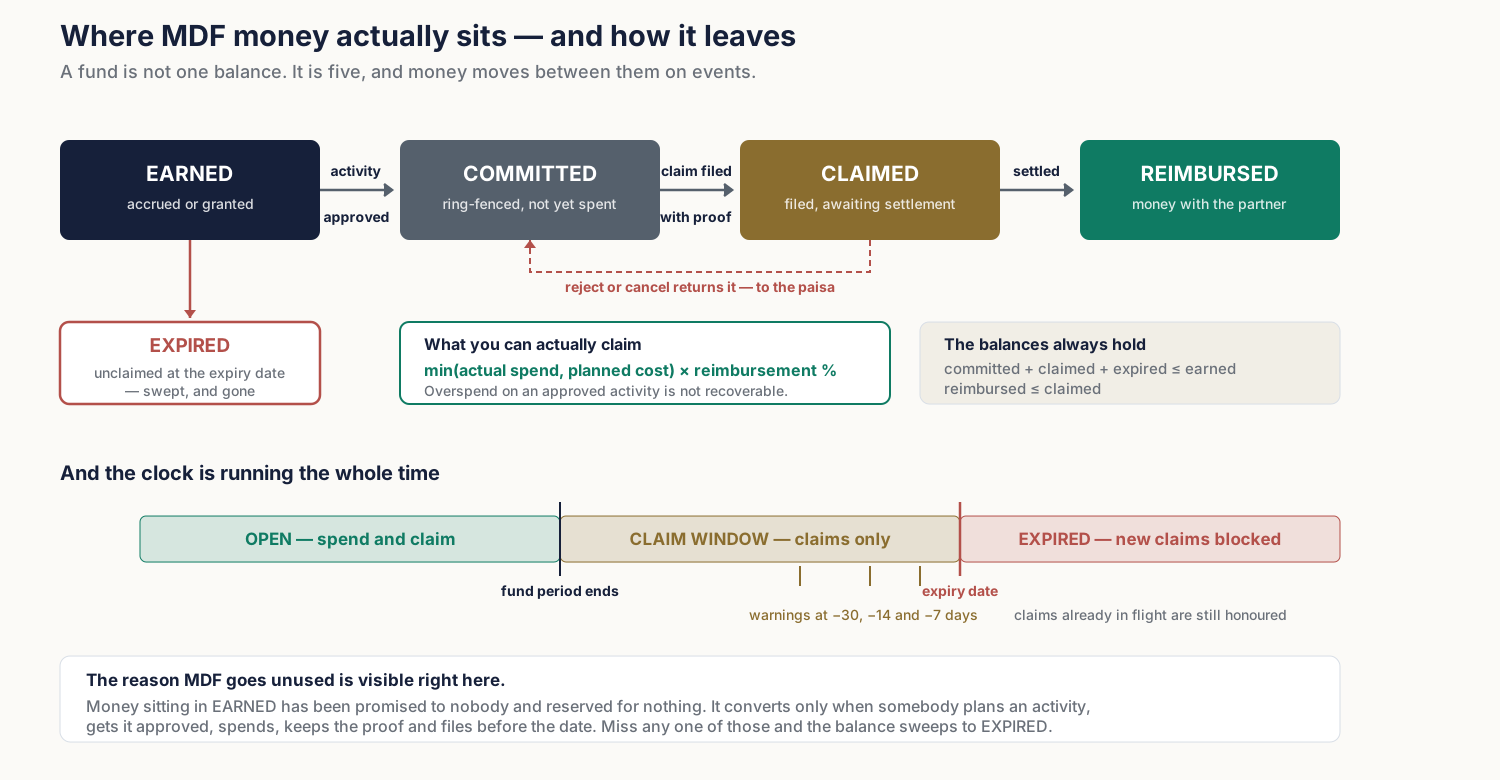
- Earned — the balance that exists, whether accrued or granted. Promised to nobody, reserved for nothing.
- Committed — an activity has been planned and approved, so that money is ring-fenced against it. Nothing has been spent yet.
- Claimed — the partner has done the work and filed, with proof attached.
- Reimbursed — the brand has settled and the money has actually reached the partner.
- Expired — the deadline passed while the balance was still sitting in earned. Swept, and gone.
Two rules hold at all times in a well-run programme: committed plus claimed plus expired can never exceed earned, and reimbursed can never exceed claimed. A rejection or cancellation returns the money to where it was, exactly — a fund whose positions do not reconcile after a full approve-claim-reject cycle is a fund nobody can trust a balance from.
What you can actually claim
The number is usually the lesser of what you spent and what was approved, multiplied by the reimbursement share.
Both halves catch people out. Overspending on an approved activity does not increase what you recover — plan a ₹2 lakh campaign, spend ₹3 lakh, and the extra lakh is yours. And a reimbursement share below 100% means the fund was always a contribution, not a cheque; a 60% share on a ₹2 lakh approved campaign returns ₹1.2 lakh, and the rest was your marketing budget from the start.
Most programmes also gate the claim on proof of performance — the photograph of the installed board, the ad tearsheet, the invoice from the agency, the event attendance list. What counts as proof, stage by stage, is set out in the MDF and co-op claim process.
Why MDF goes unused
Unclaimed MDF is one of the most reliable leaks in channel finance, and the diagram above explains why better than any list.
Money in earned converts only if a whole sequence completes: somebody plans an activity, gets it approved before spending, spends it, keeps the evidence, and files before the window closes. Every one of those is a separate opportunity to stall, and none of them announces itself when it fails.
The recurring causes are mundane:
Nobody knows the balance exists. An accrued fund grows quietly on a statement the partner does not read. You cannot spend what you do not know you have.
Pre-approval is skipped. The partner runs the campaign, then discovers the programme required approval before the spend. The activity was real and the money is still unrecoverable.
The proof was never collected. The board went up, the event happened, and nobody photographed it. Reconstructing evidence months later is usually impossible.
The window closed. Funds carry a period end and an expiry date, and the gap between them is often shorter than the partner assumes. Good programmes warn at thirty, fourteen and seven days out; many do not warn at all.
Nobody owns the calendar. Marketing owns the activity, finance owns the claim, sales owns the relationship — and the deadline belongs to none of them.
How MDF is measured
The headline metric is utilization: what share of an allocated fund actually reached partners as reimbursement. It is a more honest number than spend, because it counts money that completed the whole journey rather than money that was announced.
Read it alongside two others. Time to settle — how long a filed claim waits — because a slow reimbursement cycle quietly teaches partners not to bother next time. And claim rejection rate, because a high one usually indicts the programme's clarity rather than the partners: if a third of claims fail on proof, the proof requirement was never communicated properly.
Tax treatment: read the arrangement, not the label
General guidance on where the questions sit, not tax advice.
MDF settlement is not one uniform thing. Some arrangements pass the money as a credit note against the partner's account. Others treat the partner's activity as a service supplied to the brand — the partner marketed on the brand's behalf and is being paid for it — which points at a tax invoice rather than a credit note.
Which applies turns on the substance of the arrangement rather than what the programme is called, and it carries consequences on both sides. The Indian position, including how dealer advertising reimbursements and Section 194R interact with this, is worked through in the MDF and co-op claims guide and, for the harder valuation question, are distributor marketing costs part of GST consideration. Confirm your own position with a qualified professional.
Getting it right
MDF is the one pot of channel money that rewards administration. A rebate arrives whether or not anyone is paying attention, because it falls out of volume that was going to happen anyway. MDF arrives only if somebody runs the process.
That means three things are worth being able to answer at any moment: what is the balance, what is committed against it, and what is the next date at which something lapses. Where those three are visible, utilization tends to look after itself. Where they are not, the fund is a number in an agreement that quietly returns to the brand at year end.
RebateLedger holds MDF and co-op funds as live positions rather than a spreadsheet line — earned, committed, claimed, reimbursed and expired, each moving only on the event that should move it, with the expiry clock visible while there is still time to act on it. How the agreement behind the fund should be structured is covered in supplier rebate agreements, and the claim-to-settlement mechanics in settling MDF and co-op claims.
Frequently asked questions
What are market development funds (MDF)?
Market development funds are money a brand allocates so its channel partners can build demand in their own territory — local advertising, in-store branding, events, digital campaigns. The partner spends first and recovers an agreed share afterwards against proof the activity happened. It is reimbursement for work performed, not a discount on goods.
What does MDF stand for in marketing?
MDF stands for market development funds, sometimes written as marketing development funds — the two are used interchangeably in practice. Both describe a pool a manufacturer or brand sets aside for channel partners to spend on demand-building activity in their local market, claimed back after the fact with proof of performance.
What is the difference between MDF and co-op funds?
The usual distinction is how the money arises. Co-op funds typically accrue as a percentage of what the partner buys, so the pool grows with purchases and the partner has a claim on it. MDF is more often discretionary — granted for a specific purpose or campaign. In practice the labels overlap heavily and the agreement matters more than the name.
What is the difference between MDF and a rebate?
A rebate is earned by buying or selling volume and is paid because a target was met. MDF is reimbursement for money the partner actually spent on an agreed activity, and it is paid because work was done and evidenced. A rebate needs a number to clear a threshold; MDF needs a receipt and a photograph.
How is MDF allocated?
Two common models. An accrual fund earns at a percentage of the partner's qualifying business volume, so the balance builds automatically as they buy. A discretionary fund is granted — a fixed sum for a launch, a season or a specific campaign. Accrual funds feel owned by the partner; discretionary funds are the brand's to direct.
Why does MDF go unused?
Because the money only converts if a sequence completes: somebody plans an activity, gets it approved, spends, keeps the proof and files before the deadline. Miss any one step and the balance lapses. Unused MDF is rarely a decision — it is usually nobody owning the calendar, or a partner not knowing the balance existed.
What can MDF be spent on?
Whatever the programme's activity list permits, which is the part worth reading before spending. Common categories are local advertising, in-store and dealer branding, signage, demonstrations and sampling, trade events, joint digital campaigns and training. Activities outside the approved list are usually not reimbursable however well they performed.
See RebateLedger on your own claims data
A 30-minute walkthrough tailored to how your channel actually settles claims.