
AI in RebateLedger: Every Number Is Computed, Not Generated
The fourteen AI features in RebateLedger, what each one does, and the boundary that keeps every figure computed by program rather than written by a model.
In short
RebateLedger has fourteen live AI features. In all of them the same boundary holds: every number, threshold and rupee figure is computed by a deterministic program on your own data, and the language model only writes the explanation around those finished figures. A guard-rail rejects any explanation containing a number the program did not produce.
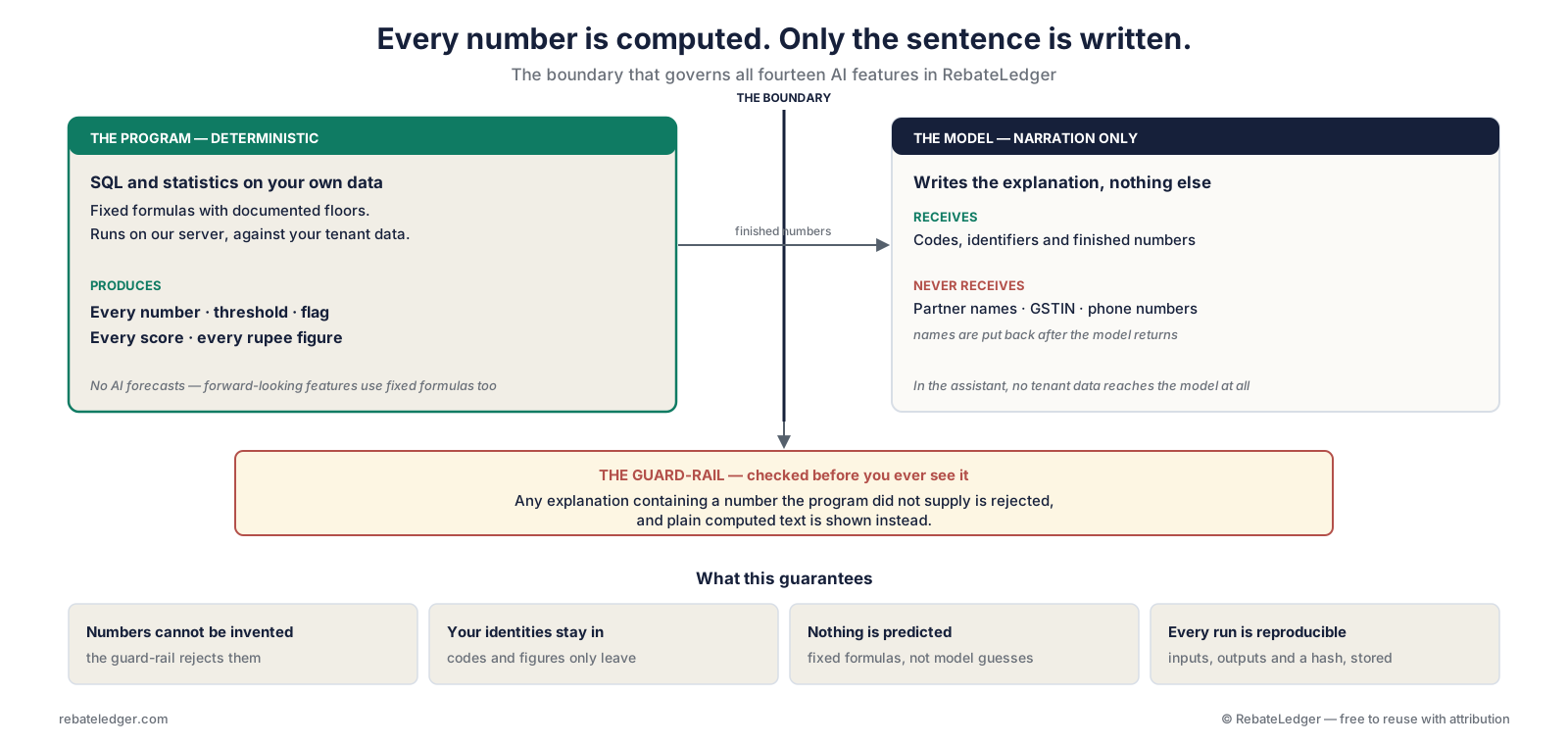
RebateLedger has fourteen live AI features, and one rule that governs all of them: the numbers are computed, not generated. Every threshold, score and rupee figure comes from a fixed formula running on your own data. The language model is only allowed to write the sentence around a figure it was handed — and if it writes a number the program did not produce, that explanation is rejected before you see it.
That boundary is the whole design, and it is worth understanding before the feature list, because it is what makes the feature list trustworthy.
The line between computing and explaining
Most software that claims to use AI is vague about which part of the answer the model produced. That vagueness is the problem: if a model wrote the number, the number carries the model's failure modes, and a finance team cannot defend it to an auditor.
RebateLedger splits the two jobs explicitly.
| What does it | What it produces | |
|---|---|---|
| Computing | A deterministic program — SQL and statistics running on your own data | Every number, threshold, flag, score and rupee figure |
| Explaining | The language model | The plain-English sentence describing what those finished figures mean |
Four things enforce that split, and each one is a fair question to ask any vendor:
- A guard-rail rejects invented numbers. The explanation is checked against the figures the program supplied. If it contains a number that was not in that set, it is thrown away and plain computed text is shown instead.
- Identifying data does not reach the model. What it receives is codes, identifiers and already-computed values — never partner names, GSTIN or phone numbers. Names are substituted back into the text after the model has returned.
- There are no AI forecasts. Forward-looking features run fixed formulas with documented floors. A forecast nobody can reproduce is not usable in a close.
- Every run is on the record. Each run stores its inputs, outputs, the explanation and a hash of the result, alongside the audit trail the rest of the product writes.
The practical consequence is simple. If you disagree with a figure, you can trace it to the data and the formula that produced it. The explanation is commentary on that figure, not the source of it.
The fourteen features
They cover cash recovery, risk scoring, forecasting and question-answering. All of them read data you already hold in RebateLedger — none of them needs a new integration or a separate data feed.
| Feature | What it does |
|---|---|
| Margin Leakage Detector | Shows where margin is being lost — claims or schemes that have not been recovered |
| Recovery Aging Prioritizer | Ages overdue claims and settlements by how long they have been outstanding, like a receivables aging |
| Smart Opportunities | The rollup — recoverable and at-risk amounts across the workspace in one view |
| Anomaly & Duplicate Detector | Scans claims for outliers and duplicates that do not fit the normal pattern |
| Deduction Dispute Triage | Ranks un-decided inbound deductions and calls each one dispute, consider or accept |
| Slab-Optimization Recommender | Analyses how partner volumes land across an agreement's slab bands and flags structural problems, such as a band no partner falls into |
| GST Note Pre-Validator | Scans credit and debit notes for compliance issues before the return window |
| Agreement Summarizer | The live position on each sales agreement — booked volume, current slab and rate, money claimed, settled and pending |
| Purchase Agreement Summarizer | The same view for the rebates you receive from your principals and vendors |
| Counterparty Risk Scorecard | Credit and default-risk scoring across partners, computed from their activity with you |
| Period-Close Risk Scanner | Flags timeline risks and blockers that could delay your close, before they bite |
| Net Position Tracker | Your net settlement position and obligation forecast — what you are likely to owe and be owed |
| Festival-Season Demand Index | Reflects India's seasonal demand peaks, computed from your own history, so forecasting is realistic |
| Assistant | Answers questions about your own data in plain language |
Two of these deserve a note, because their names could be read as promising more than they do.
Deduction Dispute Triage ranks inbound deductions and recommends a call; it does not dispute anything for you. The signal it uses is your own history with that counterparty — how past disputes with them were resolved — not a recomputation of your entitlement under the agreement. Thin history is scored against your own base rate and flagged as thin rather than presented as confident.
Slab-Optimization Recommender reports structural facts about an agreement's bands against actual partner volumes. It surfaces the problem; the commercial decision about whether to change a slab remains yours.
The step-by-step guides live in the Help Centre: finding recovery opportunities, detecting claim anomalies, reading risk and close insights, reading an agreement summary, pre-validating GST before settlement, the festival index and building what-if scenarios. The overview of how the layer fits together is in how Smart insights work.
What the assistant can and cannot do
The assistant answers questions about your own data — a claim's status, an accrual balance, a claims aging position, a settlement summary, your GST exposure, the health of a slab — and it explains decisions that have already been recorded, such as why a claim was decided the way it was, why a settlement is blocked, why a reconciliation shows a variance, or why a permission was denied.
Every one of those skills is read-only. The assistant cannot create, approve, edit, settle or delete anything. That is a property of how it is built rather than a policy someone could relax: the skills have no write path at all.
It is also narrower than it looks in one deliberate way. The model never sees your data. It sees your question and a catalogue of the things it is allowed to run, and it returns which one to run and with what parameters. The answer is then computed and written on the server. Piping your figures through a model to compose an answer would be a different architecture, and it is not this one.
The same discipline applies to documentation search: when it quotes the Help Centre, it quotes stored text directly rather than paraphrasing it, so the answer cannot drift from what the documentation actually says.
What happens when it cannot answer
It tells you, in fixed wording, and gives you a reference you can quote to support. The wording is not regenerated each time — it ships exactly as written, so an unanswerable question produces an honest reply rather than a fluent guess.
Questions it could not handle are recorded separately as coverage gaps, which is how the answerable set gets extended. A question refused because it was out of scope, and a question that failed, are not the same thing and are not counted together.
This matters more than it sounds. The failure mode people fear with an AI assistant over financial data is not that it says "I don't know" — it is that it says something plausible instead. Fixed fallback wording and a traceability check on every figure are the two mechanisms that prevent it.
On the roadmap, and not built yet
Four features are planned and not live: claim drafting from scanned documents, WhatsApp deduction capture, GST e-invoice IRN verification, and narration in additional languages.
They are named here because they are visible inside the product, where they appear marked "coming soon" rather than as working features. They are not part of the fourteen, and nothing on this page depends on them. If one of them is the reason you would buy, ask for a date before you do.
How to test any vendor's AI claims
The questions that separate real capability from packaging are short, and they work on any vendor, including this one.
- Which part of the answer did the model produce — the number, or the sentence about the number? If the number, ask how it is validated.
- What does it send to the model? Ask specifically whether customer names, GSTINs or transaction detail leave the system.
- What happens when it does not know? Ask to see the failure, not the happy path. A demo that never shows a refusal is hiding one.
- Can it change anything? An assistant that can approve or settle needs a much stronger control story than one that can only read.
- Is every run reproducible? Ask whether you can retrieve what a given run computed, months later, and what it said.
The wider version of this test, applied to the category rather than to one product, is in can AI automatically match distributor claims to scheme terms, and the honest outlook for agent-driven settlement is in what is agentic claims processing. For the tax-document side specifically, see AI software for GST credit note automation.
Smart points you at what is worth attention; the recovery itself happens through the normal RebateLedger flows — raising the claim, reconciling it, settling it. That division is intentional, and it is why the AI layer can be switched off without stopping any of the work.
Frequently asked questions
Does RebateLedger use AI?
Yes, in fourteen live features covering cash recovery, risk and forecasting, plus an assistant that answers questions about your own data. In every one of them the numbers are computed by a deterministic program and the model only writes the explanation around them. The features are listed in full on this page.
Can the AI change a number or make a decision?
No. Every figure comes from a fixed formula running on your data, and the model is only given finished numbers to describe. A guard-rail rejects any explanation containing a figure the program did not supply, falling back to plain computed text. The AI explains; it does not decide and it cannot alter a value.
Does my data go to the AI model?
Not your identifying data. What the model receives is codes, identifiers and already-computed numbers — never partner names, GSTIN or phone numbers. Names are put back into the text after the model returns. In the assistant, no customer data reaches the model at all; it only picks which question to run.
Can the assistant approve a claim or change my data?
No. Every one of its skills is read-only — it can look up a claim status, an accrual balance, an aging position or a settlement summary, and it can explain a decision that has already been recorded. It cannot create, approve, edit or settle anything. Actions stay in the normal RebateLedger flows.
What happens when the assistant cannot answer?
It says so, in fixed wording, and gives you a reference number you can quote to support. Questions it could not answer are recorded as coverage gaps so they can be closed. It does not guess, and it does not produce a plausible-sounding answer in place of a real one.
Does RebateLedger use AI to forecast?
No. Forecasting features such as the net position tracker and the festival demand index run fixed formulas on your own history, not model predictions. This is deliberate — a forecast you cannot reproduce or explain is not usable in a finance function that has to defend the number.
Which AI features are not built yet?
Four are on the roadmap and not live — claim drafting from scanned documents, WhatsApp deduction capture, GST e-invoice IRN verification, and narration in additional languages. They appear in the product marked "coming soon" rather than as working features, and they are not counted among the fourteen.
Is every AI run recorded?
Yes. Each run writes a record holding its inputs, its outputs, the explanation produced and a cryptographic hash of the result, and every assistant reply carries its own reference. The audit trail is described in using the audit trail.
See RebateLedger on your own claims data
A 30-minute walkthrough tailored to how your channel actually settles claims.