
Rebates and Sales Incentives Are the Same Calculation. Only the Payee Changes.
A trade scheme and a sales incentive are the same computation — a target, an achievement, a payout. Only the payee and the tax treatment differ.
In short
A trade scheme paid to a distributor and a sales incentive paid to a salesperson are computationally the same thing: a target, an achievement measured against it, a rate applied, an approval, a payout, and a clawback if the sale later reverses. What differs is the payee — the channel or a person — and therefore which Indian tax rule attaches to it.
A trade scheme paid to a distributor and a sales incentive paid to a salesman are, computationally, the same thing: a target, an achievement measured against it, a rate applied, an approval, a payout, and a clawback if the sale later reverses. What differs is who receives the money — the channel or a person — and therefore which Indian tax rule attaches to it. Build the engine once, and you can settle both sides of your gross-to-net waterfall from a single, auditable calculation.
The engine is identical
Strip away the labels and a channel rebate and a field-force incentive run the same seven steps. Here they are, with a channel example and a people example side by side — the same computation, two payees.
| Step | Channel payee (distributor / dealer) | People payee (salesman / ASM / partner) |
|---|---|---|
| 1 · Target or slab | Distributor buys 500 cases in the month | ASM hits 110% of the quarter's quota |
| 2 · Achievement measured | Secondary sales / lifting reconciled to the slab | Attributed sales credited to the rep |
| 3 · Rate or tier applied | ₹40 per case over the slab (illustrative) | 1.5% of incremental sales at the top tier (illustrative) |
| 4 · Qualifier gates | On-time payment, minimum range sold | Beat-visit compliance, DSO within terms |
| 5 · Caps & floors | Scheme capped at ₹2 lakh a quarter (illustrative) | Payout capped at 150% of target (illustrative) |
| 6 · Approval | Claims / finance sign off the accrual | Sales head + finance sign off the payout |
| 7 · Payout & clawback | Credit note issued; reversed if the sale returns | Paid via salary / AP; recovered if the deal cancels |
That table is the whole argument. What a rebate is at its core and what a sales incentive is are the same object: a policy that turns a measured achievement into a payout. The rebate calculation engine that runs slabs, tiers, scheme types, qualifier gates and clawbacks on reversal does not care whether the payee is a firm or a person. Neither does the discipline of accruing what you owe before it is paid.
Only the payee changes — and that changes the tax
The single fork in the whole system is at the payout. Who receives the money decides which tax regime applies — and this is where one engine still needs two tax treatments.
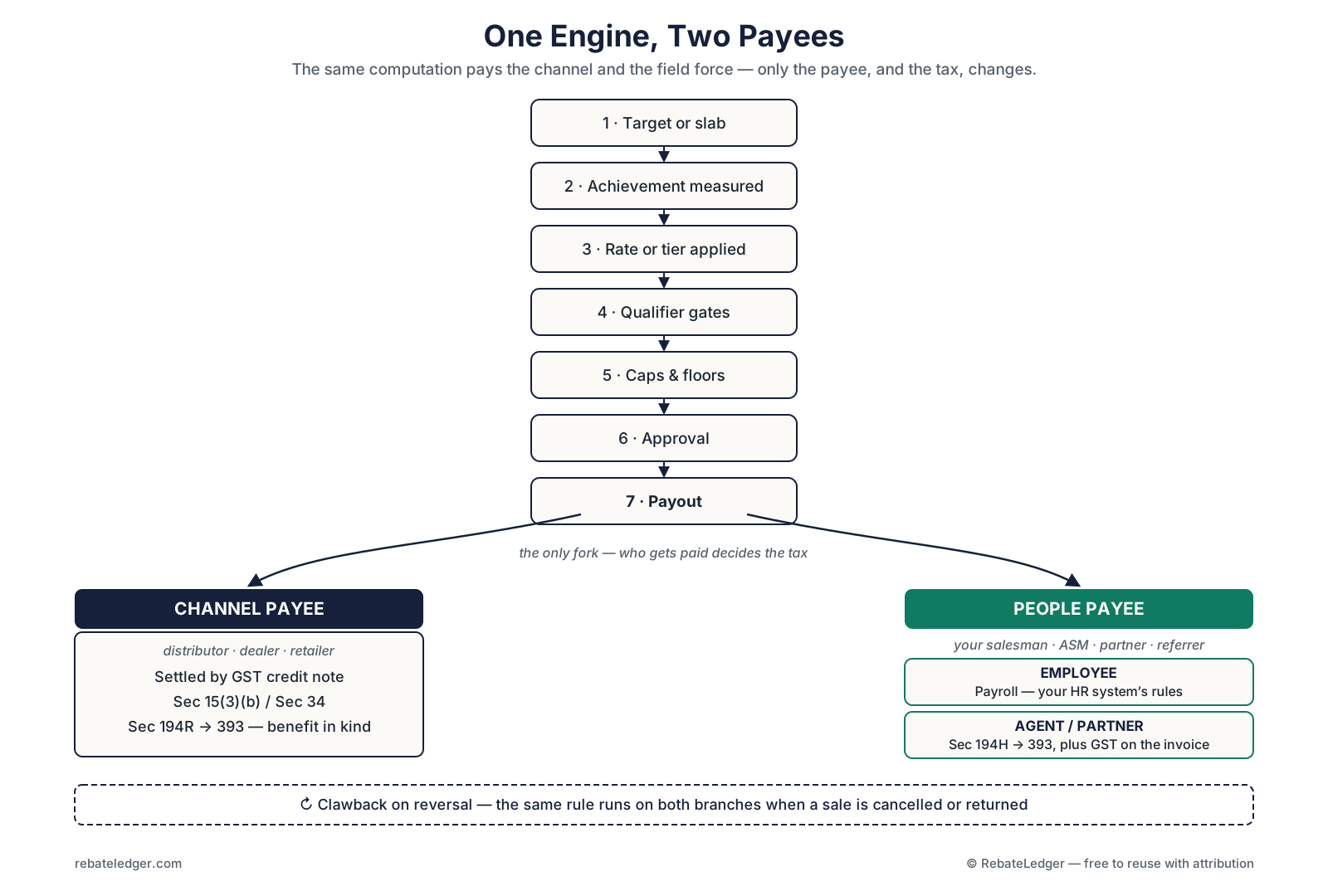
Source: RebateLedger — free to reuse with a link back to this article.
Channel payee — distributor, dealer, retailer. A scheme paid down the channel is generally settled by a GST credit note, and whether it reduces the original taxable value turns on the post-supply-discount conditions in Section 15(3)(b) and the credit-note mechanism in Section 34. Where the benefit is given in kind rather than in cash, Section 194R can bring a TDS obligation into play. The depth behind this line lives in the financial-vs-tax credit note distinction, the ITC-reversal mechanics, and the GST treatment of trade discounts and dealer incentives.
People payee — your own field force or a partner. Here the treatment forks again by what the person is to you:
- An employee — a payout to your own salesman or ASM belongs to payroll, not to a claims or rebate system. RebateLedger is not an HR or payroll product: it does not compute salary, deduct on a salary payout, or hold employment records. Amounts payable to employees are processed by your HR or payroll system, under that system's rules and the applicable law in force at the time of payment. What a rebate engine contributes here is the earned amount and the evidence behind it, handed to payroll as an input. Treatment of that amount in payroll is a matter for your HR team and your own advisers.
- An agent or partner — a commission to someone acting on your behalf generally falls under Section 194H, at the rate and threshold in force for the relevant year, and the partner typically raises a service invoice carrying GST. The applicable rate, the aggregate threshold and the base on which withholding is computed all change over time — confirm the current figures against the Act and with your own adviser rather than relying on any number quoted in an article.
From 1 April 2026, Section 194H is carried into Section 393 of the Income-tax Act 2025 — a renumbering rather than a new rule, covered in Section 194H becomes Section 393, which is the article to check for the current section reference. The distinction between distributor margin, commission and incentives under GST is the neighbouring question on the channel side.
The question that decides everything: discount or commission?
Every one of those forks reduces to one question, and it is not answered by the word on the voucher. Calling a payment an "incentive", "backend margin", "referral support" or "business promotion payout" does not decide its tax treatment — the substance of the relationship does. Is this a discount in a principal-to-principal sale, where two independent businesses transact and one gives the other a better net price? Or is it a commission paid to someone acting on your behalf to bring you a sale? The answer determines whether commission-TDS and GST attach at all.
Two well-known lines of authority pull in different directions on facts that can look similar, which is exactly why the label cannot be trusted and the relationship has to be characterised on its own facts. This article does not tell you how they apply to your arrangement — that is a question for your advisor. Route the depth to the TDS-on-incentives article.
Why this ends up in two spreadsheets
In most companies these two calculations have never met. Channel schemes live in one spreadsheet with the claims or commercial team; sales incentives live in another with sales ops or HR. Neither reconciles cleanly to the ERP, because — as we argue in why schemes and claims sit awkwardly in an ERP — neither a scheme circular nor an incentive plan has a native object in a general ledger. So the numbers are rebuilt by hand each period, in two files, by two teams who rarely compare notes.
When the CFO asks a simple question — what did we pay out, in total, to move this quarter's gross sales to net? — nobody can answer it from one place. The channel number and the people number are computed on different assumptions, at different times, and reconciled to nothing. That is less a tooling failure than a modelling one: the business treats one calculation as two problems, and pays for the split in reconciliation effort every quarter-end.
One engine, one audit trail
RebateLedger was built as that one engine. The same slab-and-tier calculation that runs your distributor schemes runs your field-force incentives, with the payee type deciding which settlement and tax path each payout takes. Every step — the target, the measured achievement, the qualifier gates, the approval, the payout and any clawback on reversal — is recorded in one audit trail, so "who approved what, on which rule, and when" has a single answer. One calculation, one approval flow, one number for total payout cost. If your schemes and incentives currently live in two disconnected files, that is the gap this closes.
Book a demo to see it run on your own schemes and incentive plans.
If you're a distributor
Everything above is written from the manufacturer's side of the table — but a distributor has the same engine pointing in three directions at once. You claim schemes and rebates from the brands you carry; you pay secondary schemes to the retailers below you; and you pay incentives to your own salesmen who sell into that retail. Three payout relationships, three tax treatments — brand-to-you often a credit note, you-to-retailer a secondary scheme, you-to-salesman a salary or commission line — and all of it is the same computation of target, achievement, rate and payout. A distributor running these on three disconnected spreadsheets has exactly the reconciliation problem this article describes, just with more edges. See distributor vs dealer vs super-stockist for how the tiers claim from each other, and claims management software for the intake side.
Read next
- Can your ERP calculate rebates, schemes and sales incentives? — why this problem escapes the general ledger; and ERP integration for claims & rebate software for the data-flow side.
- Section 194R: TDS on dealer and distributor incentives — the in-kind-benefit rule on the channel side.
- Rebate clawbacks and scheme cancellations — the reversal step, both branches.
- GST credit notes for rebates (Rule 53(1A)) and financial vs tax credit notes — how the channel payout settles.
- Incentive management software and supplier incentive programs — the incentive side of the same engine.
- GST and TDS on automotive dealer incentives — a worked channel-tax example.
- Best rebate management software for Indian distributors and dealers and vendor rebate management software.
- What is a rebate?, what is a billback? and rebate management software — the product basics.
Tax note. This article is general information, not tax, accounting or legal advice. It names Sections 15(3)(b), 34, 194H, 194R and 393 as signposts to where a question arises, and deliberately states no rate, threshold or withholding base — those change, and the current figures must be confirmed against the Act. Employee and salary payouts are out of scope entirely: those are processed by your HR or payroll system under its own rules and the applicable law in force. Confirm the treatment of any specific arrangement with a qualified chartered accountant or tax adviser against your own facts.
One engine, both sides of the channel, the right Indian tax treatment on each — calculated once and settled correctly. Book a demo and we will show you the whole payout picture on your own numbers.
The case for one engine rests on how many distinct incentive shapes a business actually runs. The catalogue of channel incentive types is a fair measure of that.
Frequently asked questions
What is the difference between a rebate and a sales incentive?
Computationally, very little. Both take a target, measure an achievement against it, apply a rate or tier, pass qualifier gates, and produce a payout that can be clawed back if the sale reverses. The real difference is who receives the money — a channel partner or a person — which decides how it is settled and taxed.
Is a sales incentive to an employee handled differently from a partner commission?
Yes, and they are handled by different systems. An amount earned by your own employee goes to your HR or payroll system, which applies its own rules and the law in force at payment. A commission to an agent or partner acting on your behalf is a withholding question under the commission provisions. Confirm both with your own advisers.
Is GST applicable on a sales commission?
A commission paid to an agent or partner for a service they render to you is generally treated as a supply of service, so the partner typically raises an invoice carrying GST at the applicable rate. An amount paid to your own employee under an employment contract sits with payroll instead. The characterisation of the relationship decides it — have it reviewed for your arrangement.
Can the same software manage both channel rebates and sales incentives?
Yes — because they are the same calculation. One engine that runs slabs, tiers, qualifier gates, caps, approvals and clawbacks can compute a distributor scheme and a field-force incentive alike, then route each payout down the correct settlement and tax path by payee type. That is the design RebateLedger is built around.
What is the difference between a discount and a commission for tax purposes?
A discount is a lower net price in a principal-to-principal sale between two independent businesses. A commission is money paid to someone acting on your behalf to bring you a sale. The substance of the relationship, not the word used on the voucher, decides which one applies — and it is a fact-specific question for your advisor.
Do distributors need incentive management software?
Often yes. A distributor claims schemes from the brands it carries, pays secondary schemes to the retailers below it, and pays incentives to its own salesmen — three payout relationships running the same target-achievement-payout calculation. Managing all three in one engine solves the same reconciliation problem a manufacturer has, with more moving parts.
Does RebateLedger handle salary or employee payouts?
No. RebateLedger is not an HR or payroll product — it does not compute salary, deduct on a salary payout, or hold employment records. What it contributes for a field-force incentive is the earned amount and the evidence behind it, handed to your HR or payroll system as an input. That system applies its own rules and the law in force at payment.
See RebateLedger on your own claims data
A 30-minute walkthrough tailored to how your channel actually settles claims.